IAW

iaw-white-logo iosandweb technologies
Categories
Blog

AI App Development Cost in 2026: A Complete Business Guide

Artificial intelligence is reshaping mobile applications, empowering businesses to streamline processes, personalize user interactions, enhance decision-making, and provide innovative digital solutions. Given the increasing adoption of AI, businesses are keen to understand AI app development and the cost involved in building a new mobile app. 

What Is the AI App Development Cost in 2026?

AI application costs can vary widely based on complexity, AI features, underlying technologies, and the integrations chosen by your company.

How Much Does It Cost to Develop an AI App in 2026?

It varies in costs of AI app development because there are various apps designed with different capabilities. Development of a simple application leveraging existing AI APIs might cost much less than that of advanced artificial intelligence applications based on machine learning, generative AI, computer vision, predictive analytics, and intelligent automation. Businesses shouldn’t consider only the cost of development but also the cloud, the cost of cloud storage, API call costs, security measures, test cases and deployment costs and also the ongoing maintenance cost for the development of the AI app.


Businesses should consider the overall cost to develop an AI app, including development, deployment, launch, and ongoing operational expenses.
Businesses often ask how much it costs to build an AI app, but the answer depends on its functionality, complexity, integrations, and maintenance requirements.

Major Factors Affecting AI App Development Cost

Understanding the factors affecting AI app development cost can help businesses create a realistic budget for their project.

1. App Complexity

The number and difficulty of AI features are likely the biggest single cost factor. Basic applications that have a feature, such as an AI chatbot or a prediction feature for recommendation services, will typically require much less development effort than an enterprise application involving voice recognition, machine vision, speech-to-text, machine-learning-powered prediction algorithms or autonomous processes.

2. AI Technology and Model Selection

This is one of the strongest indicators, as AI type determines whether a company can leverage readily made AI models via APIs or invests in developing custom app AI based on needs. A company utilising ML tech for an application may incur costs tied to data formatting and preparation, model training, and app refinement. If relying on generative AI, app development costs depend on model costs, the number of token utilization, app prompt design, and ongoing maintenance and optimization processes.

3. AI Integration and API Integration

The overall development cost of an app also depends on the kind of AI technology incorporated. Companies may choose an experienced AI app development company to build a solution that suits their specific business needs.

Or they may pick from readily available pre-trained AI models via APIs and deploy them in an application.
Machine learning-based applications typically involve the stages of data collection and preparation, training the machine learning model, testing the models, tuning the model, and deployment. Whereas generative AI in a mobile app may include selection of the right pre-trained generative models, prompt design, text generation model, tokenization, API usage and its constant monitoring for its performance.

Hence, the selection of the right type of AI technology for your app determines not just functionality and efficiency but also affects the overall cost.

4. Technology Stack

Technology Stack Choices Also Influence Development Prices Every aspect of the tech stack, from front-end tools and back-end tech to data storage solutions, cloud environments, AI tools, security solutions, etc., needs to function cohesively. Selecting a technology stack that scales readily can also simplify handling a growing user base, large data volumes, or greater AI demand while avoiding expensive rewrites at a future point.

5. Development Team and Timeline

Development Timelines Lead To Development Cost There are also the development costs, which usually increase with the complexity of the app. Choosing the right technology early in the app development process can help businesses manage resources efficiently, reduce delays, and control development costs. 

Custom AI App Development vs. Traditional App Development

Developing fully custom AI apps may be expensive, as it is likely to need the aid of specialized AI knowledge, data processing, model integration, extra testing and infrastructure, compared to a native or cross-platform application. Nevertheless, businesses don’t always have the need to develop their own AI models; it can simply integrate an existing AI service (e.g., machine learning APIs, natural language processing) to gain intelligence at a cheaper development cost and a much faster time.

The cost of AI-powered app development depends on the level of customization, AI features, integrations, and technology required for the application. 

The actual method to be implemented totally depends on the functionalities that the app needs, the targets who will use it, the required data and a company’s business strategy: businesses should think about adding AI.

In the apps to address some specific issue, and not only because they’re cool and trendy. Businesses can also use professional mobile app development services to build a scalable application platform and integrate AI capabilities according to their requirements.

Ongoing Maintenance and Operational Costs

AI app development doesn’t stop when the app is deployed; development costs should also extend to post-deployment expenses such as software updates, security measures, server upkeep, API fees, bug repairs, and AI model fine-tuning, and ongoing monitoring and optimization may eventually call for scaled infrastructure. 

Since AI applications continue to gain users over time and become popular, operational expenses of AI applications go high as users increase. It becomes very essential for organisations to control such expenses by continuously checking the operations with optimal checks that would ensure smooth flow of services from AI applications to control AI development expenses that are continuing.

Conclusion

AI App Development Price in 2026

The final AI app development price in 2026 can vary depending on specific business and technical requirements, so there is no fixed price that applies to every project. Several factors influence the overall cost, including app complexity, AI features, machine learning capabilities, generative AI, API integrations, technology stack, development expertise, development timeline, and post-development support.

Best Ways to Successfully Develop an AI Application

The best way to build a successful AI-powered app is to clearly define your business goals, choose the right AI functionalities, use scalable infrastructure, and partner with a skilled development company. A well-developed AI application can improve automation, personalization, performance, and efficiency while keeping development costs aligned with the business’s objectives.

FAQ

How much does it cost to develop an AI app in 2026?

The AI app development cost in 2026 depends on the app’s complexity, features, and integrations.

What factors affect AI app development cost?

App complexity, AI integration, API integration, technology stack, and maintenance affect the cost.

How long does it take to develop an AI-powered app?

The development timeline depends on the app’s features, complexity, and integration requirements.

Is custom AI app development more expensive than regular app development?

Yes, custom AI app development usually costs more due to advanced AI features and development requirements.
Categories
Blog

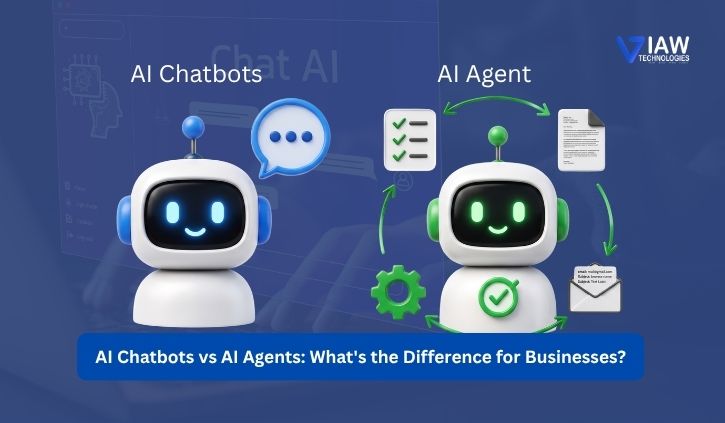
AI Chatbots vs AI Agents: What’s the Difference for Businesses?

AI is revolutionizing how companies communicate with customers, streamline their processes and take charge of repetitive processes. Some of the biggest and most commonly adapted types of AI technology are: AI chatbots AI agents Both agents and chatbots may use natural language to converse with users, but they’re utilized in very diverse contexts.

Knowing the Difference: AI Agents vs Chatbots is essential when deciding on the right AI solution to invest in for your business, as in some cases answering questions with a chatbot will suffice, while for others, an AI agent will be needed to take the conversation to the next level, as they make decisions and perform tasks, not answer questions. 

What Are AI Chatbots?

Simply put, AI chatbots are smart computers designed to talk to humans using voice or text as communication. AI chatbots work using advanced conversational AI, generative AI, and natural language processing technologies so they’d be able to comprehend human language and respond appropriately. 

Chatbots are predominantly used by businesses for customer service, lead generation, answering frequently asked questions, booking of appointments and suggesting items and offering basic technical support. 

An e-commerce store could deploy an AI chatbot on their website that fields inquiries related to stock levels, expected shipping dates, return policies and purchase order status so as to provide customers with quick support when they have queries. 

However, with their heavy reliance on conversations and response-orientated systems, most chatbots are often not agile enough for multi-step operations or requests that require high decision-making processes and interaction between many business systems. 

What Are AI Agents?

AI agents offer a step up from conventional artificial intelligence. This is where an AI agent receives an objective and is then expected to work its way toward finishing a specific goal. In the event of a task requiring a set of actions or the use of available tools, the agent can ascertain and execute accordingly to complete the desired task. Such is value to businesses that seek a step up from a conversational bot for purposes like;

The bottom line. Take, for instance, how customers seek to change an appointment with a professional. While a bot can identify the possibilities on offer, an AI bot could log into the scheduler and update an appointment by finding an alternative appointment time slot and sending the booking. In simpler terms, instead of just answering customer queries, an AI agent can action change.

AI Agents vs Chatbots: Understanding the Difference

The key difference between AI agents and chatbots is autonomy.

AI chatbots – Chatbots are computer programs that simulate the way humans use their voice to interact. AI chatbots help users answer their queries, get advice, and interact. AI Agent – An agent is defined as a piece of code. AI agents are meant to perform a task to reach a certain goal through sequential steps. 

AI ChatbotsAI Agents
Focus on conversationsFocus on goals and actions
Provide answers and assistancePerform tasks and workflows
Limited autonomyHigher level of autonomy
Best for routine interactionsBest for complex processes
Usually follow defined workflowsCan dynamically determine next steps
Limited system interactionCan integrate with multiple tools and systems

This makes the AI chatbot vs AI agent comparison more important for businesses choosing the right automation solution.

The right option depends on what a company actually wants to automate.

When Should Businesses Use AI Chatbots?

AI chatbots are an effective choice for reliable, scalable communication, customer support, and virtual assistants rather than complex task execution. 

They can be particularly useful for:

  • Answering frequently asked questions
  • Providing 24/7 customer assistance
  • Qualifying leads
  • Collecting customer information
  • Supporting basic troubleshooting
  • Handling common service requests

Businesses investing in AI chatbot development can improve response times, strengthen customer support automation, and reduce the workload on support teams.

Also, for many organisations, chatbots are an affordable way to get started with AI because you’re able to fulfil a customer use case with not that much complex integration.

When Should Businesses Use AI Agents?

AI chatbots are an effective choice for reliable, scalable communication, customer support, and virtual assistants rather than complex task execution. 

They can be particularly useful for:

  • Answering frequently asked questions
  • Providing 24/7 customer assistance
  • Qualifying leads
  • Collecting customer information
  • Supporting basic troubleshooting
  • Handling common service requests

Businesses investing in AI chatbot development can improve response times, strengthen customer support automation, and reduce the workload on support teams.
Also, for many organizations, chatbots are an affordable way to get started with AI because you’re able to fulfil a customer use case with not that much complex integration.

When Should Businesses Use AI Agents?

As businesses adopt intelligent automation, workflow automation, and autonomous AI for their operations, AI agents become more valuable. An AI agent can access CRM systems, databases, calendars, APIs, in-house software, and other business applications to perform task automation across multiple steps. 

An AI agent can, in a sales example, pinpoint a strong candidate, gather pertinent details, make a CRM note, book a meeting and inform the sales rep. These benefits of AI agents for businesses include reducing repetitive work, streamlining operations, improving productivity, and allowing employees to focus on higher-value tasks. 

Businesses that are looking to automate even more may want to try a category like ‘AI Automation Software Solutions to help integrate existing business functions and existing AI tools. 

AI Chatbot vs AI Agent: Which Is Right for Your Business?

How you pick between a chatbot or an AI bot really should begin with business outcomes. If you need help with chat or get immediate replies, a bot can support you. Lead qualification or general assistance – that is when you want an AI chatbot if we consider these needs.

AI does multi-step tasks and would support you on interactions between several other devices, producing decisions and full workflow automation. Then the agent is much more viable.

The long run isn’t restricted to merely one technological solution; AI bots with AI assistants could perform best to handle both the chat and complicated duties simultaneously. A bot’s ability would work best for initial contact, which could then escalate to an autonomous bot agent’s ability for actual reasoning capability or physical actions along the actual planet through integration to robotic systems to execute the required tasks by AI system technology. 

These types of combinations of chatbots, together with the ability to execute some genuine Earth motions by autonomous bots, will help produce quick, smart and also smooth digital experiences through AI systems.

FAQ

What is the difference between AI agents and chatbots?

AI chatbots mainly focus on conversations, answering questions, and providing information. AI agents can go further by making decisions, using tools, and completing tasks autonomously.

Are AI agents better than chatbots for businesses?

It depends on the business need. AI chatbots are ideal for customer support and routine queries, while AI agents are better for complex tasks, workflow automation, and business automation.

What can AI agents do that chatbots cannot?

AI agents can perform multi-step tasks, interact with business systems, use APIs, make decisions, and complete workflows with less human intervention. This makes AI agent development useful for advanced automation.

How much does AI agent development cost?

The cost of AI agent development depends on the project’s complexity, integrations, AI model, customization, and required features. Simple AI agents cost less, while advanced enterprise solutions require a larger investment.

Categories
Blog

How to Build an AI-Powered SaaS Product in 2026

The SaaS market is becoming more intelligent as AI automates routine tasks, personalizes user experiences, and analyzes vast amounts of information to support better decision-making. This has turned AI SaaS development into a real solution for businesses aspiring to create scalable software with AI components. 

However, building a SaaS product powered by AI is not just plugging an AI API into an existing application. Companies will need to analyze and explain the use of AI, select the right AI technology, devise a secure SaaS architecture, handle data effectively, and monitor the AI. 

What Is AI SaaS Development?

AI-powered SaaS (Software as a Service) is the term for the development of software on the web which employs the use of artificial intelligence to complete operations which otherwise might require manual labour or programmed rules. 

AI SaaS solutions use machine learning, generative AI, natural language processing, predictive analytics and LLMs (large language models) to enable smart features 

Consider how a SaaS platform that runs on AI may help your company by, for example, automating customer support functions; writing content; studying and documenting existing literature; predicting customer buying habits; and, above all, providing product recommendation services. Also, the summarisation tool for your documentation will bring the system closer to the market. 

The difference between a conventional SaaS application and an AI SaaS solution is that AI helps the software understand data, detect patterns, produce outputs, and make the application adaptable to a variety of user requirements.

How to Build an AI-Powered SaaS Product

Now let your SaaS development process bring your next great SaaS for AI to light!


With appropriate applications, the AI automation can lighten repetitive workloads, streamlining your operations and allowing your teams to get stuck in to more complex tasks instead.


Use automation and streamline my process by following the steps I will explain, translating your wide idea into a framework of scalable proportions.

Identify a Clear Business Problem

Think about the problem first, then the technology. What kind of customer is your product for? What problem is it solving? How many times does that problem come up? Would AI solve the problem significantly better than existing solutions? For example, a company could create a SaaS application for customer support—which uses AI to auto-tag tickets, generate form responses, summarise customer chats, and tag urgent enquiries—instead of developing an AI chatbot entirely from scratch.


An obvious use case also helps to clarify which AI models you should be utilizing, what the functionality of the product should be, and how much the product will cost.

Validate the SaaS Product Idea

Prior to fully commencing SaaS application development, companies must confirm the product concept and research the existing competition and whether there is a real market need for it.

Study existing solutions to ensure feasibility, talk to your target audience, research current workflows, and verify the required functions your consumers do need. This helps in the development of an “MVP” (minimum viable product) to assess real-world demand while minimizing wasted cost on development and enhancing more advanced AI capabilities when relevant later.

Select the Right AI Technology

“AI technology choice for the product may depend on whether generative AI & LLMs can be applied for content creation, dialogue systems & analysis of documents, whereas the traditional machine learning models may be deployed for classification tasks or prediction, fraud detection or forecasting & analytic predictions,” said a statement.


“Alternatively, the company may leverage AI APIs from third parties and not develop any such modelling.


“Based on the choice of AI technology, the accuracy, latency requirements & data requirements, privacy concerns, operating cost, and availability & scale need to be taken into consideration.”

Design a Secure SaaS Architecture

Design that’s Ready to scale. This architecture is particularly important for custom SaaS development, where the product needs to meet specific business and user requirements.

You’ll have many building blocks to consider as the backend of your SaaS, like frontend applications, backend systems/servers, databases, APIs, authentication layers, cloud infrastructure, and possible AI services.

Designing the infrastructure of your cloud software solution might become a key component that eases scalability when you welcome more customers. Modern cloud-based software development also makes it easier to manage infrastructure, improve flexibility, and scale resources as customer demand increases.

It’s important to note that multi-tenant applications enable customers to get the advantages of the cloud platform simultaneously, with no interference in their information. The security aspect must have built-in security since the beginning (authentication, authorisation, encryption, secure APIs, granular control access to data, logging, and handling of sensitive information).

Integrate AI and APIs

Next, we need AI integration. Secure API integration allows developers to connect AI models and third-party services with the SaaS backend.

It allows your product to interface with various systems, such as CRM software, databases, AI services, reporting and analytics software, or payment service providers. The AI output should also be verified where accuracy is critical. Human verification, confidence thresholds, structured outputs, monitoring, and fallback processes are some ways to mitigate the effects of incorrect AI output.

Test, Monitor, and Improve the Product

Testing for AI SaaS is more than classic software testing. You should test its functionality, security, performance, scalability, and API dependability, as well as AI model output quality.

Once the product release is active, it should be analyzed based on key metrics such as answer accuracy, latency, user engagement, and conversion rates, as well as failure rates. Continuous evaluation and testing are especially essential since AI models and user actions, as well as data and behaviour patterns, can alter gradually.

Continuous testing and optimization are essential parts of modern SaaS software development, especially when AI-generated outputs are involved.

Key Features of an AI SaaS Product

Depending on the use case of the software, an AI SaaS can offer the automation services that decrease repetitive work, optimize workflows and help individuals concentrate more time on valuable tasks. 

  • AI-powered chatbots and virtual assistants
  • Generative AI content creation
  • Automated workflows and intelligent automation
  • Predictive analytics and forecasting
  • Personalized recommendations
  • Document and data analysis
  • AI-powered search
  • Real-time reporting and insights
  • Third-party integrations
  • Role-based access and security controls

The objective should not be to add AI everywhere. Each AI feature should provide a measurable benefit to the user.

How Much Does AI SaaS Development Cost?

The price of AI software development depends a lot on the product’s complexity. Key aspects will define the price, including the number of features, UI/UX needs, the chosen AI model, external APIs, integrations, the need for data, security, the cloud platform, and skills of developers.

Building a focused MVP and launching it in the short term is much cheaper than creating a full-blown enterprise platform with multiple functionalities using AI. This is why it is better to develop indispensable features first and, after confirming that there is demand, extend the product.

There is no standard timeline to build the product; for an MVP a few months might be sufficient; however, for a complex enterprise SaaS with lots of AI functionality, API integrations, and required security, it might take much longer.
An experienced SaaS development company can help businesses select suitable technologies, prioritize features, and create a practical development roadmap.

Build a Scalable AI SaaS Product in 2026

At the end of the day, designing and developing the best AI SaaS in the business involves integrating helpful AI functionalities with solid professional engineering and a robust customer experience. If you do that, you’ll create an adaptable, extensible SaaS solution for growing users and workload.

For businesses looking to be in it for the long run, some of the most successful strategies for creating sustainable SaaS include defining a proven problem, creating an MVP focused on solving that specific problem, selecting AI technologies in service of business needs and not just the cool, cutting-edge ones, emphasizing security and scalability from the get-go and monitoring how a product’s usage unfolds.


For firms looking to scale to full maturity, hiring out the work and leveraging SaaS product developers to build an idea from scratch can facilitate building an AI SaaS solution that is scalable and safe, above and beyond.

Frequently Asked Questions

What is AI SaaS development?

AI SaaS development is the process of building cloud-based SaaS products that use artificial intelligence to automate tasks, analyze data, and provide intelligent features.

How do you build an AI-powered SaaS product?

You build an AI-powered SaaS product by defining the problem, validating the idea, choosing the right AI technology, developing the SaaS architecture, integrating AI APIs, testing, and launching the product.

How much does it cost to build an AI SaaS product?

The cost depends on the product’s features, AI technology, integrations, security, cloud infrastructure, and development complexity. An MVP generally costs less than a full-scale enterprise product.

How long does AI SaaS development take?

AI SaaS development can take a few months for a basic MVP, while complex products with advanced AI features, integrations, and security requirements may take considerably longer.

Categories
Blog

How AI Is Transforming Mobile App Development in 2026

Mobile App AI-Driven development is here in 2026: Organizations come from a completely different direction of developing mobile apps in 2026. AI for mobile app development is empowering organizations to build a quicker and savvier custom & personalized mobile app experience through personalized solutions, smart prediction, automated workflows & chatbots, real-time solutions, and smart insights in each and every nook and corner of the app experience. 

Think Past the ‘Feature’: AI’s true business value does not lie in stuffing more complex capabilities into your offering. Smart applications will feature streamlined UIs, automate tiresome and time-consuming tasks, provide more comprehensive guidance for strategic decisions, and enable software to adjust over time based on individual customer behaviour. 

What Is AI Mobile App Development?

AI mobile app development is the process of developing mobile applications using artificial intelligence and machine learning techniques to make them smarter and more efficient. Traditional apps, in general, follow instructions given earlier, and AI apps can analyze data, recognize the pattern, create a response, and make predictions from the available data. 

For instance, the app can analyze user shopping habits and provide customized recommendations to customers of a retail company. It can also analyze a user’s behaviour in a fitness app to give them personalized health or diet tips; likewise, it would save considerable costs to organizations where AI chatbots are already giving instant advice to users on an individual level without the constant involvement of humans. 

Similar AI capabilities are also being used in AI-powered web development and AI website development to create more connected digital experiences across mobile apps and websites. Businesses can also use AI web development services to integrate intelligent features into their digital platforms. 

How AI Is Changing Mobile App Development in 2026

1. Delivering More Personalized User Experiences

Personalization is one of the most transformative applications of AI. ML algorithms can learn individual user behaviour from their preferences, engagement patterns, browsing history, and interaction with mobile apps.

This enables mobile applications and AI-powered websites to deliver a personalized user experience to each customer.

 A personalized website facilitated by artificial intelligence also allows businesses to present the relevant content, service or features instead of offering the same thing to everyone. Personalization is known to create more engagement, as users do not necessarily want to see something that suits their needs and not someone else’s. 

2. Automating Repetitive Tasks

AI enables smart automation and website automation by reducing repetitive tasks across digital platforms. Businesses can automate customer support, notifications, onboarding, product recommendations, data processing, and routine communications. 

3. Using Predictive Analytics for Better Decisions

Modern applications yield lots of consumer and enterprise data. We utilize machine learning and predictive analytics to convert raw user or business data into actionable business intelligence and insights through data pattern discovery or forecasting an occurrence.

By leveraging predictive analytics, companies are able to forecast customer buying behaviour, segment future customers, predict future products or services demand and present relevant product or service recommendations and customization. The reliance on guessing is decreased, and data-backed recommendations are strengthened by the analysis performed

4. Improving the Development Process

AI has changed more than just software itself; it has also begun to change how it is developed. AI-supported applications may help in coding, debugging, documenting, and testing and may be programmed to perform repetitive jobs.

Although human experts can benefit greatly from AI-supported tools for writing and debugging code, designing it, testing it, documentation, etc., it has not replaced the need for human professionals, especially in the development of such complex applications in architecture, security, performance optimization, and quality control, and in understanding business needs. 

The standard development process: design, implementation, testing, deployment, and feedback remain relevant for reliable AI-driven application development.

Benefits of AI-Powered Mobile and Web Development

Businesses can also work with specialized AI web development services to integrate intelligent features across their websites and mobile applications. 

To those businesses who want to know the process to have a website or mobile application powered by artificial intelligence, they should first focus on what the problem is that AI should solve. The advantages of AI web development and AI-powered mobile applications involve better customer engagement, automating business processes, analyze data and giving custom experiences. 

The AI-based website can be beneficial for users on a given platform by providing intelligent suggestions, automatic customer assistance, and adaptive content; for the mobile app, a more specific application would be related to smart search functionality, prediction mechanisms, speech-based interaction, and tailored content suggestions.

Artificial intelligence is also being harnessed to develop intelligent websites and applications that actively learn and respond to a user’s behavior. Powered by strong web development skills, this enables a deeper level of engagement between a brand’s multiple digital channels, such as its website and mobile apps.

How to Build an AI-Powered Website or Mobile App

These trends show how AI technology has altered the web development scene through AI tools for personalization, automating workflows, intelligence, personalization and the use of predictive technology. So the question for a lot of business leaders now is, how can one develop a website with a web application with the use of AI technology? 

The approach, like that to creating any AI application, should involve first specifying the problem to address with AI. Developing should focus on defining goals and desired outcomes for the business, target audience, functional requirements, and data needs. 

Other factors to think about include data privacy, scalability, response time, the infrastructure involved, and the maintenance required for data operations. Whether you should opt for an AI service in the cloud, for third-party APIs, or for a fully custom-built model depends on how the application has to function. 

The Future of AI Mobile App Development

AI mobile development focus will be on the ability for the applications to know what the users want, predict actions they may take and know context, making use of intelligent suggestions, automated processes, voice and a personalised experience. 

This being said, good AI development goes beyond relying on new technologies: it involves good UX design, great and reliable data, good data security, scalability, testing, and performance optimization. Combining AI with a focused product strategy can help businesses build useful applications and improve operational efficiency. 

AI will greatly impact mobile and web development from 2026 onwards as the technology develops. Companies building intelligent, scalable mobile apps can turn to mobile app development services to build, test,, and optimize AI features in their applications. 

Frequently Asked Questions

What is AI mobile app development?

AI mobile app development involves using artificial intelligence and machine learning to build smarter applications with features such as AI chatbots, personalized recommendations, predictive analytics, and automation.

How does AI improve mobile app development?

AI improves mobile app development by enabling personalization, smart automation, predictive features, intelligent recommendations, and faster development through AI-assisted coding and testing.

What are the benefits of AI-powered websites for businesses?

The benefits of AI-powered websites include personalized user experiences, website automation, intelligent customer support, predictive analytics, and better user engagement.

How does AI improve website development?

AI improves website development through automation, personalization, intelligent search, AI chatbots, data analysis, and adaptive content.

How much does AI web development cost?

AI web development costs vary based on features, website complexity, AI integrations, custom development, security requirements, and development time.

How can businesses build an AI-powered website or mobile app?

Businesses should define their goals, users, required AI features, and data needs before selecting suitable AI technologies and development approaches.

Categories
Blog

How to Build a SaaS Product from Scratch: A Step-by-Step Guide

Developing a new SaaS product is more than just building and launching an application. A successful SaaS product must include a tested business idea, a clear product strategy, solid product design, scalable product architecture, adequate security, and an ongoing improvement process. Software as a Service development combines these elements to create secure and scalable online products. 

As SaaS application development trends in 2026 increasingly embrace AI-native features and agentic workflows, these capabilities should be considered when planning a new product. 

If you are wondering how to build a SaaS product from scratch, the process starts with validating the idea and continues through MVP development, product design, development, testing, launch, and continuous improvement. 

1. Validate Your SaaS Product Idea

The very first thing that needs to be done in SaaS product development is to pinpoint a real customer problem. Before beginning custom SaaS development or custom software development, carry out research on the target market, competition, customer needs, and existing solutions.

Conduct interviews, survey the potential customers, have a close look at the competitors and identify needs which can be fulfilled by your product. With the help of product validation, you will know whether your solution is actually demanded by the target market and that they are ready to pay for it. This step-by-step SaaS product development guide helps startups validate ideas, control costs, and build features based on real customer needs. 

This SaaS product development process for startups helps teams validate ideas, control costs, and build features based on real customer needs. 

2. Define Your MVP

MVP development allows startups to deploy a streamlined version of their software with only the core functionality required to solve the main customer problem. Instead of implementing all the features on your to-do list, brainstorm: what is the key problem your SaaS application should address? An MVP usually consists of user sign-up & login, dashboard, business workflows, payments processing, basic reports & notification settings, etc.

MVP’s primary goal is to launch quickly, get feedback from users, understand their engagement level, and utilize data in the decision of what features to develop next. 

3. Plan SaaS Product Design and Architecture

Effective SaaS product design and UI/UX design for SaaS should keep the interface clean and simple while ensuring the technology can support future growth. – SaaS application architecture, database structure, API design, API integration, authentication, authorisation, third-party integration, monitoring, and data management 

Multi-tenant architecture is an important consideration in SaaS platform development, allowing different customers to share application infrastructure while maintaining appropriate data isolation. 

4. Choose a Modern Technology Stack

The tech stack depends on many factors such as product requirements, anticipated traffic volume, security measures required, skill level of available developers and scale, future plans of a product, etc. Common Tech stacks range from React.js, Node.js, Python language, to databases (including but not limited to PostgreSQL); and the tech of cloud computing services and containers as well. 

In 2026, cloud-based software development and cloud-native deployment are becoming increasingly important for building scalable applications that require flexible infrastructure, observability, and deployment automation. Cloud computing services can provide flexible infrastructure as the SaaS application grows. 

The cost of building a SaaS product in 2026 will vary based on product complexity, technology choices, AI features, integrations, security requirements, and the development team’s expertise. that would require elastic infrastructure, observability, and automation in deployment. Hybrid cloud is gaining traction as a preferred deployment strategy by native cloud developers in India. 

5. Add AI Where It Creates Real Value

One significant area of transformation will be the move from AI functionality towards an all-new level with both AI-native applications and agentic workflows. AI agents are able to execute a series of steps, automate routines, offer individualized content to individual users and interact with third-party services.

But of course, we don’t want to see an onslaught of technology incorporated solely because it’s trending. 

Understanding where AI can create real value is also important when deciding how to develop a successful SaaS application that delivers measurable benefits to users.

Companies will want to recognize where in an AI agent can deliver measurable ROI — the automatic support, documentation management, recommendation, data analysis or task automating.

6. Develop, Test, and Deploy

Once product design and architecture are complete, the SaaS software development phase can begin using Agile software development practices. Development will occur in the form of a small series of sprints during which customers can receive features progressively and get incorporated with their feedback. Throughout the SaaS product development process, testing should be in place from start to finish. By having the functional, performance, security, API and user acceptance testing, the problems could be found before they affect the end user.

DevOps for SaaS solutions provides an effective framework which helps SaaS teams deliver better quality and more frequent releases through automated deployment, monitoring, infrastructure automation, and continuous delivery. 

7. Prioritize SaaS Security and AI Governance

SaaS security should not be treated as a last-minute check. It needs to be built into the development process from the beginning through access controls, authentication, authorization, encryption, secure APIs, backups, and monitoring to protect customer data. —– And as AI-enabled SaaS platforms continue to grow in adoption, while enterprise SaaS solutions increasingly require stronger governance, security controls, compliance, and centralized administration, governance takes just as much importance. 2026 SaaS Research reveals customer fear of AI Data loss, Shadow AI and controls needed to governAI agents and AI apps 

8. Launch, Measure, and Scale

The SaaS product lifecycle doesn’t end once the product is launched. Tracking customer onboarding, engagement, retention, conversions, requests for support, and product usage is key to understanding how users interact with your product. The most popular model for SaaS products is subscription-based software, although usage-, value-, and outcome-based models are becoming more common in the AI market. However, usage-, value-, and outcome-based models are more present in the AI market. 

Conclusion

The SaaS product development process requires the right balance between business validation, product design, SaaS application architecture, development, security, and scalability. Companies in 2026 should, however, incorporate AI-native functionalities, agentic workflows, cloud-native infrastructure, governability and a pay-as-you-go pricing structure.

Whether the team is in-house or managed by a SaaS development company, following a structured SaaS product development approach can provide a solid foundation for building scalable software solutions and achieving long-term growth 

What is SaaS product development?

SaaS product development is the process of creating, testing, launching, and maintaining software that users access online, usually through a subscription model.

How long does it take to build a SaaS product?

SaaS application development can take a few months for a basic MVP, while complex SaaS products may take longer depending on features, integrations, and technical requirements.

How much does SaaS product development cost?

The cost of SaaS product development depends on the product’s features, complexity, design, integrations, security, and development team. An MVP usually costs less than a full-scale SaaS platform.

What technologies are used to build a SaaS application?

Common technologies for SaaS application development include React, Node.js, Python, PostgreSQL, cloud platforms, APIs, containers, and DevOps tools.

How do I choose the right SaaS development company?

Choose a SaaS development company or software development company with relevant SaaS experience, a strong portfolio, technical expertise, clear communication, good security practices, and reliable post-launch support.