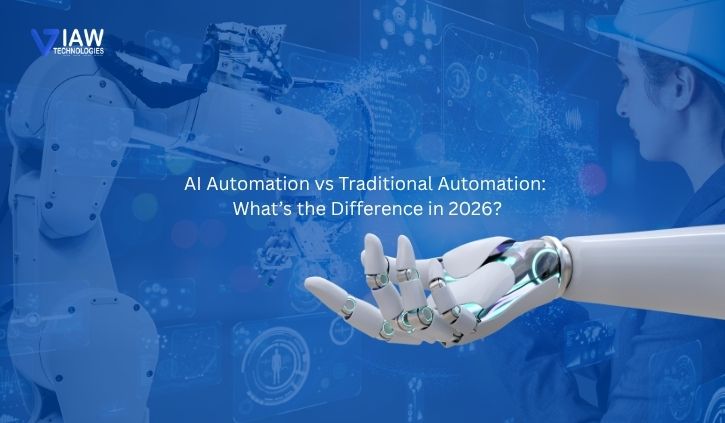
Automation in Business: In the current times, a lot of our businesses are increasingly automated. Businesses worldwide are making use of the new technological era not just to carry out mundane tasks like receiving queries from consumers, but also to carry out our company policies and protocols. By 2026, not only systems that could carry out tasks based on programmed protocols, but also.
As a result of artificial intelligence and machine learning, AI automation adopts an intelligent way to improve work. Therefore, AI automation vs traditional automation now faces a problem that every business has to ask itself: Should your business adopt AI automation or traditional automation?
Basically, both techniques contribute to increasing work output by leveraging intelligence, but these two techniques are different in information processing, taking decisions as well as business adaptation.
What Is Traditional Automation?
Business automation is essentially automated, preprogrammed, or pre-instructed rule- or condition-based workflows. The system carries out a specific task on a certain trigger or condition. A good example of such a case would be e-commerce, where an automated order confirmation receipt is generated after a customer finishes making purchases on a site. This system also allows businesses to automatically generate invoice processing, send appointment confirmations, and so on.
This type of rule-based automation is very well suited for tasks that are routine and predictable. This automation can lead to a reduction of human mistakes, ensure consistency, & save employees from doing boring, time-consuming jobs. But there are drawbacks to rule-based automation.
Automation automates based on rules; you usually can’t do anything that you haven’t been trained to do or that requires exceptions outside of the existing rules.
What Is AI Automation?
Businesses that adopt AI automation merge automation with artificial intelligence and machine learning. By using AI to build automated processes, the result is a process that not just reacts to instructions – but intelligently responds.
With AI automation, the output of the machine doesn’t just come from following specific instructions; it’s drawn from analysis and identification of relevant patterns and an ability to incorporate variables and context to make smarter decisions. These benefits help in a business process where there is no clear path from input to output — not always predictable.
An example of an intelligent automation system is the customer service system, capable of not only decoding customer communication, comprehending purpose, and recognizing priority, but also of correctly determining which department the service request should be forwarded to.
A manual system would require keywords and programmed rules in order to perform these activities. Intelligent automation is useful to organizations where large quantities of data and work processes have to be navigated.
AI Automation vs Traditional Automation: Key Differences
Understanding the difference between AI automation and traditional automation starts with their different levels of adaptability and ability to make decisions.
A conventional automation system operates in a predefined manner. With AI automation, data can be processed to make the appropriate decisions based on trends, data, and context.
Conventional automation systems work well in process environments with rules.
However, the dynamic nature of AI-based automation suits situations when information changes or an action requires interpretation to decide and perform actions.
Another key distinction is data handling. Traditional automation usually thrives best with structured data, whereas AI automation can manage structured as well as unstructured data, including emails, documents, discussions from your clientele, pictures or images, etc.
Why Are Businesses Moving Toward AI Automation?
The increased pressure to utilize AI automation in business operations is because many companies and entrepreneurs demand better scalability and efficiency from their systems. Most organizations today produce tons of data daily; analyzing or processing this data might lead to overconsumption of man-hours for their organization.
It saves businesses the effort of going through and making every single analysis manually.
Some important benefits include:
- Faster handling of repetitive tasks and large data volumes
- More efficient workflow automation
- Improved process optimization
- Better customer experiences through personalized interactions
- Faster data-driven decisions
- Reduced dependency on manual processes
- Greater operational efficiency as businesses scale
For instance, you can have an AI that can sift through thousands of your customer calls and recognize frequently raised complaints and trends that a simple automation software may miss.
Can AI Automation and Traditional Automation Work Together?
Businesses are not required to use either AI automation or “traditional” automation. The fact is that both work very effectively together. Traditional automation can take care of those tasks that are structured, repetitive and predictable – notifications, data transfer, automated scheduling, approvals and basic, structured workflows.
Business benefits when it uses AI on the other hand, to provide prediction, interpretation, classification and automatic decision-making.
This hybrid combination can help organizations automate everyday processes, with AI deployed for tasks that need a degree of intelligence. If a business intends to take up automation, the right AI software development company will assist businesses with finding appropriate use cases and integrating AI within the business infrastructure.
They’ll also aid with developing automation solutions that can scale according to business requirements.
Which Approach Should Your Business Choose?
For AI automation vs traditional automation for businesses, the answer to which is better depends on the nature of the process.
For common, predictable and repeatable activities in your business, traditional automation may well be an effective solution. In contrast, for a task with large amounts of data, dynamic environments, natural language, pattern recognition or high decision complexity, AI automation can provide better value.
The best strategy is not always about replacing traditional automation with AI. Instead, businesses should identify where each technology can create the greatest impact.
In 2026, the strongest automation strategies will focus on combining reliability with intelligence—using traditional automation where rules work best and AI where businesses need systems that can understand, adapt, and make smarter decisions.
Frequently Asked Questions
1. Is AI automation better than traditional automation?
AI automation for businesses is better for complex tasks requiring flexibility and automated decision-making, while traditional business automation works well for simple, repetitive processes.
2. What are the benefits of AI automation for businesses?
The benefits of AI automation over traditional automation include faster data processing, better adaptability, intelligent decisions, and improved business process automation.
3. Can AI automation and traditional automation work together?
Yes. Businesses can combine AI-powered automation with traditional systems, using each for the business workflows where it works best.
4. How much does AI automation cost compared with traditional automation?
Traditional automation may cost less for simple tasks, while AI automation can require more investment for complex processes but deliver greater long-term value.