IAW

iaw-white-logo iosandweb technologies
Categories
Blog

AI + Blockchain: How Businesses Can Use Both Technologies in 2026

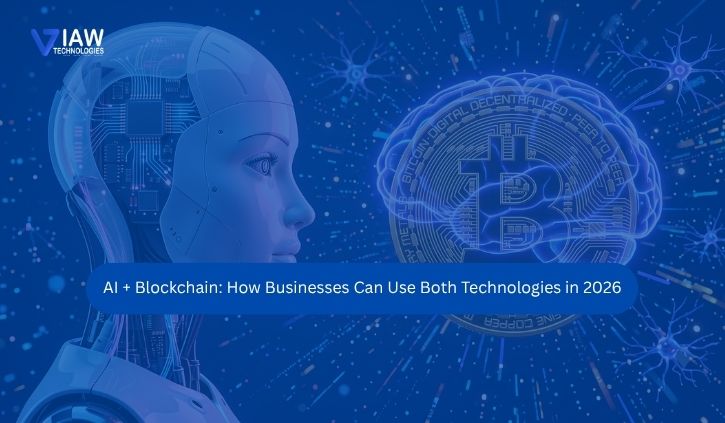
The business technology landscape in 2026 has gone through and continues to go through significant transformation; the enterprise of 2026 seeks and looks for smart solutions that can enhance effectiveness, security, and decision-making. With two major trends in the technology space — artificial intelligence and blockchain — that are solving totally different problems separately, combining the two gives us the AI+Blockchain enterprise solution.

Artificial intelligence enables organizations to analyze data, detect patterns, automate routine tasks, and drive decisions based on evidence. Whereas blockchains offer distributed digital ledgers with inherent trust and visibility. Using each tool, organizations could develop efficient, intelligent, and honest processes.

Why Are AI and Blockchain Being Combined?

The fuel powering our AI systems needs to be trusted. Our solutions can provide a greater degree of certainty regarding the source and immutability of that data. And simultaneously, our blockchain integration makes blockchain-based solutions more valuable via the power of advanced analytics, prediction, and automation.

For instance, a company might apply AI to thousands of supply chain transactions and use those analyses to forecast potentially unavoidable delays. Simultaneously, a blockchain could be used to securely and verifiably log product transit, transactions, and the suppliers involved.

This illustration highlights how these technologies are more likely to be used in combination than against each other. Companies should use both these technologies to solve genuine operational problems rather than simply because the new technologies happen to exist.

How Businesses Can Use AI and Blockchain

There are several practical AI and blockchain use cases for businesses across different industries.

1. Improving Supply Chain Visibility

Supply chains are composed of several suppliers, manufacturers, distributors, and customers, which makes it difficult to track accurate information for all participants.
Using blockchain, key events throughout a supply chain can be stored as an immutable history of data for clear traceability and transparency. 

The stored data can then be analyzed by AI to flag any abnormal trends, predict demand, and identify potential delays or inventory needs. The business would then benefit from improved visibility in its operations with less manual effort in tracking processes.

2. Strengthening Fraud Detection

Transactions leave large amounts of data, which can make it quite complex to observe the behaviour of these operations by hand. Machine learning (ML) techniques can find such transactions based on behaviour pattern analysis, potentially fraud-related. 

Added: This would be done on a blockchain, which, by providing a clear and unmodifiable trail of transaction records of transactions, would further empower ML techniques to analyze transactions stored in the distributed ledger.

3. Automating Business Processes With Smart Contracts

Smart contracts offer conditions that automate actions on a blockchain network once triggered. Using AI could also integrate business data to make automated actions smart. If smart contracts monitor when conditions arise, they can act upon a transaction, but AI adds value at that point by interrogating data to find trends and then outputting suggestions. AI predictions are also not inherently correct. 

Businesses must carry out security checks on AI data and maintain good governance, regardless of integrating into financial or operational processes.

4. Enhancing Data Security

Data security is of utmost importance in today’s organizations. Centralised databases provide convenient access points and are prime targets for breaches and manipulation. Blockchain allows records to be decentralised and manipulated in ways that will not go undetected.

AI can monitor and learn any unusual patterns indicating possible threats to the data and its security.

When combined, this technology can benefit from enhanced security alongside increased detection speeds.

5. Building Smarter Decentralized Applications

Incorporation of artificial intelligence (AI) in decentralized applications also enables enterprises to provide intelligent, automated, and customized insights.

One example could be a decentralized platform whose AI algorithm is able to analyse user behaviour while the blockchain handles ownership, identity, permissions, etc. It is thus possible to make digital products that are more personalized due to intelligent and decentralized infrastructure.

Benefits of Combining AI and Blockchain

The benefits of combining AI and blockchain depend on the business use case, implementation quality, and data involved. However, several advantages can make this combination valuable:

  • Greater transparency: Blockchain can provide verifiable records and transparent transactions.
  • Intelligent decision-making: AI and machine learning can turn complex data into actionable insights.
  • Improved automation: Businesses can automate repetitive processes through blockchain automation and AI-powered workflows
  • Better data integrity: Blockchain can help establish a reliable record of important business information.
  • Enhanced security: Decentralized systems can reduce dependence on a single point of control.
  • Operational efficiency: Automated workflows can reduce manual processes and improve productivity.

AI Blockchain Solutions for Enterprises

The scale, integration, security, and compliance demands of large enterprises can complicate technology implementation. AI blockchains within an enterprise layer can then unite sophisticated data analytics with blockchain infrastructure. A technology solution must support these business-specific goals.

But adopting such a technology solution requires more than deciding on new technology.

Organizations need to define the business problem; determine infrastructure capacity and feasibility of implementation; verify data quality; determine the needs of the regulatory environment; and assess whether the investment will produce a reasonable return.

Businesses looking to embrace blockchain in their digital transformation journey can take advantage of blockchain development services to build and integrate blockchain-based solutions into their business model. 

Furthermore, Enterprise Blockchain Technology can help establish secure business networks, create automated agreements, manage digital assets, and execute transparent transactions. 

Industries That Can Benefit From AI + Blockchain

Possible benefits exist for multiple industries; banking, for example, could find applications in fraud, risk assessment, and digital assets. Hospitals, for example, might have opportunities in secure data exchange and research, while in supply chain and manufacturing, we may see improved tracking and prediction, combined with blockchain records.

Many other industries, such as insurance, retail, and logistics, might be interested in specific applications relevant to their unique operation.

The Future of AI + Blockchain in 2026

Both AI and blockchain bring with them powerful functionalities, but when combined, they could tackle a key modern-day issue: building intelligent yet trustworthy systems.

Modern-day businesses leveraging smart contracts, automation, decentralized systems, and AI will more and more probably need more and more practical AI blockchain services. Businesses that benefit the most will probably be those that think about truly valuable use cases, credible data, secure systems, fair AI, reliable results, and measurable impact.

AI and blockchain are not trends. But if designed strategically, AI + blockchain technology can be a powerful combo for modern organizations seeking to bring more automation, trust, security, and better intelligence and informed decisions.

FAQs

1. How can businesses use AI and blockchain together?

AI can handle data analysis and automation, while blockchain provides secure and transparent records. Together, AI and blockchain solutions improve business processes.

2. What are the benefits of combining AI and blockchain?

They offer better security, transparency, automation, and decision-making through AI and blockchain technology.

3. Can AI work with smart contracts?

Yes. AI can analyze data, while smart contracts can automatically execute predefined actions.

4. What industries can benefit from AI and blockchain?

Finance, healthcare, supply chain, retail, and manufacturing can benefit from AI-powered blockchain applications.

5. Is AI + blockchain useful for small businesses?

Yes. Blockchain for businesses can support secure transactions, automation, and data verification.
Categories
Blog

AI Automation vs Traditional Automation: What’s the Difference in 2026?

Automation in Business: In the current times, a lot of our businesses are increasingly automated. Businesses worldwide are making use of the new technological era not just to carry out mundane tasks like receiving queries from consumers, but also to carry out our company policies and protocols. By 2026, not only systems that could carry out tasks based on programmed protocols, but also.

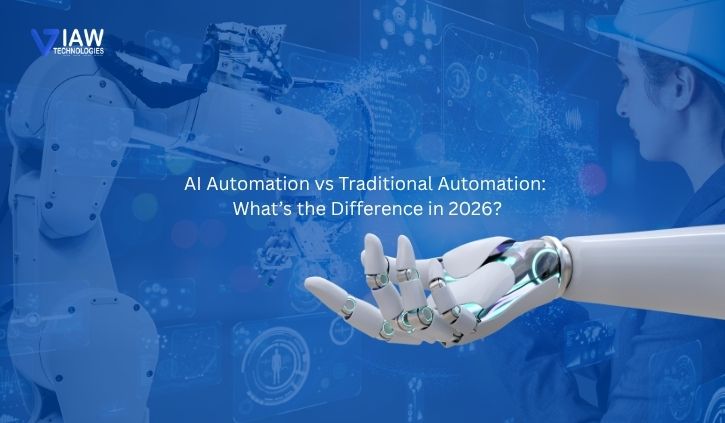
As a result of artificial intelligence and machine learning, AI automation adopts an intelligent way to improve work. Therefore, AI automation vs traditional automation now faces a problem that every business has to ask itself: Should your business adopt AI automation or traditional automation?

Basically, both techniques contribute to increasing work output by leveraging intelligence, but these two techniques are different in information processing, taking decisions as well as business adaptation.

What Is Traditional Automation?

Business automation is essentially automated, preprogrammed, or pre-instructed rule- or condition-based workflows. The system carries out a specific task on a certain trigger or condition. A good example of such a case would be e-commerce, where an automated order confirmation receipt is generated after a customer finishes making purchases on a site. This system also allows businesses to automatically generate invoice processing, send appointment confirmations, and so on.

This type of rule-based automation is very well suited for tasks that are routine and predictable. This automation can lead to a reduction of human mistakes, ensure consistency, & save employees from doing boring, time-consuming jobs. But there are drawbacks to rule-based automation. 

Automation automates based on rules; you usually can’t do anything that you haven’t been trained to do or that requires exceptions outside of the existing rules.

What Is AI Automation?

Businesses that adopt AI automation merge automation with artificial intelligence and machine learning. By using AI to build automated processes, the result is a process that not just reacts to instructions – but intelligently responds. 

With AI automation, the output of the machine doesn’t just come from following specific instructions; it’s drawn from analysis and identification of relevant patterns and an ability to incorporate variables and context to make smarter decisions. These benefits help in a business process where there is no clear path from input to output — not always predictable.

An example of an intelligent automation system is the customer service system, capable of not only decoding customer communication, comprehending purpose, and recognizing priority, but also of correctly determining which department the service request should be forwarded to. 

A manual system would require keywords and programmed rules in order to perform these activities. Intelligent automation is useful to organizations where large quantities of data and work processes have to be navigated.

AI Automation vs Traditional Automation: Key Differences

Understanding the difference between AI automation and traditional automation starts with their different levels of adaptability and ability to make decisions. 

A conventional automation system operates in a predefined manner. With AI automation, data can be processed to make the appropriate decisions based on trends, data, and context.
Conventional automation systems work well in process environments with rules. 

However, the dynamic nature of AI-based automation suits situations when information changes or an action requires interpretation to decide and perform actions.

Another key distinction is data handling. Traditional automation usually thrives best with structured data, whereas AI automation can manage structured as well as unstructured data, including emails, documents, discussions from your clientele, pictures or images, etc. 

Why Are Businesses Moving Toward AI Automation?

The increased pressure to utilize AI automation in business operations is because many companies and entrepreneurs demand better scalability and efficiency from their systems. Most organizations today produce tons of data daily; analyzing or processing this data might lead to overconsumption of man-hours for their organization.

It saves businesses the effort of going through and making every single analysis manually. 

Some important benefits include:

  • Faster handling of repetitive tasks and large data volumes
  • More efficient workflow automation
  • Improved process optimization
  • Better customer experiences through personalized interactions
  • Faster data-driven decisions
  • Reduced dependency on manual processes
  • Greater operational efficiency as businesses scale

For instance, you can have an AI that can sift through thousands of your customer calls and recognize frequently raised complaints and trends that a simple automation software may miss.

Can AI Automation and Traditional Automation Work Together?

Businesses are not required to use either AI automation or “traditional” automation. The fact is that both work very effectively together. Traditional automation can take care of those tasks that are structured, repetitive and predictable – notifications, data transfer, automated scheduling, approvals and basic, structured workflows.

Business benefits when it uses AI on the other hand, to provide prediction, interpretation, classification and automatic decision-making.

This hybrid combination can help organizations automate everyday processes, with AI deployed for tasks that need a degree of intelligence. If a business intends to take up automation, the right AI software development company will assist businesses with finding appropriate use cases and integrating AI within the business infrastructure.

They’ll also aid with developing automation solutions that can scale according to business requirements. 

Which Approach Should Your Business Choose?

For AI automation vs traditional automation for businesses, the answer to which is better depends on the nature of the process. 

For common, predictable and repeatable activities in your business, traditional automation may well be an effective solution. In contrast, for a task with large amounts of data, dynamic environments, natural language, pattern recognition or high decision complexity, AI automation can provide better value.

The best strategy is not always about replacing traditional automation with AI. Instead, businesses should identify where each technology can create the greatest impact.

In 2026, the strongest automation strategies will focus on combining reliability with intelligence—using traditional automation where rules work best and AI where businesses need systems that can understand, adapt, and make smarter decisions.

Frequently Asked Questions

1. Is AI automation better than traditional automation?

AI automation for businesses is better for complex tasks requiring flexibility and automated decision-making, while traditional business automation works well for simple, repetitive processes.

2. What are the benefits of AI automation for businesses?

The benefits of AI automation over traditional automation include faster data processing, better adaptability, intelligent decisions, and improved business process automation.

3. Can AI automation and traditional automation work together?

Yes. Businesses can combine AI-powered automation with traditional systems, using each for the business workflows where it works best.

4. How much does AI automation cost compared with traditional automation?

Traditional automation may cost less for simple tasks, while AI automation can require more investment for complex processes but deliver greater long-term value.

Categories
Blog

AI Automation for Businesses: Benefits, Use Cases & Future Trends

AI automation has quickly evolved beyond a buzzword into a practical addition to everyday business. Businesses are rapidly adopting AI for the purpose of automating mundane and repetitive tasks, improving employee productivity, rendering Personalized Customer experiences, and enabling faster decisions.

Enterprises’ automation priorities have rapidly changed away from rules-based automation to intelligent automation encompassing context awareness, the ability to integrate business data, decision-making capability, and the ability to execute multi-task automation.

Agentic AI, multi-agent workflows, multimodal AI, voice automation, and AI-powered workflow automation are some of the most important business automation trends that we can see.

The flip side of automation expansion is the new focus by many enterprises on governance, data privacy, and human oversight and on demonstrating value delivered by AI in real-world operations, not just experiments.


AI automation solutions for businesses involve the integration of artificial intelligence and workflow automation so tasks can be done with minimal human intervention.


In contrast to classical automation approaches, which focus predominantly on predefined rules, the development of intelligent AI-based automation systems allows for handling information of various forms, discerning patterns, interpreting context, and learning how to interact under different circumstances.

What Is AI Automation for Businesses?

AI automation involves leveraging tools like artificial intelligence, AI agents, workflow automation, and machine learning to optimize business activities. This approach, often referred to as AI business automation, helps organizations connect applications, process data, execute actions, and support employees across different departments.

Businesses can also use specialized AI automation services to identify suitable workflows, integrate AI tools, and build scalable automation systems based on their operational requirements.

It can orchestrate data between various applications and systems, perform data processing tasks, execute actions in an automated fashion, and even assist your workforce throughout your entire organization.
Realistically, what you are likely to use it for would be having an automated email service that either directly resolves a customer’s request (extracting data from email, writing a response, etc.), updates records in CRM, or escalates to a human agent if needed.

AI automation is becoming core in digital transformation because of its ability to significantly boost productivity. Modern-day automated business solutions are built around full workflows now, not just automated processes.

Benefits of AI Automation for Businesses

The potential to be more productive is one of the biggest advantages of AI automation for the business.

Workflows that have always depended upon individual, time-consuming human effort can be taken over by automated systems, enabling the business person to allocate more time towards planning, thinking creatively, and making decisions on the business and handling the clients.

Other important benefits include:

  • Higher productivity: AI can handle repetitive administrative activities continuously.
  • Faster operations: Automated workflows can reduce delays between different business processes.
  • Lower operational costs: Businesses can reduce the amount of manual effort required for routine work.
  • Better customer experiences: AI can provide faster and more personalized support.
  • Improved accuracy: Automated systems can reduce errors associated with repetitive data entry and processing.
  • Scalability: Companies can handle increasing workloads without increasing manual processes at the same rate.

The value is increasingly measured by business outcomes rather than simply the amount of work automated. This becomes especially important for businesses as they move AI projects from the pilot to the production stage.

How AI Automation Helps Businesses: Key Use Cases

Businesses can apply AI workflow automation across almost every department.

1. Customer Support Automation

With AI automation for customer support, repetitive customer questions (FAQs), can be automatically answered, customer queries can be intelligently categorised, conversations between customer and agent can be summarized,nd support agents are guided to provide an efficient answer, or escalations may be escalated to an actual support agent in case of complicated issues.

This customer support automation helps businesses respond faster while allowing support teams to focus on complex customer issues that require human judgment. 

Increasingly sophisticated modern AI chatbots are evolving to include what we can think of as an AI agent capable of actually doing things in addition to just writing an answer. Agentic AI in service is a big topic in customer service today. 

This is because, according to Salesforce, service leaders identified an investment in an AI agent as their top priority, while organizations also indicate it as the way they will make improvements to customer-service costs and speed.

2. Sales and Lead Management

AI may be programmed to score and qualify leads automatically, populate CRM fields, set up follow-up appointments, provide a summary of sales calls, and identify good prospects.

AI automation for sales and marketing combines sales automation with marketing workflows to automate manual qualification and follow-up processes, freeing sales and marketing teams to focus on qualified prospects and strategic customer relationships. 

Across India , AI agents are already being deployed from an experiment into a sales process function.

3. Marketing Automation

These AI systems can also observe customer behaviour, tailor content, segment data into audience groups, automate workflows, and adapt to varying customer behaviour over time, leading to more data-driven marketing automation. 

4. Business Process Automation

BPA offers many applications, from processing invoices to onboarding new employees, analyzing documents to providing reports, linking up various applications and eliminating most manual handover. 

Companies can start by looking for mundane tasks that will be able to be standardized and then gradually introduced with AI where the business need is of reasoning, forecasting, prediction, etc. 

Through process standardization, businesses can identify areas for process optimization by taking a critical look at where the main bottlenecks are and improving workflows accordingly. 

How to Automate Business Processes With AI 

A pragmatic start: Begin with a high-volume process with tangible business value. Define the business processes, note where repetitive tasks exist, how business systems are interrelated, and determine where human review is necessary. If the workflow requires even more complex, step-based actions, agents can perform the plans and execute based on the planned tasks.

Google Cloud sees these agentic workflows as another key trend for 2026, as more agents can coordinate multiple activities across business processes.

As AI goes deeper into the business operations, businesses should have governance, data security, monitoring, and human review in place for automation scaling.

AI Automation Trends to Watch in 2026

The greatest transformation for 2026 isn’t simply AI assistance but agentic AI, where AI agents can comprehend goals, deploy tools, engage with business apps, and carry out multi-step processes. Additional important trends mentioned are multimodal AI, voice automation, decision support augmentation with AI, multi-agent workflows, model routing, and human-AI partnership. 

The trends of Multimodal and Voice AI, to bring in a more natural customer experience, are seeing early adoption from customer care departments in India.

AI Commerce—whereby autonomous systems handle shopping and product discovery. Increasingly, especially at the enterprise level, controlling AI expenditure, appropriate selection of AI models and developing a resilient and adaptable infrastructure are becoming more prevalent.

Any businesses implementing an overall AI strategy should use any recent developments to anticipate and address where automation is growing, and the following AI development trends every business should watch in 2026 will be important in this respect.

The Future of AI Automation

It’s not a world purely focused on replacing manual operations. It’s going to be driven by the intelligence of business operations, with humans and AI working together. AI automation for small businesses can provide significant efficiency benefits by helping smaller teams automate administrative work, customer enquiries, lead follow-ups, and reporting.

Meanwhile, companies with larger teams can use intelligent AI agents to manage an increasingly greater number of complex activities.

These will be the organizations dedicated to functionality, ROI, data security, ethically-based AI, and the guiding force of the human decision-maker, which can then develop AI automation from innovation to a lasting source of competitive advantage. 

Categories
Blog

AI Automation Software Solutions: The Future of Smart Business

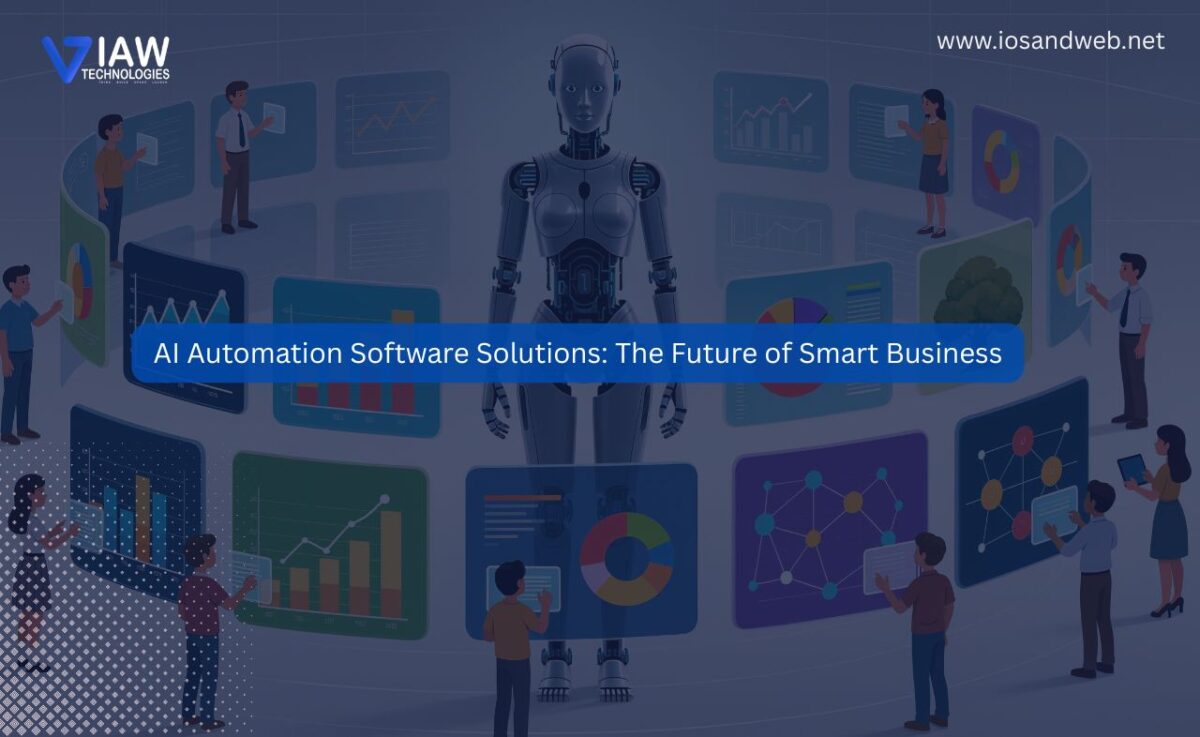
The business landscape is evolving at breakneck speed, and companies that fail to adapt risk being left behind. At the forefront of this transformation are AI automation software solutions—intelligent systems that are revolutionizing how businesses operate, compete, and grow. But what exactly makes these solutions so transformative, and why should your business care?

In this comprehensive guide, we’ll explore everything you need to know about AI automation software solutions, from their core capabilities to implementation strategies that can help your business thrive in an increasingly digital world.

What Are AI Automation Software Solutions?

AI automation software solutions are intelligent systems that combine artificial intelligence with automation technology to perform tasks that traditionally required human intervention. Unlike simple automation tools that follow pre-programmed rules, these solutions leverage machine learning, natural language processing, and cognitive computing to make decisions, adapt to new situations, and continuously improve their performance.

Think of them as digital employees who never sleep, never take breaks, and get smarter with every task they complete. They can handle everything from responding to customer inquiries and processing invoices to analyzing complex data patterns and making strategic recommendations.

The Evolution from Simple Automation to AI-Powered Intelligence

Traditional automation has been around for decades, handling repetitive, rule-based tasks. However, AI automation software solutions represent a quantum leap forward. They don’t just execute commands—they understand context, learn from experience, and can handle nuanced situations that would stump conventional automation tools.

This evolution means businesses can now automate far more complex processes, freeing human workers to focus on creative, strategic, and relationship-building activities that machines can’t replicate.

Why Businesses Are Embracing AI Automation Software Solutions

Unprecedented Efficiency and Productivity Gains

The primary driver behind the adoption of AI automation software solutions is their ability to dramatically boost operational efficiency. These systems can process vast amounts of data in seconds, complete tasks 24/7 without fatigue, and eliminate the bottlenecks that plague manual workflows.

Research shows that businesses implementing AI automation see productivity increases of 20-40% in automated departments. Tasks that once took hours can now be completed in minutes, and processes that required multiple team members can often be handled by a single automated workflow.

Cost Reduction Without Compromising Quality

While the initial investment in AI automation software solutions might seem significant, the long-term cost savings are substantial. By automating routine tasks, businesses reduce labor costs, minimize errors that lead to expensive corrections, and optimize resource allocation.

More importantly, these solutions scale effortlessly. Unlike hiring additional staff to handle increased workload, AI automation can manage growing demands without proportional cost increases. This scalability is particularly valuable for businesses experiencing rapid growth or seasonal fluctuations.

Enhanced Accuracy and Consistency

Human error is inevitable, especially in repetitive tasks. AI automation software solutions eliminate this variability, ensuring that processes are executed with consistent accuracy every single time. Whether it’s data entry, invoice processing, or quality control checks, automated systems maintain the same high standards without the fatigue or distraction that affects human workers.

Data-Driven Decision Making

Perhaps the most transformative aspect of AI automation software solutions is their ability to collect, analyze, and derive insights from massive datasets. These systems can identify patterns, predict trends, and provide actionable recommendations that would be impossible for humans to uncover manually.

This capability transforms business intelligence from reactive reporting to proactive strategic planning, giving companies a significant competitive advantage in their markets.

Key Applications of AI Automation Software Solutions

Customer Service and Support Automation

AI-powered chatbots and virtual assistants are revolutionizing customer service. These systems can handle thousands of inquiries simultaneously, provide instant responses 24/7, and escalate complex issues to human agents only when necessary. The result? Improved customer satisfaction, reduced support costs, and faster resolution times.

Modern customer service automation goes beyond simple FAQ responses. Today’s AI automation software solutions understand context, sentiment, and customer history, enabling them to provide personalized, empathetic support that rivals human interaction.

Marketing and Sales Automation

From lead scoring and email campaign optimization to predictive analytics and personalized content delivery, AI automation is transforming how businesses attract and convert customers. These solutions analyze customer behavior, segment audiences with precision, and deliver the right message to the right person at the right time.

Sales teams benefit from automated lead qualification, intelligent CRM updates, and predictive forecasting that helps them focus their efforts on the most promising opportunities.

Financial Operations and Accounting

AI automation software solutions excel at financial tasks that require accuracy and compliance. They can process invoices, reconcile accounts, detect fraudulent transactions, and generate financial reports with minimal human oversight. This not only reduces errors but also ensures regulatory compliance and provides real-time visibility into financial health.

Human Resources and Talent Management

From screening resumes and scheduling interviews to onboarding new employees and managing performance reviews, AI automation is streamlining HR operations. These systems can analyze candidate qualifications, predict employee turnover, and recommend personalized training programs based on individual career paths.

Supply Chain and Inventory Management

AI automation optimizes supply chain operations by predicting demand, automating reorder processes, optimizing routing, and identifying potential disruptions before they impact operations. This results in reduced carrying costs, minimized stockouts, and improved supplier relationships.

Implementing AI Automation Software Solutions: A Strategic Approach

Assessing Your Automation Readiness

Before diving into implementation, conduct a thorough assessment of your current processes. Identify repetitive, rule-based tasks that consume significant time and resources. Look for processes with high error rates or compliance requirements. These are your prime candidates for automation.

It’s equally important to evaluate your technical infrastructure and team capabilities. Successful implementation requires adequate data quality, system integration capabilities, and staff who understand how to work alongside automated systems.

Choosing the Right AI Automation Software Solutions

The market is flooded with automation tools, each claiming to be the best. When evaluating options, consider factors like:

  • Integration capabilities: Can the solution seamlessly connect with your existing systems?
  • Scalability: Will it grow with your business needs?
  • Ease of use: Can your team implement and manage it without extensive technical expertise?
  • Customization options: Does it adapt to your unique business processes?
  • Vendor support and community: Is there robust documentation and responsive customer service?

Starting Small and Scaling Strategically

The most successful AI automation implementations start with pilot projects—small-scale deployments that prove value before company-wide rollout. Choose a well-defined process with measurable outcomes for your initial automation project. This approach minimizes risk, builds organizational confidence, and provides valuable lessons for larger deployments.

Once you’ve demonstrated success, create a roadmap for expanding automation across departments and processes. Prioritize based on ROI potential, implementation complexity, and strategic business objectives.

Training and Change Management

Technology is only half the equation. The human element of AI automation implementation is equally critical. Invest in comprehensive training programs that help employees understand how automation will affect their roles and how to work effectively with automated systems.

Address concerns about job displacement honestly and proactively. Most successful implementations augment human capabilities rather than replace workers, allowing them to focus on higher-value activities that require creativity, emotional intelligence, and strategic thinking.

Overcoming Common Challenges in AI Automation Adoption

Data Quality and Availability Issues

AI automation software solutions are only as good as the data they process. Poor data quality—inconsistent formats, incomplete records, or outdated information—can severely limit automation effectiveness. Before implementation, invest in data cleansing and establish governance policies that maintain data integrity going forward.

Integration Complexity

Legacy systems and siloed data create integration headaches that can derail automation projects. Work with vendors who offer robust APIs and integration tools, and consider middleware solutions that bridge gaps between incompatible systems.

Security and Compliance Concerns

Automated systems that handle sensitive data must comply with regulations like GDPR, HIPAA, or industry-specific requirements. Ensure that your AI automation software solutions include appropriate security measures, audit trails, and compliance features. Regular security assessments and updates are essential to maintaining protection against evolving threats.

Managing Organizational Resistance

Change is difficult, and automation can trigger fears about job security and competence. Combat resistance through transparent communication, early involvement of affected stakeholders, and demonstrating quick wins that benefit both the organization and individual employees.

The Future of AI Automation Software Solutions

Emerging Trends to Watch

The AI automation landscape continues evolving rapidly. Hyper-automation—the combination of multiple automation technologies—is gaining traction, enabling end-to-end process automation across entire value chains. Low-code and no-code platforms are democratizing automation, allowing business users to create automated workflows without programming expertise.

Conversational AI is becoming more sophisticated, with systems that understand context, emotion, and nuance far better than early chatbots. Meanwhile, automation is increasingly moving from back-office processes to customer-facing applications, creating seamless experiences that blur the line between human and machine interaction.

Preparing Your Business for an Automated Future

The question is no longer whether to adopt AI automation software solutions, but how quickly and strategically to implement them. Businesses that embrace automation thoughtfully will gain significant competitive advantages in efficiency, agility, and customer experience.

Start by developing a clear automation strategy aligned with your business objectives. Build internal capabilities through training and hiring, and cultivate partnerships with automation vendors and consultants who understand your industry. Most importantly, maintain a learning mindset—the automation landscape will continue evolving, and successful businesses will adapt continuously.

Conclusion: Embracing the Intelligent Automation Revolution

AI automation software solutions represent far more than a technology trend—they’re a fundamental shift in how businesses operate and compete. Companies that successfully implement these solutions gain unprecedented efficiency, accuracy, and insights that translate directly into competitive advantage and business growth.

The future belongs to smart businesses that leverage AI automation strategically, augmenting human capabilities rather than simply replacing them. By starting with clear objectives, choosing the right tools, and managing change effectively, your business can harness the transformative power of AI automation software solutions.

The revolution is already underway. The question is: will your business lead it or be left behind?