IAW

iaw-white-logo iosandweb technologies
Categories
Blog

AI + Blockchain: How Businesses Can Use Both Technologies in 2026

The business technology landscape in 2026 has gone through and continues to go through significant transformation; the enterprise of 2026 seeks and looks for smart solutions that can enhance effectiveness, security, and decision-making. With two major trends in the technology space — artificial intelligence and blockchain — that are solving totally different problems separately, combining the two gives us the AI+Blockchain enterprise solution.

Artificial intelligence enables organizations to analyze data, detect patterns, automate routine tasks, and drive decisions based on evidence. Whereas blockchains offer distributed digital ledgers with inherent trust and visibility. Using each tool, organizations could develop efficient, intelligent, and honest processes.

Why Are AI and Blockchain Being Combined?

The fuel powering our AI systems needs to be trusted. Our solutions can provide a greater degree of certainty regarding the source and immutability of that data. And simultaneously, our blockchain integration makes blockchain-based solutions more valuable via the power of advanced analytics, prediction, and automation.

For instance, a company might apply AI to thousands of supply chain transactions and use those analyses to forecast potentially unavoidable delays. Simultaneously, a blockchain could be used to securely and verifiably log product transit, transactions, and the suppliers involved.

This illustration highlights how these technologies are more likely to be used in combination than against each other. Companies should use both these technologies to solve genuine operational problems rather than simply because the new technologies happen to exist.

How Businesses Can Use AI and Blockchain

There are several practical AI and blockchain use cases for businesses across different industries.

1. Improving Supply Chain Visibility

Supply chains are composed of several suppliers, manufacturers, distributors, and customers, which makes it difficult to track accurate information for all participants.
Using blockchain, key events throughout a supply chain can be stored as an immutable history of data for clear traceability and transparency. 

The stored data can then be analyzed by AI to flag any abnormal trends, predict demand, and identify potential delays or inventory needs. The business would then benefit from improved visibility in its operations with less manual effort in tracking processes.

2. Strengthening Fraud Detection

Transactions leave large amounts of data, which can make it quite complex to observe the behaviour of these operations by hand. Machine learning (ML) techniques can find such transactions based on behaviour pattern analysis, potentially fraud-related. 

Added: This would be done on a blockchain, which, by providing a clear and unmodifiable trail of transaction records of transactions, would further empower ML techniques to analyze transactions stored in the distributed ledger.

3. Automating Business Processes With Smart Contracts

Smart contracts offer conditions that automate actions on a blockchain network once triggered. Using AI could also integrate business data to make automated actions smart. If smart contracts monitor when conditions arise, they can act upon a transaction, but AI adds value at that point by interrogating data to find trends and then outputting suggestions. AI predictions are also not inherently correct. 

Businesses must carry out security checks on AI data and maintain good governance, regardless of integrating into financial or operational processes.

4. Enhancing Data Security

Data security is of utmost importance in today’s organizations. Centralised databases provide convenient access points and are prime targets for breaches and manipulation. Blockchain allows records to be decentralised and manipulated in ways that will not go undetected.

AI can monitor and learn any unusual patterns indicating possible threats to the data and its security.

When combined, this technology can benefit from enhanced security alongside increased detection speeds.

5. Building Smarter Decentralized Applications

Incorporation of artificial intelligence (AI) in decentralized applications also enables enterprises to provide intelligent, automated, and customized insights.

One example could be a decentralized platform whose AI algorithm is able to analyse user behaviour while the blockchain handles ownership, identity, permissions, etc. It is thus possible to make digital products that are more personalized due to intelligent and decentralized infrastructure.

Benefits of Combining AI and Blockchain

The benefits of combining AI and blockchain depend on the business use case, implementation quality, and data involved. However, several advantages can make this combination valuable:

  • Greater transparency: Blockchain can provide verifiable records and transparent transactions.
  • Intelligent decision-making: AI and machine learning can turn complex data into actionable insights.
  • Improved automation: Businesses can automate repetitive processes through blockchain automation and AI-powered workflows
  • Better data integrity: Blockchain can help establish a reliable record of important business information.
  • Enhanced security: Decentralized systems can reduce dependence on a single point of control.
  • Operational efficiency: Automated workflows can reduce manual processes and improve productivity.

AI Blockchain Solutions for Enterprises

The scale, integration, security, and compliance demands of large enterprises can complicate technology implementation. AI blockchains within an enterprise layer can then unite sophisticated data analytics with blockchain infrastructure. A technology solution must support these business-specific goals.

But adopting such a technology solution requires more than deciding on new technology.

Organizations need to define the business problem; determine infrastructure capacity and feasibility of implementation; verify data quality; determine the needs of the regulatory environment; and assess whether the investment will produce a reasonable return.

Businesses looking to embrace blockchain in their digital transformation journey can take advantage of blockchain development services to build and integrate blockchain-based solutions into their business model. 

Furthermore, Enterprise Blockchain Technology can help establish secure business networks, create automated agreements, manage digital assets, and execute transparent transactions. 

Industries That Can Benefit From AI + Blockchain

Possible benefits exist for multiple industries; banking, for example, could find applications in fraud, risk assessment, and digital assets. Hospitals, for example, might have opportunities in secure data exchange and research, while in supply chain and manufacturing, we may see improved tracking and prediction, combined with blockchain records.

Many other industries, such as insurance, retail, and logistics, might be interested in specific applications relevant to their unique operation.

The Future of AI + Blockchain in 2026

Both AI and blockchain bring with them powerful functionalities, but when combined, they could tackle a key modern-day issue: building intelligent yet trustworthy systems.

Modern-day businesses leveraging smart contracts, automation, decentralized systems, and AI will more and more probably need more and more practical AI blockchain services. Businesses that benefit the most will probably be those that think about truly valuable use cases, credible data, secure systems, fair AI, reliable results, and measurable impact.

AI and blockchain are not trends. But if designed strategically, AI + blockchain technology can be a powerful combo for modern organizations seeking to bring more automation, trust, security, and better intelligence and informed decisions.

FAQs

1. How can businesses use AI and blockchain together?

AI can handle data analysis and automation, while blockchain provides secure and transparent records. Together, AI and blockchain solutions improve business processes.

2. What are the benefits of combining AI and blockchain?

They offer better security, transparency, automation, and decision-making through AI and blockchain technology.

3. Can AI work with smart contracts?

Yes. AI can analyze data, while smart contracts can automatically execute predefined actions.

4. What industries can benefit from AI and blockchain?

Finance, healthcare, supply chain, retail, and manufacturing can benefit from AI-powered blockchain applications.

5. Is AI + blockchain useful for small businesses?

Yes. Blockchain for businesses can support secure transactions, automation, and data verification.
Categories
Blog

SaaS Web Application Development: Cost, Process, Features & Benefits in 2026

It goes without saying that companies are progressively replacing on-premise/desktop solutions with the flexibility that web-centric access has offered to their employees across geographies.

 Hence, it is imperative to invest in SaaS web application development for one’s resources in tech, startups, or enterprise-scale applications or solutions.

Today, anything from CRM and accounting systems to project management solutions or even AI-driven services is likely to operate via a SaaS model, enabling companies to ship software over the net and without relying on users to install or deal with hardware themselves.

When designed with subscriptions in mind, a SaaS product can serve as another stream of recurring revenue. But creating the ideal SaaS solution takes more than just a web application – it takes the right infrastructure, UX and security, and an ongoing development plan.

What Is SaaS Web Application Development?

SaaS Web Application Development: Web-based application development is a process of building software that is accessed using the internet. In essence, it means the software is not downloaded/installed on personal devices. 

It’s typically done based on a model called SaaS (Software as a Service), where customers will usually buy a plan, and the developers of that software will maintain and host such apps for all their customers. This makes SaaS the most popular form of subscription-based software that we use all over the internet – offering clients easy, on-the-go access to programmes without the hassle and upkeep of the technical requirements that come with it.

Usually developed as a cloud-hosted application. May employ multitenant architecture. Multiple customers may use a single application simultaneously while maintaining separate (logical) data for each. 

The vendor can more easily host the product and serve all clients by leveraging such architecture. Typically SaaS applications are developed with the use of cloud-hosted services and multi-tenant architecture, enabling several tenants or customers to share access and use of one instance of the software and its underlying infrastructure.

SaaS Application Development Process

Familiarize yourself with the SaaS development process before building the product. The development of the SaaS product may differ from case to case, but a typical SaaS development process can be represented by:

1. Business and requirements analysis: A team defines the users of the product, the business goals, the problem it addresses, the features of the product, the relevant stakeholders (user roles), and how the business earns money. 

2. UI/UX design: A designer translates the idea into a logical, easy-to-understand, and easy-to-use application. 

3. Technology stack and architecture design: It defines which frontend, backend, database, APIs, and cloud the system uses.

This must happen from the beginning, not as an add-on to handle a bigger scale/ security, for instance.

4. Development: A team implements the product with all the features such as authentication, dashboards, workflows, payment module, external connections, and so on. 

5. Testing and Security: A system is tested for functional issues, performance, compatibility with browsers or other factors, and security measures before it’s put live. Data security must also be addressed during development. 

6. Release and Continuous Improvement: Once the system goes live, it is monitored, patched, and updated, and new features are developed. 

So businesses seeking an answer to “how to create a Saas web application” should aim to solve one particular problem for their customer before thinking about the tech stack required to do that.

Key Features of a SaaS Platform

The features of a SaaS product depend on its purpose and target audience, but several capabilities are commonly required:

  • Secure registration, login, and authentication
  • User roles and permission management
  • Personalized dashboards
  • Subscription management and billing
  • Payment gateway integration
  • API integration with third-party services
  • Analytics and reporting
  • Notifications and automated workflows
  • Data backup and recovery
  • Scalable database architecture
  • Strong data security
  • Admin management tools

Having these features will convert your basic web app into a proven and dependable SaaS platform that will give you support for many clients and also be able to sustain many business flows.

SaaS Web Application Development Cost in 2026

The cost of development varies significantly according to the complexities of a SaaS web application. There is not a “one-fits-all” price for developing a SaaS application.

The overall price may rely on: the number and complexity of the application’s functionalities, the UI and UX complexities, the tech stack used, the level of integration, the security measures required, the cloud services utilized, the development team appointed, how it is tested, and the necessary maintenance.

If you are trying to gauge what developing a SaaS application costs, then it is wise to first develop an MVP of the application with a minimal set of functionalities. This gives a definitive brief for your development team, and they can supply you with a viable estimate. Advanced analytics, AI functionalities, complex integrations, automations or enterprise-level security can obviously affect development time and the final price significantly.

Benefits of Custom SaaS Development

Advantages Custom SaaS Development The beauty of custom SaaS software is the fact you develop your software to your own processes, instead of trying to make the existing process fit to software out of the box. 

Custom SaaS provides the opportunity to have much more control over customisation, integrations and data. Control over functionality and security are more inherent in this approach.

Other benefits include:

  • Scalability: A good application must support the increase of the number of its users and the data handled by it. 
  • Accessibility: This software is usable via any Internet device. 
  • Recurring revenue: Subscription software offers potential for a recurring revenue stream. 
  • Centralized updates: Improvements can be deployed without requiring every user to install a new version.
  • Integration flexibility: APIs allow the SaaS product to connect with existing business tools.
  • Better customization: Features can be designed around specific customer and business requirements

Choosing SaaS Development Services

Selecting the right company for SaaS development is important to the overall project.

Reliable SaaS development companies tend to be equipped with good technical knowledge and experience regarding SAAS products, together with clearly defining the issues of security, scaling, and support.

Businesses can easily outsource their product development, cloud, security and integration needs as well as maintenance from professional SaaS development providers.

The company that should do the evaluation based on the working of the outsourcing partner should evaluate the following points, such as the experience of the company and technical ability, the working of the company, the company’s information security measures, the communication protocol of the company and its overall practice of integrating information, the past practice of making solutions into SaaS mode and the last one on the commitment of the ongoing support.

Apart from technical skills—coding and architecture—a reliable provider needs to know how to align business goals with product architecture, user interface, security, scalability, and metrics that reflect product success or failures. 

Whether it is a full-scale SaaS development service or just skilled developers, finding the right SaaS development partner will improve the overall reduction of technical risks and support long-term product evolution.

Why SaaS Web Development Matters in 2026

Contemporary products of SaaS type should be reliable in terms of security, convenient in terms of simplicity in usage, quick in execution, and also adaptable to the customer requirements evolution over time. Excellent SaaS web development should be defined as the combination of engineering excellence and a business strategy to make the products ready for any upcoming evolution. 

A software development company might be an alternative option, either when your organization requires vast engineering competence in general or an AI Software Development Company, in case you’re considering implementation of features such as AI Assistants, Intelligent Automation, Predictive analytics, and Generative AI. Eventually successful SaaS development means not only releasing the software in question, but delivering a trusty and predictable solution to a specific client’s needs, maintaining ongoing value, with the capacity to grow over time.

FAQs

1. What is SaaS web application development?

SaaS web application development creates cloud-based software that users access online through a subscription. It is also known as software as a Service.

2. How much does SaaS web application development cost?

The SaaS web application development cost depends on features, complexity, technology, integrations, and security. An MVP usually costs less than a feature-rich SaaS platform.

3. How long does it take to build a SaaS application?

The time for SaaS application development depends on the project’s features and complexity. A basic MVP can take a few months, while larger platforms may take longer.

4. What technologies are used for SaaS web application development?

SaaS web development commonly uses React, Angular, Node.js, Python, Java, databases, APIs, and cloud infrastructure based on project requirements.

5. Why should businesses choose custom SaaS development?

Custom SaaS development lets businesses build software around their specific needs while improving scalability, integrations, flexibility, and data security.

Categories
Blog

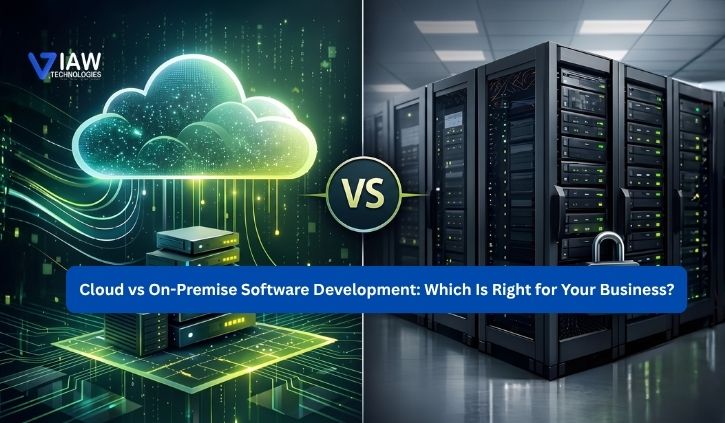
Cloud vs On-Premise Software Development: Which Is Right for Your Business?

Today, the business world must be equipped with software that can develop and adapt; enable workers from many distant locations to collaborate on the same project; that will protect confidential information; and that will prove to be an efficient investment to future trends.
. Software deployment models make some critical choices when making decisions for their software.

However, cloud vs on-premises software development is not just about where you host the software anymore. It includes aspects like the ease of scalability, data security, how much control you will have over your infrastructure, speed of deployment, maintenance, and more.

Then, between cloud and on-premises software development, which one is the right choice for your business? It is absolutely dependent on your business needs, your budget, your security, and future growth

Cloud Software Development: What Does It Mean?

Cloud software development refers to applications designed to run on a cloud computing environment instead of on-premises servers in your workplace. When choosing between cloud and on-premises deployment, businesses should evaluate their current technology environment and long-term requirements. The cloud service provider will provide the application with all other necessary computing services, like storage, networking, database management, and hosting on the cloud.

Organisations can allocate the resources needed on the fly and scale their applications in the cloud without purchasing more hardware components on their premises. Cloud software solutions are attractive to young businesses, digital products and dispersed organizations because computer resources are at our command instantly.


Also, cloud-based software development enables contemporary methods like continuous integration, continuous delivery, containers, managed databases and cloud-native architectures.

On-Premise Software Development: What Does It Mean?

On-premises software development relies on an organization to have applications developed that it will run on hardware, infrastructure, and systems that it itself owns or directly controls. When using on-premises development, the business itself generally controls and provides all necessary hardware, networks, hosting, security, and administration and the deployment, backups, upgrades, and maintenance of all software.
This on-premises approach puts great control back in the hands of a business over the hardware and information.


It is an on-premises development that best fits businesses that operate with data security requirements that must remain internal; have existing, complex IT structures and policies that must remain under the full control of the business; have specialised systems that may be highly proprietary or legacy; and any business where certain strict security or operational controls must remain at the discretion of the business owner.

Also, cloud-based software development enables contemporary methods like continuous integration, continuous delivery, containers, managed databases and cloud-native architectures. Virtualization in Cloud Computing helps businesses use computing resources efficiently by allowing multiple virtual environments to run on shared physical infrastructure.

Cloud vs On-Premise Software: Key Differences

The difference between cloud software and on-premises software becomes clearer when comparing their approach to infrastructure and resource management.

Scalability: Cloud environments can scale resources according to application demand, while on-premises systems may require additional hardware and infrastructure upgrades.

Deployment: Cloud platforms can enable faster software deployment because infrastructure resources can be provisioned digitally. On-premises deployments may require physical configuration and internal IT coordination.

Maintenance: Cloud providers typically manage significant portions of the underlying infrastructure, whereas on-premises environments require the organization to manage its own servers and infrastructure.

Accessibility: Cloud applications can generally be accessed from different locations with appropriate authentication and network connectivity. On-premises applications may depend more heavily on internal network configurations.

Data control: Physical resources controlled by an on-premises system. A shared physical resource within a public cloud where responsibility for securing the resources is shared between the provider and client.

Benefits of Cloud Software Development

The benefits of cloud software development go beyond reducing dependence on physical servers. When implemented correctly, cloud solutions can help businesses build a more flexible and scalable technology environment.

Greater Scalability

Cloud infrastructure provides companies with the flexibility to ramp up and down as needed for the amount of computing resources. For applications that are heavily seasonal, experience unexpected spikes in traffic or very high traffic growth.

Faster Deployment

Allows development teams to provision environments and deploy applications quicker without the lag caused by purchasing and configuring the underlying hardware infrastructure. This may lead to shorter development lifecycles and more frequent delivery of enhancements by the business.

Flexible Accessibility

Users, clients or employees located remotely may all benefit from cloud-based applications. With appropriate security and authentication mechanisms, users can authenticate and use applications from outside of the office environment. 

Reduced Infrastructure Management

With the adoption of clouds, the necessity to buy and to maintain physical infrastructure will be decreased. The company will need to be much more concentrated on its applications and on its own business processes and leave many operational burdens with the cloud provider.

Improved Business Agility

The cloud allows you to experiment easily, launching new services, increasing resources, or scaling technology based on your business’ needs at any given time. This flexibility is often of special concern for many young businesses and fast-growing companies.

When Does On-Premise Software Make More Sense?

Cloud adoption is the best answer to most enterprises… but not all. The difference between cloud software vs on-premise software becomes clearer when comparing their approach to infrastructure and resource management. If a company wants to use a proprietary stack on a specific type of hardware, has numerous sensitive workloads, meets compliance requirements, or runs many complex and monolithic applications on its own hardware, an on-premises solution might work for the enterprise.

It ensures a higher level of control over hardware configuration, network architecture, software builds and versions, data storage solutions, etc.

Yet, increased control implies increased responsibility. For an on-premises structure, you are in control of all the hardware failures, machine maintenance, hardware replacements, backup processes, and disaster recovery, and all of this must have someone monitoring it and securing it from breaches of security. 

Cloud or On-Premise Software for Business: How to Choose?

A choice between cloud and on-premises implementation also requires businesses to examine where current technology is and where it needs to be. Consider factors such as security of data, scalability, IT infrastructure, where hosting is located, price of maintenance and ongoing costs, how to implement new software, legality/compliance issues, who can access information and who controls it, and more.

If your business has and expects to experience rapid expansion, cloud software is likely right for you.

On the flip side, if your business demands a huge amount of control over its IT infrastructure, on-premises makes more sense. Or it could even be a hybrid approach encompassing both the previous models. Clearly, the ultimate decision depends on what kind of technology isn’t quite as in the foreground—your specific needs concerning security, operational demands, and the future.

Organizations should begin any cloud migration by determining what software it will utilise, where its data is, the kind of security it needs for those applications and its data, and how it is going to support everything over the long term. 

Final Thoughts

There are pros for both cloud and on-premises solutions, including the following: cloud software development is scalable, agile, and flexible; deploys faster; and requires less physical infrastructure for the client, while on-premises allows for more direct control over the data and infrastructure for software vendors.

As any organization contemplating new applications should have its goals in sight, early consideration of these elements ensures a business does not suffer unnecessary costs of infrastructure or technical restraints down the line. Using an appropriate custom software development strategy, a business should design a solution that remains productive, secure, and scalable for its future use and value.

Frequently Asked Questions

What is the difference between cloud and on-premises software?

Cloud software runs on cloud infrastructure, while on-premises software runs on the company’s own IT infrastructure.

Is cloud software better than on-premises software for businesses?

Cloud software is ideal for businesses needing scalability, flexibility, and faster deployment, while on-premises software offers greater data control.

What are the benefits of cloud software development?

Key benefits of cloud software development include scalability, faster deployment, remote accessibility, and reduced infrastructure maintenance.

Which is more secure: cloud or on-premises software?

Both can be secure. Data security depends on proper architecture, access controls, monitoring, and security practices.