IAW

iaw-white-logo iosandweb technologies
Categories
Blog

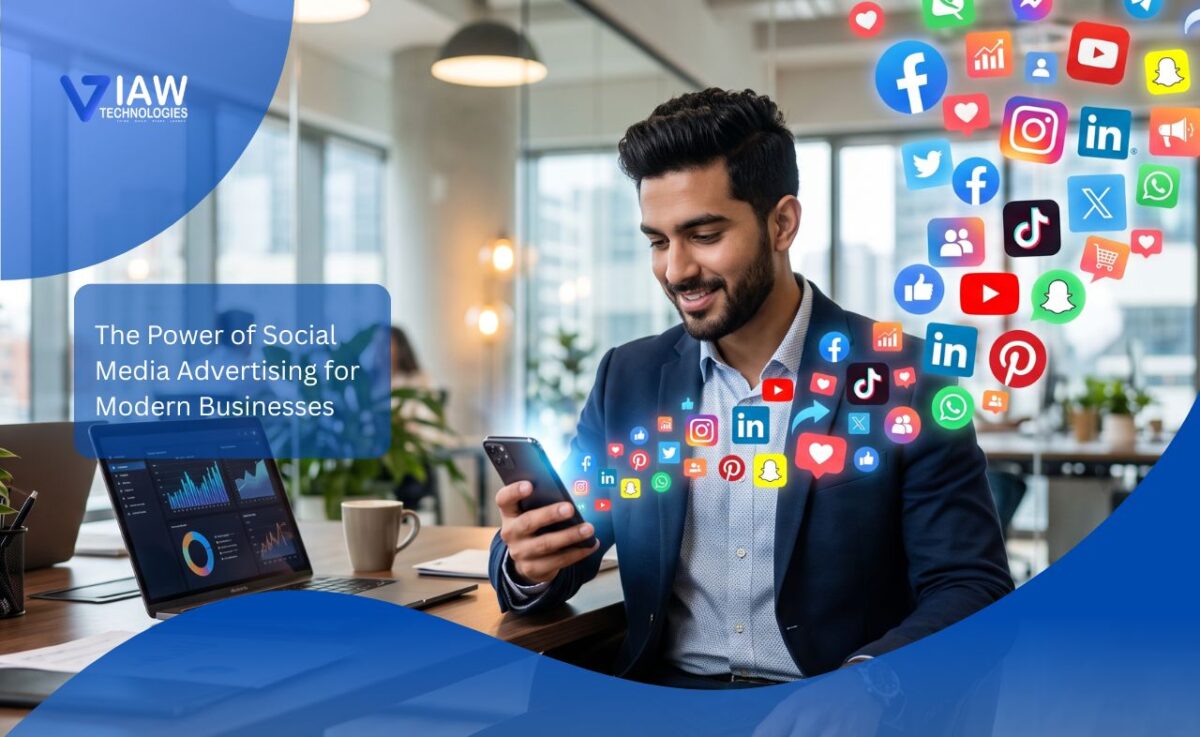
The Power of Social Media Advertising for Modern Businesses

Social Media Advertising allows businesses to promote products and services through paid campaigns on platforms like Facebook, Instagram, LinkedIn, TikTok, and YouTube.It helps brands reach highly targeted audiences, generate leads, improve conversions, and maximize return on investment (ROI). Today, it has become one of the most effective digital marketing strategies for increasing brand visibility, customer engagement, and long-term business growth , as a means of achieving business objectives such as increased reach to target audiences, boosted brand visibility and sustainable business development.

DataReportal shows billions of users engaged on social media across the globe, with many actively looking for brands on these platforms.In practice, businesses that continuously test audience segments, ad creatives, and campaign objectives often achieve better engagement rates and a higher Return on Ad Spend (ROAS) than campaigns that rely on a single setup. , purchasing behaviors, and interests as opposed to organic reach alone.

What is Social Media Advertising and Why Does It Matter?

Social media advertising is how you run paid campaigns on social media websites to sell products, promote brands, or showcase services to specific target audiences. Rather than counting on organic posts to succeed, you pay to expose your ads to people who’re susceptible to act.Paid social advertising is one of the most effective ways for businesses to reach qualified audiences, generate leads, improve conversions, raise brand awareness, and achieve measurable business growth . With billions of users globally currently active on social media, Social Media Advertising has become one of the most effective customer acquisition channels for businesses, enabling brands to reach highly relevant audiences and achieve measurable marketing results. (DataReportal).

Audience targeting includes:

  • Age and gender
  • Location
  • Interests and hobbies
  • online shopping behaviors
  • past website visits
  • previous orders
  • use of device
  • job role and industry
  • customer intent signals

This type of advanced audience targeting allows businesses to reach their prospects at the most relevant time, with the most relevant message. Instead of yelling ads to the whole world, a brand can put their money into reaching consumers that would be truly interested in what they have to sell, driving a more engaged consumer and a higher conversion rate.

The following is an extra plus point social media marketing campaigns bring to you: -ability to be tracked down with a measuring result that was lost in old-fashioned method of marketing. We are allowed to track campaigns performance with real-time indicators of engagement, conversion, click, impressions, Return on investment, CTR, et Cetera which would enhance the marketing performance.

Why Social Media Advertising Matters for Businesses

Social media is changing consumer behavior. Almost everyone nowadays has done the shopping research for any product before buying and watching videos or read reviews from social media pages and now everyone does shopping, watching and searching on social media. So Social Media Marketing works even better when combined with Social Media Advertising. 

Businesses that are able to make smarter investments in Paid Social efforts reap some key competitive benefits:

Target High-Intent Consumers

Social networks store useful data about user behaviour that can enable advertisers to hone in on individuals that are far more likely to buy certain goods or services. Targeting by Audience becomes much more powerful and leads to much less wasted advertising spending.

Increase Brand Exposure

Consumers usually aren’t willing to buy after they’ve encountered a brand only once.

Through consistent advertising on different campaigns, you’ll ensure that your brand name gains and increases visibility in consumers’ minds so you are front-of-mind once they’re looking to buy.

Generate Qualified Leads

Social ads can be particularly effective as a Lead generation vehicle for service businesses and those with longer sales cycles. Ads can lead to targeted Landing pages, contact forms, webinar registrations or even e-books and other valuable content to grow a pipeline of valuable prospective customers.

Optimize Your Campaigns With Data

Paid Social’s greatest strength arguably lies in the accessibility of detailed performance data.

Every social media campaign you run generates valuable, actionable data about who engaged, when they clicked, and where they went.

Instead of relying on guessing games, marketing teams have performance metrics to build around

Top Benefits Of Social Media Advertising

Businesses from all niches are still pouring their money into social media marketing because it is a method that gives real time and quantifiable results, helps grow your customer base, and fosters sustained business growth.

Here are some of the leading Benefits Of Social Media Advertising:

1. Highly Targeted Advertisement

As opposed to a lot of other platforms that use traditional advertising models, social media allows you to focus on incredibly narrow and targeted demographic. You can market to people on basis of their gender, interest, browsing and shopping patterns,This helps businesses spend their advertising budget more efficiently by reaching only the audiences most likely to convert.

2. Enhanced Brand Awareness

In cases when you are trying to sell a new product in the market or expand to an entirely new industry, the first things your target clients require to know about you are you! With social Media ads, you can introduce yourself to thousands if not millions of potential clients in a very small period of time and gain an instant recognition.

3. Better Lead generation

Using lead form ads, instant messaging and other features that lead generating ads offer you have the advantage of grabbing leads in much simpler and quicker way. You do not have to redirect the user to some landing page for the job of capturing leads.

4. Effective Cost

Paid advertising works for just about any business model, whether astartup, a large enterprise, or small to medium business. The primary reason for this is that with the support ofpaid ads, the only restriction that remains on how large or small you can scale your campaigns is just your budget. It means that, you only pay for the ad that results in an effective output, hence makes paid advertising most efficient for marketing budgets of almost all kinds.

5. Measurable Results of Your advertising efforts

In the world of the modern marketing strategies, the performance of your advertisements is tracked in the real-time. So, no matter how big or small the amount invested or campaigns carried out, the real-time monitoring will give you an update in terms of number of clients acquired and return on ads. These will further be useful in making modifications in the ads so as to gain even better results in the future.

6. Helps Long term Business growth

One may not know this, but Paid social media advertising works even better when integrated with digital marketing services, content marketing, email marketing, and SEO strategies for sustainable business growth. By taking a multi faceted approach towards digital marketing, one can effectively take benefits of not just an immediate growth and traffic boost, but the long term visibility, customer trust and growth of their business.

Top Social Media Advertising Platforms To Help Your Business Grow

Whether your Social Media Advertising campaign delivers on its promise depends not only on the creatives but also on the advertising platform you choose. Each social network caters to a specific demographic with advertising options suited for the channel. Instead of advertising on each available platform, concentrate on where potential customers can be found.

The right platform for an eCommerce business may not necessarily work for a B2B business.

Considering your audience, their preferences and expectations, the campaign objective will help you with budget management and ROAS.

Facebook Advertising

With the huge number of people and advanced targeting options, Facebook Advertising continues to be a most efficient channel to drive better campaign results with its AI optimized advertising to deliver higher conversions.

Advertisers on Facebook have access to a plethora of demographic, interest based targeting, purchase intent targeting, live events, website activity and behavioral targeting to connect to the right audience.

The advertising platform is suited for:

  • Brand awareness campaigns
  • Product sales
  • Website campaigns
  • Lead generation
  • Remarketing campaign
  • Local advertising

It also provides some robust targeting tools to help campaign managers improve performance with ads being displayed to those most likely to purchase.

Many advertisers also use Lookalike Audiences and retargeting campaigns to reconnect with previous website visitors, often resulting in improved conversion rates and lower customer acquisition costs. 

Instagram Advertising

A visual platform like Instagram is quite suited for fashion, beauty, fitness, food and beverage brands, lifestyle and travel business, as most of them gain attention and a higher number of followers through high visual content and shorter video formats.

Some popular advertising formats are:

  • Image Ads
  • Video Ads
  • Carousel Ads
  • Stories Ads
  • Reels Ads
  • Shopping Ads

Organizations who unify eye-catchy creatives with brand voice make sure they get increased brand visibility higher engagement rates, as well as much more brand authority in the minds of their customers.

LinkedIn Advertising

The go-to platform for B2B companies.

Businesses reach prospects based on title, company size, sector, expertise, seniority and professional hobbies.

LinkedIn advertising is great for:

  • SaaS companies
  • IT service companies
  • Consultancies
  • Recruitment firms
  • Corporate coaching and training companies

Whilst they generally cost more per click, LinkedIn advertisements often provide better value B2B leads due to the targeting capabilities that help your business target professionals with certain roles, company size, and sectors.

TikTok Advertising

TikTok ads disrupt the ad world, by utilizing and leaning on short, fun, and authentic video. You should try and use it if your target demographic consists primarily of Gen Z and young millennials.

Its good for both raising brand awareness and driving engagement by creative, entertaining brand messaging.

To maximize your campaigns effectiveness on the platform, avoid direct selling and instead focus on entertainment, trending sound and challenges and even influencer campaigns.

YouTube Advertising

Video marketing continues to be a vital part of online marketing, making YouTube an excellent platform for brands that want to educate, demonstrate products, and build trust.

YouTube advertisement usage:

  • Product demonstrations
  • Testimonials
  • Educational video content
  • Brand storytelling
  • Product launch videos

Video campaigns promote brand belief, boost buy certainty.

5 Steps to Launch a Top-Performing Social Media Advertising Campaign

In order to launch an effective ad campaign on social media, businesses must do much more than just set a budget. Starting from the creation of goals to evaluation of results, every phase contributes to campaign success. By following a clear strategy, companies can make efficient advertising and eliminate spending wasted on unnecessary tasks.

Here are 5 steps to guide you:

1. Determine Clear Campaign Goals

No campaign could be a success if there isn’t clarity on the desired results, and before anything else the campaign goals need to be set.

Popular goals are:

  • Increased brand awareness
  • Driving more traffic on your website
  • Generated qualified leads
  • Improved online sales
  • Increased social media engagement
  • Promotion of your mobile app installation

Having specific advertising goals enable ad platforms to better reach the most qualified customers.

2. Get to Know Your Target Audience

All campaigns need proper Audience targeting, this will let your advertisements be highly relevant to your prospects.

Factors to consider when defining audience:

  • Age
  • Gender
  • Geographic Location
  • Interests
  • Online Behavior
  • Purchase behavior
  • Device utilization
  • Income

Beyond identifying, also learn about what kind of buyer personas match customer profile data rather than your company’s assumptions.

3. Set High-Quality Ad Creative

When ads are delivered on a user’s social feed  most likely you and product may not be their first priority. This means you will need to work on your advertisement creative and make it more impactful 

An ad should consist of:

  • A high resolution video/image
  • An appetizing headline
  • Compelling value proposition
  • Concise yet persuasive Copy
  • Strong call to action (CTA)

When communicating, think from the perspective of the customer rather than focusing on the features.

How would your advertisement solve their problem?

4. Optimize Your Landing Page

As mentioned above, the best target cannot  compensate for a poorly optimized landing page.

Having great ad traffic would be of no avail if it arrives on a page that will turn out disappointing to visitors.

Features that a good landing page must have are:

  • Load quickly on all types of device
  • Provide ad message continuity
  • Include clear CTA
  • Feature social proof such as customer reviews
  • User friendly experience with a clean look

A high performing landing page reduces bounce rates and improves lead generation rates.

5. Analyze Key Performance Indicators

You probably know how significant a role data analysis plays, but one of the benefits of advertising on the social media platforms is real-time insights you gain on your campaigns.

Important Metrics

MetricWhy It Matters
Click-Through-Rate (CTR)Measures how well your ad grab attention.
Conversion-RateIndicates how many users complete the actions specified by you after clicking.
CPC (Cost-Per-Click)Measures the efficiency of your campaigns in terms of advertising spend.
CPA (Cost-Per-Acquisition)Cost that you bear on each lead/customer acquired.
ROAS (Return on Ad Spend)Helps assess campaign performance regarding sales/revenue.
Engagement RateMeasures the user activity like like, comment, share and other user interactions.

Keeping up with these metrics helps to understand and measure the ongoing campaigns and the way in which the available budget is best spent.

Tips and Best Practices For Increased Success with Social Media Advertising

Ad management isn’t always that easy. Ad run only after initial efforts; this process only yields the ultimate results if the ads campaigns remain ongoing test campaigns.

We’ve gathered these most effective ad campaigns best practices.

  • Constantly test new and improve the visual in your Social Media Ad designs to maintain interest within your audiences and reduce creative fatigue.
  • Run multiple A/B testing of the Social Media headline, Social Media Ad copy, Social Media visual, Social Media call to action, Social Media audience groups.
  • Retarget with Social Media Ad Campaigns abandoned car users & website viewers.
  • Increase spend for successful ad campaigns that maintain optimal Return on ad spend (ROAS).
  • Review campaign’s weekly to determine if you should take any other action based on ad-campaign performance instead of guessing what will work.
  • When you integrate Social Media Advertising together with an Advanced Ecommerce SEO solution, you have a digital solution that will get an instant paid visitors and grow your long term traffic from Social Media Ads.

CONCLUSION

Paid advertising campaigns can definitely give you quick visibility, but if you want something t‌hat lasts, you ne‎ed to mix those with good digital mar‍keting services and advanced e-commerce SEO stra‎tegies. This way, you get both immediate results and longer-term business growth. It does not really matter if you are a startup, a business that is growing, or even an e‍stablished enterprise, social media advertising has potential for reaching the right people, finding good le‌ads, and making your investment worthwhile.

The companies that actually mon‌itor how their campaigns are doing, trying out different groups of people, and improving their ads based on the data, they are the ones who are more lik‎ely to see sustai‎ned growth over time. Not like the ones th‌at just run an ad once and h⁠ope for the best. Taking a strategic, data-driven approach means your marketing money is being spent effectively, where it can make the biggest difference for the business. Here at Iosandweb Technolo​gies, our goal is to help businesses create social media advertising strategies that actually get results. We tailor these to their specific goals. And we combine paid campaigns with a full range of digital mar​keting solutions, so we can rea‍lly maximize the return on their investment, make their brand more visible, and push for sustainable business growth.

Frequently Asked Questions (F​AQs)

1. What is Social Media Adverti​sing?

Social Media Advertising, this invol‌ves prom͏oting different products or services, sometimes entire brands even, using paid c‎ampaigns on social media sites. You have platforms l‍ike Facebook, Instagram, also LinkedIn, TikTok, and YouTube. Business‌es utilize this to reach very specific audiences, they build their brand awareness, generate new leads, and work to improve their conversion rates.

2. What are the benefits of Social Media Advertising?

There are several important bene⁠fits when consid‍ering Social Media Advertising. These include the ability to target audiences with much more precision, getting better brand visibility, g​enerating leads that are generally of a higher quality, and being able measure how well your campaigns are doing. Also there is better Return on Ad Spend (ROAS) and you can get scalable marketi‍ng results, which applies to businesses of any dimension.

3. Which social m͏edia platf⁠orm is best for advertising?

Decidi​ng on the best platform for your adverti͏sing really c‌omes d͏own to your business objectives and who y​our target audience is. For instance, Facebook and Instagram usually work best for businesses selling directly to consumers, known as B2C brands. LinkedIn is very good for business-to-business marketing, or B2B. TikTok tends to perform well when trying to reach younger d‍emographics. And then YouTube, it is excellent for video marketing and when a brand wants to tell its story in that format.

4. How can business‍es improve the performance of their social media advertising campaigns?

To make social media a‍dvertising campaigns perform better, businesses should first set cle‎ar goals. Then, they need to truly under⁠stand who their audience is. Creating ad creatives that really grab attention a⁠lso helps. Testing different versions of their campaigns, enhancing their landing pages, these are also important steps. And, regularly keeping an eye on important numbers, like the Click-Through-Rate, is essential.

5. How much should businesses spend on Social Media Advertising? 

There is not a fixed budget for Social Media Advertising, because the ide‌al spendi͏ng depends on your business size, industry, campaign objectives, and also the target audience. M​any small businesses usually start with a modest daily budget and they gradually increase their investment based on how the campa͏ign performs. Instead of focusing just on spending more, businesses really sho‌uld monitor some key metr​ics, things like Click-Through Rate (CTR), Cost Per Acquisition (CPA), and then Return on Ad Spend (ROAS), to make sure their advertising budget actually delivers measurable results. Regul͏ar testing and opt‌imization, those things help maximize Return on Investment, regardless of the campaign budget.
Categories
Blog

Top Benefits of Progressive Web Apps for Startups and Enterprises

In the rapidly evolving digital landscape, businesses face a critical decision: invest in expensive native app development or stick with traditional websites that often fall short of user expectations. Enter progressive web apps development—a solution that’s revolutionizing how startups and enterprises approach their digital presence. As more companies discover the advantages of PWA (progressive web app) development, it’s becoming clear that this technology offers the best of both worlds without the traditional compromises.

What Makes Progressive Web Apps Different?

Before diving into the benefits, it’s worth understanding what sets PWAs apart. Progressive web apps are essentially websites built with modern web technologies that behave like native mobile applications. They’re accessible through web browsers but offer app-like experiences including offline functionality, push notifications, and home screen installation—all without requiring users to visit an app store.

For businesses evaluating their technology stack, this hybrid approach represents a fundamental shift in how we think about digital user experiences. Rather than choosing between web or mobile, progressive web app development allows companies to deliver seamless experiences across all devices with a single codebase.

Cost Efficiency: A Game-Changer for Startups

Reduced Development Investment

For startups operating with limited budgets, the cost advantages of PWA development are substantial. Traditional app development requires separate teams for iOS, Android, and web platforms—each with distinct codebases, testing requirements, and maintenance needs. Progressive web apps eliminate this multiplication of effort.

By investing in a single progressive web app, startups can reach users across all platforms simultaneously. This doesn’t just cut initial development costs; it dramatically reduces ongoing maintenance expenses. Bug fixes, feature updates, and design changes happen once and deploy everywhere instantly.

Lower Distribution Costs

App stores charge fees, require compliance with various guidelines, and take significant revenue cuts from in-app purchases. Progressive web apps bypass these gatekeepers entirely. Users access your PWA directly through URLs, eliminating app store fees and the lengthy approval processes that can delay critical updates.

For bootstrapped startups, these savings can mean the difference between achieving product-market fit and running out of runway. For enterprises, the savings scale across multiple products and markets, contributing significantly to the bottom line.

Enhanced User Experience Across All Devices

Lightning-Fast Performance

Modern users are unforgiving about load times. Research consistently shows that even one-second delays in page load times can significantly impact conversion rates. Progressive web app development prioritizes performance through service workers, efficient caching strategies, and optimized asset delivery.

Unlike traditional websites that reload content with every interaction, PWAs cache essential resources locally. This means subsequent visits load almost instantaneously, creating the smooth, responsive experience users expect from native apps. For enterprises serving millions of users, these performance improvements translate directly to better engagement metrics and higher revenue.

Offline Functionality

One of the most compelling benefits of PWA (progressive web app) development is reliable offline functionality. While native apps have long offered offline capabilities, traditional websites simply fail when connectivity drops. Progressive web apps change this equation entirely.

Through service workers and strategic caching, PWAs continue functioning even without internet connectivity. Users can browse previously loaded content, complete forms, and perform various actions—all of which sync automatically when connection resumes. For enterprises with field workers, international users, or customers in areas with unreliable connectivity, this capability is transformative.

Engagement Benefits That Drive Business Results

Push Notifications Without App Installation

Push notifications remain one of the most effective engagement tools, yet they’ve traditionally required users to install native apps. Progressive web app development brings push notification capabilities to the web, allowing businesses to re-engage users without the friction of app downloads.

For startups building user bases, this dramatically lowers the barrier to creating ongoing engagement. Users who might never install your app will grant notification permissions to your PWA after a single positive interaction. Enterprises can leverage this for time-sensitive communications, personalized offers, and retention campaigns across their entire user base.

Add to Home Screen Functionality

Progressive web apps can be installed directly to users’ home screens, creating an app-like presence without app store distribution. The installation process is remarkably frictionless—typically just two taps—making users far more likely to complete it compared to traditional app installation.

Once installed, PWAs appear alongside native apps, launch in full-screen mode, and behave indistinguishably from their native counterparts. This visibility increases engagement frequency and creates stronger brand presence on users’ devices.

Scalability Advantages for Growing Enterprises

Single Codebase, Universal Reach

As enterprises expand into new markets and device ecosystems, maintaining multiple native apps becomes increasingly complex. Progressive web app development solves this scalability challenge elegantly. A single codebase serves all users regardless of device, operating system, or screen size.

This universality extends beyond just smartphones. Progressive web apps work seamlessly on tablets, desktops, laptops, and even emerging device categories. As your business grows, your PWA grows with it without requiring platform-specific development resources.

Easier A/B Testing and Iteration

Enterprise success often depends on rapid experimentation and data-driven decision making. Traditional native apps make this challenging—updates require app store approval, users must download new versions, and version fragmentation means some users experience old features for weeks or months.

Progressive web apps update automatically in the background, ensuring all users always have the latest version. This enables real-time A/B testing, instant bug fixes, and rapid feature deployment. When you discover what works, you can roll it out to your entire user base immediately rather than waiting for adoption curves.

SEO and Discoverability Benefits

Search Engine Friendly Architecture

Unlike native apps that exist in walled gardens, progressive web app development creates experiences that search engines can index and rank. This means potential customers can discover your PWA through organic search—a massive advantage for startups building brand awareness and enterprises expanding market presence.

Each page of your PWA can be optimized for specific keywords, shared via simple URLs, and linked to from other websites. This creates compounding discoverability advantages that native apps simply cannot match.

Lower Acquisition Costs

The friction of app installation creates significant drop-off in user acquisition funnels. Progressive web apps eliminate this friction entirely. Users discovering your PWA through search, social media, or advertising can immediately engage with full functionality—no download required.

For startups optimizing customer acquisition costs, this dramatically improves conversion rates. For enterprises running large-scale marketing campaigns, reducing acquisition friction translates to millions in saved advertising spend and increased customer lifetime value.

Security and Maintenance Advantages

Automatic Updates

One of the hidden costs of native apps is version fragmentation. Users delay updates, creating security vulnerabilities and support nightmares. PWA (progressive web app) development eliminates this problem—updates deploy automatically, ensuring every user always has the most secure, feature-complete version.

For enterprises managing compliance requirements or addressing security vulnerabilities, this centralized update mechanism is invaluable. Critical patches deploy instantly without waiting for user action or app store approval.

HTTPS-Based Security

Progressive web apps require HTTPS, ensuring all data transmission is encrypted by default. This baseline security requirement protects both businesses and users while building trust—particularly important for startups establishing credibility and enterprises handling sensitive customer data.

The Competitive Edge in 2025 and Beyond

As we progress through 2025, the businesses thriving are those that prioritize user experience, operational efficiency, and rapid iteration. Progressive web app development addresses all three priorities simultaneously, which explains its accelerating adoption across industries.

For startups, PWAs offer a path to compete with established players without matching their native app budgets. For enterprises, they provide a way to modernize digital presence while reducing technical debt and operational complexity.

Conclusion: Making the Strategic Choice

The decision between traditional web development, native apps, or progressive web apps isn’t just technical—it’s strategic. As the capabilities of PWAs continue expanding and browser support becomes universal, the advantages for both startups and enterprises become increasingly compelling.

Whether you’re a founder allocating limited resources across competing priorities or an enterprise CTO planning multi-year digital transformation, progressive web app development offers a path that optimizes for performance, cost, user experience, and future flexibility simultaneously. In an era where digital experience defines competitive advantage, that combination is difficult to beat.

Categories
Blog

Low-Code vs No-Code: Which Is Better for Rapid App Development?

The pressure to digitize faster has never been more intense. Businesses need applications yesterday, not next quarter. Enter low-code vs no-code development platforms—two revolutionary approaches that promise to slash development time from months to days. But which one actually delivers on that promise?

If you’re standing at this crossroads, you’re not alone. Organizations across industries are grappling with this decision, and the stakes are high. Choose wrong, and you might end up with technical debt, scalability nightmares, or applications that simply can’t do what you need them to do.

Let’s cut through the marketing hype and explore what really matters.

Understanding the Fundamentals

Before diving into the low-code vs no-code development debate, let’s establish what we’re actually comparing.

No-code platforms are visual development environments designed for non-technical users. Think drag-and-drop interfaces, pre-built templates, and point-and-click configuration. The entire premise is that anyone—regardless of coding knowledge—can build functional applications.

Low-code platforms take a hybrid approach. They provide visual development tools but also allow developers to write custom code when needed. This flexibility makes them suitable for both citizen developers and professional programmers working on more complex projects.

The fundamental difference? Customization depth and technical flexibility.

The No-Code Advantage: Democratizing Development

No-code platforms have sparked a revolution by putting application development into the hands of business users. Marketing managers can build campaign tracking tools, HR professionals can create onboarding workflows, and operations teams can design inventory management systems—all without writing a single line of code.

Speed to Market

When it comes to rapid app development, no-code platforms excel at getting minimum viable products (MVPs) launched quickly. Simple applications like form builders, approval workflows, or internal dashboards can go from concept to deployment in hours or days rather than weeks.

Accessibility and Empowerment

No-code democratizes development. Subject matter experts who understand business problems best can now create solutions directly, eliminating the communication gap between business stakeholders and IT departments. This citizen developer movement reduces bottlenecks and accelerates innovation.

Cost Efficiency

Without the need for specialized development talent, no-code platforms significantly reduce project costs. Subscription-based pricing models make them accessible even for small businesses and startups with limited budgets.

Low-Code Development: Power Meets Flexibility

While no-code platforms target business users, low-code vs no-code development discussions often reveal that low-code platforms serve a different master: the need for sophisticated, scalable applications that still benefit from rapid development.

Customization Without Limits

Low-code platforms shine when pre-built components aren’t enough. Need to integrate with legacy systems? Require complex business logic? Want to implement custom algorithms? Low-code development accommodates these needs by allowing developers to inject custom code where necessary.

This flexibility means you’re not boxed in by platform limitations. As your application grows and requirements evolve, low-code platforms can scale with you.

Professional Developer Productivity

For experienced developers, low-code platforms dramatically accelerate routine tasks. They handle boilerplate code, database connections, user authentication, and UI components automatically, letting developers focus on unique business logic and complex features.

The result? Professional developers can be 5-10 times more productive on low-code platforms compared to traditional coding approaches.

Enterprise-Grade Capabilities

Low-code platforms typically offer robust features that enterprises demand: advanced security controls, compliance certifications, sophisticated integration capabilities, and governance tools. These aren’t afterthoughts—they’re built into the platform architecture.

The Limitations You Need to Know

Every silver lining has its cloud, and the low-code vs no-code development landscape is no exception.

No-Code Constraints

No-code platforms hit walls faster than you might expect. Complex conditional logic, advanced data manipulations, or unique user experiences often require workarounds that feel more like hacks. When your application needs exceed what the platform offers, you’re stuck.

Vendor lock-in is another concern. Your entire application exists within a proprietary ecosystem. Migrating away can be difficult or impossible, and you’re entirely dependent on the vendor’s roadmap and pricing decisions.

Low-Code Complexity

While marketed as accessible, low-code platforms still require technical knowledge. The learning curve is significant, and truly leveraging their power demands understanding of software architecture, data modeling, and integration patterns.

Additionally, low-code development can lead to technical debt if not managed properly. Quick visual development can mask poor architectural decisions that become expensive to fix later.

Choosing the Right Platform: A Strategic Framework

So, in the low-code vs no-code development showdown, which should you choose? The answer depends on several critical factors.

Consider No-Code When You Need:

  • Simple, straightforward applications with limited complexity
  • Rapid prototyping to validate business ideas quickly
  • Citizen developer empowerment for business teams
  • Limited technical resources and budget constraints
  • Departmental tools that won’t require extensive integration

Choose Low-Code When You Need:

  • Custom functionality beyond standard templates
  • Complex business logic and data processing
  • Enterprise integration with multiple systems
  • Scalability for thousands or millions of users
  • Professional development teams seeking productivity gains
  • Regulatory compliance requiring custom security controls

The Hybrid Reality: Why Not Both?

Here’s where many organizations get it right: they don’t choose exclusively. A mature digital strategy often employs both approaches strategically.

Use no-code platforms for departmental tools, quick experiments, and empowering business teams. Deploy low-code development for customer-facing applications, integrated systems, and scalable solutions. This hybrid approach maximizes rapid app development benefits while maintaining the flexibility to grow.

Real-World Performance: What the Data Shows

Recent industry analysis reveals that low-code vs no-code development platforms both deliver on the promise of speed, but with different outcomes.

Organizations using no-code platforms report 50-70% faster time-to-market for simple applications compared to traditional development. However, 40% hit platform limitations requiring costly workarounds or complete rebuilds.

Low-code development shows 60-80% productivity gains for professional developers while maintaining 90% of applications without hitting critical platform constraints. The investment in developer training pays dividends in long-term flexibility and scalability.

Making Your Decision

The low-code vs no-code development question isn’t about which platform is objectively better—it’s about which aligns with your specific needs, technical capabilities, and strategic goals.

Start by honestly assessing your requirements. Map out the complexity of your planned applications, evaluate your team’s technical skills, and consider long-term scalability needs. Test both platform types with proof-of-concept projects before committing to enterprise-wide adoption.

Remember, rapid app development isn’t just about speed—it’s about building sustainable solutions that deliver value without creating future problems. Whether you choose low-code, no-code, or both, make sure your decision supports not just today’s needs but tomorrow’s growth.

The future of application development isn’t exclusively low-code or no-code—it’s about strategically leveraging the right tools for the right problems at the right time.

Categories
Blog

Why Full Stack UI/UX Designers Are in High Demand Today

The design landscape has undergone a seismic shift in recent years. Gone are the days when designers could simply hand off beautiful mockups and consider their job done. Today’s digital ecosystem demands professionals who can conceptualize, design, and bring their visions to life—enter the full stack UI/UX designer, a hybrid role that’s taking the tech industry by storm.

If you’ve been paying attention to job boards, salary reports, or conversations within the design community, you’ve likely noticed something striking: companies aren’t just looking for UI designers or UX designers anymore. They’re hunting for that rare breed of talent who can do it all. But what’s driving this explosive demand, and why are full stack UI/UX designers commanding premium salaries and multiple job offers?

Understanding the Full Stack UI/UX Designer

Before we explore the “why,” let’s clarify the “what.” A full stack UI/UX designer is a professional who possesses expertise across the entire design spectrum—from user research and information architecture to visual design and front-end implementation. They’re equally comfortable conducting user interviews, creating wireframes, designing pixel-perfect interfaces, and writing the HTML, CSS, and JavaScript to bring those designs to life.

Think of them as the Swiss Army knife of the design world. Where traditional designers might specialize in one area, full stack designers bridge multiple disciplines, creating a seamless flow from concept to implementation.

The Business Case: Why Companies Are Investing in Versatile Designers

Faster Time to Market

In today’s hyper-competitive digital landscape, speed is everything. Companies that can iterate quickly and launch products faster gain significant market advantages. When you have a full stack UI/UX designer on your team, you eliminate the communication gaps and handoff delays that plague traditional workflows.

Instead of a designer creating mockups, then waiting for a developer to interpret and implement them (often incorrectly), full stack designers can move directly from concept to functional prototype. This streamlined process can cut weeks off development cycles, allowing companies to respond to market demands and user feedback with unprecedented agility.

Cost Efficiency Without Compromising Quality

Let’s address the elephant in the room: hiring is expensive. Between recruitment costs, salaries, benefits, and onboarding, building a team is one of the largest investments any company makes. For startups and small-to-medium businesses especially, having one professional who can handle multiple roles isn’t just convenient—it’s often necessary for survival.

A full stack UI/UX professional can do the work of two or even three specialists in certain contexts. While they command higher salaries than single-discipline designers, they’re still more cost-effective than maintaining separate UI designers, UX researchers, and front-end developers. This efficiency becomes even more valuable in remote-first environments where coordination across multiple time zones can slow progress.

The Evolution of User Expectations

Users Demand Seamless Experiences

Today’s users are sophisticated. They’ve interacted with products designed by companies like Apple, Google, and Airbnb. Their expectations aren’t just high—they’re non-negotiable. A beautiful interface means nothing if the user experience is clunky. Similarly, thoughtful UX falls flat if the visual execution is poor or the implementation is buggy.

Full stack UI/UX designers understand this holistic view inherently. Because they work across the entire stack, they can ensure consistency from the initial user research insights through to the final interactive elements. They don’t just design for ideal scenarios; they design with technical constraints and implementation realities in mind.

The Mobile-First, Omnichannel Reality

Users don’t interact with brands through a single touchpoint anymore. They might research on mobile, compare on desktop, and purchase through a tablet app. This omnichannel reality requires designers who understand how experiences translate across devices, platforms, and contexts.

Full stack designers excel here because they’re not just thinking about how something looks—they’re considering how it functions across different screen sizes, interaction patterns, and technical environments. Their coding knowledge means they can prototype responsive designs that actually work, not just look good in static mockups.

The Skills Gap: Supply and Demand Imbalance

Here’s a telling statistic: while demand for full stack UI/UX designers has surged over the past three years, the supply of qualified professionals hasn’t kept pace. Traditional design education programs are still largely siloed, producing specialists rather than generalists. Meanwhile, bootcamps and online courses are only beginning to catch up with industry needs.

The Renaissance Designer Advantage

Companies are realizing that T-shaped professionals—those with deep expertise in one area and broad knowledge across others—are incredibly valuable. But full stack designers are more like π-shaped professionals: they have multiple deep specializations (both design and development) connected by a strong cross-functional understanding.

This rare combination makes them difficult to replace and gives them significant leverage in salary negotiations and career advancement. LinkedIn’s latest workforce report indicates that roles requiring both design and coding skills are among the fastest-growing and highest-paid in the tech sector.

Technology’s Role in Democratizing Full Stack Skills

Design Tools Are Evolving

The rise of tools like Figma, Webflow, and Framer has blurred the lines between design and development. These platforms allow designers to create interactive prototypes and even production-ready code without leaving their design environment. This technological evolution hasn’t just made it easier to become a full stack UI/UX designer—it’s made it increasingly necessary.

Companies now expect designers to create high-fidelity prototypes that behave like real products. They want design systems that developers can implement directly. They need professionals who understand component-based architecture, not just static screen designs.

AI and Automation Are Changing the Game

As artificial intelligence handles more routine design tasks—generating color palettes, suggesting layouts, or even creating basic UI components—the human designer’s role is evolving. The professionals who thrive are those who can work at a higher level of abstraction, connecting user needs with business goals and technical possibilities.

Full stack UI/UX expertise positions designers perfectly for this AI-augmented future. Instead of being replaced by automation, they become the orchestrators, using AI tools to accelerate their work while applying human judgment to complex problems that machines can’t solve.

The Career Advantages Are Undeniable

Commanding Premium Salaries

The numbers don’t lie. According to recent industry surveys, full stack designers earn 25-40% more than their specialized counterparts. In major tech hubs, experienced full stack UI/UX designers can command salaries exceeding $150,000 annually, with senior professionals and those at top-tier companies earning significantly more.

But it’s not just about the base salary. Full stack designers often receive better equity packages, performance bonuses, and benefits because they’re seen as critical, hard-to-replace talent.

Greater Job Security and Flexibility

When economic headwinds hit and companies tighten budgets, versatile employees fare better than specialists. A full stack designer can pivot between roles as needed—handling front-end development when engineering is short-staffed, conducting user research during discovery phases, or focusing on visual design during brand refreshes.

This flexibility also opens doors to freelancing and consulting opportunities. Clients increasingly prefer working with one professional who can handle end-to-end design rather than coordinating between multiple specialists.

The Remote Work Revolution

The shift to remote and hybrid work has accelerated demand for full stack UI/UX professionals. When teams are distributed globally, having designers who can work independently across the entire design-to-development spectrum becomes invaluable. They don’t need constant coordination or handoffs—they can take a project from concept to functional prototype on their own.

This independence makes them ideal for remote positions, and companies are willing to compete globally for top talent, further driving up demand and compensation.

Making the Transition: Is It Right for You?

If you’re a designer wondering whether to expand your skill set or a student deciding which path to pursue, consider this: the future of design isn’t about choosing between UI and UX, or between design and development. It’s about integration, about understanding the complete picture of how digital products come to life.

Becoming a full stack UI/UX designer isn’t easy—it requires dedication to continuous learning and a genuine curiosity about multiple disciplines. But for those willing to make the investment, the opportunities are extraordinary.

The demand isn’t just a temporary trend; it reflects a fundamental shift in how digital products are created. Companies have learned that the best products come from professionals who think holistically, who understand both the “what” and the “how” of great design.

The Bottom Line

The question isn’t whether full stack UI/UX designers are in high demand—they clearly are. The real question is how long this supply-demand imbalance will persist. Smart designers are already upskilling, companies are investing in training their existing teams, and educational institutions are beginning to adapt their curricula.

If you’re positioned at this intersection of design and development, you’re not just employable—you’re essential. And in a rapidly evolving industry, that’s exactly where you want to be.

Categories
Blog

Affordable & Reliable Web Development Services in Chandigarh

In today’s digital world, having a strong online presence is non-negotiable. Your website is often the first interaction a potential customer has with your brand. That’s why businesses are turning to a trusted Web Development Company in Chandigarh for affordable yet reliable web development solutions.

Finding a Web Development Agency in Chandigarh that balances quality, affordability, and timely delivery can be challenging. At IAW, we specialize in delivering web solutions that not only look great but also perform flawlessly—without breaking your budget.

In this article, we explore why choosing the right web development partner is critical and how IAW stands out as a trusted provider of affordable and reliable web development services in Chandigarh.

1. Why Quality Web Development Matters

A website is more than just a digital brochure—it’s a powerful tool to attract, engage, and convert visitors. Poorly designed websites can lead to:

  • Slow page loading speeds
  • Poor user experience
  • Low search engine rankings
  • Lost leads and sales

With the increasing competition in Chandigarh, businesses cannot afford to compromise on website quality. Partnering with a skilled web development company in Chandigarh ensures that your website is secure, fast, responsive, and SEO-friendly.

2. Features of Affordable & Reliable Web Development Services

Affordable web development doesn’t mean cutting corners. Here’s what businesses should expect from a reliable service provider:

2.1 Customized Web Solutions

Every business has unique needs. A good web development company tailors its services to reflect your brand identity, target audience, and industry requirements.

2.2 Responsive and Mobile-Friendly Designs

With over half of web traffic coming from mobile devices, mobile-friendly websites are a must. IAW ensures that your site adapts seamlessly to desktops, tablets, and smartphones.

2.3 SEO-Friendly Development

A beautiful website is ineffective if it can’t be found. Our team integrates best practices in SEO to improve visibility, ranking, and organic traffic. Keywords like “Web Development Company in Chandigarh” are strategically implemented for maximum impact.

2.4 Fast and Secure Performance

Slow websites drive visitors away. We focus on speed optimization, secure hosting, and robust backend architecture to provide a seamless browsing experience.

2.5 Cost-Effective Solutions

IAW’s approach combines affordability with quality. We deliver professional results without hidden charges or unnecessary upsells, making our services ideal for startups and SMEs in Chandigarh.

3. The IAW Advantage: Reliable Web Development in Chandigarh

What makes IAW a standout Web Development Company in Chandigarh?

Expert Team

Our team comprises experienced developers, designers, and SEO experts who understand the latest trends and technologies.

Transparent Communication

We maintain clear communication with our clients at every stage of development, ensuring expectations are met and projects stay on schedule.

Proven Track Record

With numerous successful projects across various industries, IAW has built a reputation for delivering reliable web solutions that drive results.

Post-Launch Support

Our commitment doesn’t end at launch. We provide ongoing support, updates, and maintenance to ensure your website remains secure and competitive.

4. Services Offered by IAW

IAW offers a comprehensive suite of services designed to cover all aspects of web development:

4.1 Custom Website Development

From corporate websites to e-commerce platforms, we build fully customized solutions that align with your business objectives.

4.2 WordPress Development

Flexible, scalable, and easy to manage, our WordPress solutions are perfect for businesses seeking a user-friendly CMS.

4.3 E-Commerce Development

We create e-commerce stores with secure payment gateways, product management tools, and optimized checkout flows to maximize conversions.

4.4 Web Design & UI/UX

Attractive design and intuitive user experience ensure visitors stay engaged and interact with your brand positively.

4.5 SEO & Digital Marketing Integration

Our team ensures your website is ready for search engines and integrated with marketing strategies for maximum online visibility.

5. How to Choose the Right Web Development Company in Chandigarh

Selecting the right partner is critical to achieving success. Here’s what to consider:

  1. Portfolio & Experience: Review past projects to assess quality and capability.
  2. Client Testimonials: Feedback from previous clients helps gauge reliability.
  3. Technical Expertise: Ensure they are proficient in modern frameworks, CMS, and coding standards.
  4. Transparent Pricing: Look for affordable solutions with no hidden costs.
  5. Post-Launch Support: Long-term maintenance and updates are essential for sustained success.

By evaluating these factors, businesses in Chandigarh can confidently choose a provider that aligns with their goals.

6. Why Affordable Doesn’t Mean Compromising on Quality

Many businesses hesitate to invest in web development fearing high costs. However, affordable doesn’t mean low quality. IAW demonstrates that with the right strategy, expertise, and project management, a website can be both cost-effective and high-performing.

By leveraging modern frameworks, reusable components, and efficient development practices, IAW delivers exceptional results without stretching budgets—making us the preferred Web Development Company in Chandigarh for startups, SMEs, and established businesses alike.

Conclusion

A website is more than just a digital presence; it’s a tool to engage customers, build trust, and grow your business. Choosing an affordable and reliable web development company in Chandigarh is crucial for achieving these goals.

IAW combines expertise, modern technology, and cost-effective solutions to deliver websites that are not only visually appealing but also SEO-friendly, secure, and performance-optimized. With our team by your side, you can ensure your digital presence stands out in Chandigarh’s competitive online landscape.

Invest in your website today, and let IAW help you build a platform that truly reflects your brand and drives results.