IAW

iaw-white-logo iosandweb technologies
Categories
Blog

How Much Does Mobile App Development Cost in the USA?

Planning to build a mobile app in 2026? The very first question businesses usually have is, ‘How much does it cost to build a mobile app for a business in the USA? Ideally, a list of initial features is just a beginning; it doesn’t include any backend integrations, admin interface, testing, or security features and future updates that can add to the final estimate. Ideally, a list of initial features is just a beginning 

Other Factors Influencing Final Mobile App Development Cost. It’s also important to account for the budget impacts of factors like backend integrations, admin panels, testing, security implementation needs, and post-launch assistance. The industry average for mobile app development cost in the USA is 30,000 dollars to 500,000 dollars and more. The average mobile app development costs can vary significantly from as low as 30,000 to 75,000 dollars for a straightforward application to 75,000 to 200,000 dollars for mid-sized applications to a significant investment of 200,000 to 500,000 dollars plus for complex or enterprise-level applications. These range prices do not act as a solid basis, because every custom mobile app development has unique requirements. Knowledge about the estimated cost of mobile app development in the USA gives companies the flexibility and capability to plan the budgets effectively prior to the development process.

Average Mobile App Development Cost in the USA

The app development cost generally increases with functionality and technical complexity:

  • Simple/MVP app: $30,000–$75,000
  • Medium-complexity app: $75,000–$200,000
  • Complex mobile app: $200,000–$500,000+
  • Enterprise mobile application: $300,000–$500,000+ and potentially higher for large-scale platforms

For startups, understanding the custom mobile app development cost for startups is important when deciding whether to begin with an MVP (minimum viable product). This app provides an ideal starting point and can even help us reduce your mobile app design costs, as the design can begin as an outline of the most core functionalities, and after getting and analyzing the feedback from the end users, we can develop the app with more features and functions to add up, based upon what the market wants for a particular startup. 

What Factors Affect Mobile App Development Cost in the USA?

There are various factors responsible for the ultimate custom app development cost in USA. Among them are the complexity of the app, choice of features, platform, designing services, system integrations and even security standards. Knowing the cost-drivers beforehand can assist business owners in planning realistic budgets for the app development projects. 

1. App Complexireal-timeatures

An average business application requiring merely login, profiles, a dashboard, and basic forms is much cheaper and faster to develop than an application needing real-time tracking, payments, chat, AI features, various user role-administered sections, backend work, etc. For instance, e-commerce or booking applications usually demand payments and related gateways, notifications, APIs, user control and a web-administered section. If you need AI within a mobile app, further setup of the model and the backend infrastructure is required, which leads to higher effort and cost.

2. iOS, Android, or Cross-Platform Development

Your platform approach to building your app can directly impact the price of development. If you choose to develop dedicated native iOS and dedicated native Android apps, this will inherently cost more because of the platform-specific build and testing. Cross-platform development using technologies like Flutter or React Native can make it possible to write the code for both platforms off a single codebase, making the go-to-market strategy quicker for those new startups and businesses, although again – it all depends on the tech requirements. 

3. UI/UX Design

Mobile apps demand sophisticated UI/UX design that goes far beyond visual aestheticism; your app’s success hinges on user flow, navigation, accessibility, responsive design, prototypes, usability and everything in between. A super custom design system needs significantly more time to research and design compared with simple interfaces that ultimately have a higher total cost in terms of the design process.

4. Backend, APIs, and Integrations

This mobile frontend is not the only item your app requires modern-day developers building it need – your app will undoubtedly want backend features for secure operations (servers, database, APIs, Cloud services), Payment solutions, mapping, Authentication, integrations of 3rd party (i.e., social networks or maps), as well as the mapping and analysis tools you want, etc. All this and more add to both the cost of developing an app and the time it will take. 

5. Security and Testing

Any application that works with data that are payment, personal, health care or business critical needs very robust security and testing for it. QA and testing of an app can help find out functional, performance, compatibility, usability and security bugs before the app gets released to the end customers. Companies must also calculate costs associated with the app maintenance, which include software fixing, OS compatibility maintenance and upgrades, security improvement and maintenance and application maintenance and support. 

Regarding the mobile application’s need for scalability, one has also to consider other factors such as monitoring, maintenance, updates, cloud environment and security enhancement in the long term.

Mobile App Development Timeline

The mobile app development process generally consists of discovery and planning, UI/UX design, development, testing, deployment, and after-launch support. A simple application may take a few months to create, and medium and complex products require several more months, whereas enterprise applications can take 6 months and above to design and develop depending on integration, regulatory needs, team size, and scale of the application. A clear roadmap for the product will guide the development process and eliminate scope creep. 

Native vs. Cross-Platform: Which Is Better?

There is no one single right choice. Native application development may be the right option for applications that require close platform integration, optimum device performance and sophisticated hardware features.

There are also Flutter app development and React Native app development options that would be fitting for startups and ventures looking to cover both iOS & Android with having better control of development timeframe and budget. Your final choice depends on performance considerations, intended user, scale, resources & the company’s goals for the project. It isn’t wise to pick the lowest quoted services only. 

How to Manage Your App Development Budget

To manage mobile app development cost USA effectively, businesses should define the product scope and core features before development begins, as this makes app development pricing easier to estimate. Aim to concentrate on basic functions, concentrate on user experience, and explore launching a Minimum Viable Product before introducing advanced functions.
In addition, don’t judge a development agency just by their hourly rate. A lower hourly rate does not necessarily mean a lower total expense, since if they did lack planning, lack communication, lack experience or make poor designs, you would definitely have a lower overall expenditure by spending some higher hours.

Don’t choose a USA mobile app development agency based only on their hourly rates but also assess their expertise in technology; experience (portfolio); design; mobile app development methodology; communication style; team’s testing approach; security principles; and back-end support after the release. Experienced mobile app developers USA can clearly explain how app development technology will be implemented, the expected timeline, project scope, and associated expenses before development starts rough project timeline, project coverage & associated expenses before start. 

If your business is about to introduce a new product, hiring professional mobile application development services may aid you in every step of the process. Ranging from strategy formulation and UI/UX design to engineering, testing, deployment and maintenance. Regardless of whether it’s MVP or enterprise-level app development, the development service provider must have the competency to create a secure and scalable product. 

Frequently Asked Questions

How much does mobile app development cost in the USA?
Mobile app development in the USA typically costs between $20,000 and $150,000 or more, depending on the app’s features, complexity, platform, and development requirements.

What factors affect the cost of developing a mobile app?
The main factors include app complexity, features, UI/UX design, platform choice, backend development, integrations, security requirements, testing, and ongoing maintenance.

How long does it take to develop a mobile app?
A mobile app can take anywhere from 3 to 9 months to develop, depending on its complexity, number of features, design requirements, and development approach.

Should I choose native or cross-platform app development?
Choose native development when you need maximum performance and platform-specific features. Cross-platform development is a better option when you want to build for both iOS and Android faster and at a lower cost.

How do I choose the right mobile app development company in the USA?
Choose a company based on its experience, portfolio, technical expertise, client reviews, communication, development process, pricing, and post-launch support.
Categories
Blog

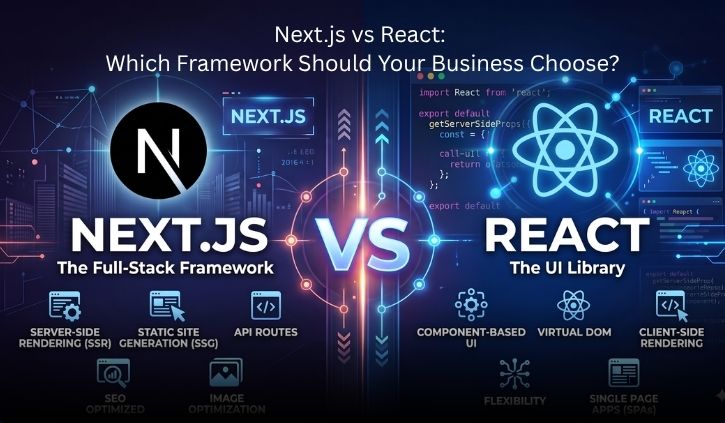
Next.js vs React: Which Framework Should Your Business Choose?

Selecting the appropriate web development framework is one of the major factors that directly affects the performance, SEO, scalability, development speed, and long-term maintenance of modern web applications.

The question of Next.js vs React is common among companies planning to create a new digital product because these two closely related technologies serve different purposes and meet different business needs. Ultimately, the decision is less about which technology is better and more about what your business needs from its web application.

Understanding React and Next.js

Due to its component reuse and component architecture, React developers bring to React.js development services that are widely adopted in front-end development, and it’s a sensible choice for React.js development.


React is a flexible library, perfect for developing SPAs, dashboards, and web portals. It is widely used to build modern web applications through reusable React components. Next.js is a React-based JavaScript framework that adds extra functionality and structure for developing complete web applications.


The Next.js framework provides a structured environment for building modern applications. It supports server-side rendering (SSR), static site generation (SSG), and client-side rendering (CSR), along with routing, API handling, and flexible web application architecture. These Next.js features help developers create scalable and fast-loading websites based on specific business requirements.


Therefore, it can be a strong choice for businesses developing scalable web applications that require an excellent user experience and reliable technical infrastructure.

Next.js vs React: Key Differences for Businesses

The primary difference between React and Next.js lies in the features each respective technology uses and also its structure. By default, however, React uses much fewer constraints, which would then offer more control and freedom to your application based upon your project’s requirements to choose your preferred tools and structure that makes the most sense for your project.


On the other hand, Next.js offers a complete environment by itself, with many critical features embedded.


The difference in capabilities also has ramifications for businesses when considering the speed at which projects can be developed and then maintained. React can be a strong choice for highly dynamic applications that may not have significant indexing demands. Next.js works best for those sites and applications for which natural traffic, load times, and scale are a high priority.

With regard to web application performance, both technologies can achieve high performance when implemented correctly. However, a Next.js vs React performance comparison should consider factors such as rendering methods, page-loading requirements, SEO needs, and application complexity. Next.js provides additional options for delivering content efficiently and building fast-loading websites.

SEO and Performance Considerations

One of the key benefits of Next.js over React for SEO is its ability to support server-rendered and statically generated content through server-side rendering (SSR) and static site generation (SSG). client-side rendering: As you know, sometimes there’s a potential to rely a lot on JS rendering in the browser before displaying useful information. Next.js gives developers greater control over the delivery of content.


In doing so, this can help in the SEO development of your website, speed up loads, and make your content indexable. The technology itself is, however, not the only thing that search engines consider when ranking a website, but rather the aspects of technical SEO, content relevance, Core Web Vitals, responsive design, internal links, and the user experience.

React applications can also be optimized for SEO, although some projects may require additional configuration or supporting technologies. For businesses where search ranking plays a significant part in the acquisition of potential customers, Next.js can therefore provide a more streamlined approach for businesses with strong SEO requirements.

When Should a Business Choose React?

React is an excellent option for highly interactive applications rather than primarily static, content-driven websites. Businesses asking, “Should I choose Next.js or React for web development?”, should consider their application’s interactivity, SEO requirements, and long-term development needs. It is well suited for dashboards and customer portals, any type of internally used business portal, and apps where users spend more time interacting with authenticated features than discovering pages through organic search. Since it is popular and has a broad ecosystem of resources, it can be a practical choice for businesses continuing their React development plans or maintaining an existing React application.

When Should You Choose Next.js?

Next.js can be a strong option for businesses creating marketing websites, SaaS platforms, e-commerce sites, corporate websites, publishing platforms, and other large, search-friendly, speed-optimized sites. For businesses looking for the best JavaScript framework for modern web applications, Next.js can be a strong choice when SEO, performance, scalability, and structured development are priorities.

It may also be better suited for the development of projects that require full-stack web development through a full-stack React framework, since it provides capabilities for different application needs in one place. Scalable web app to make as much and more business progress. The platform that will help you to create a web app that may scale up long-term in your custom web development enterprise for ongoing progress.


Next.js can also be a strong choice for enterprise web development, where performance, scalability, extensibility, and long-term maintainability are important for business growth.

Making the Right Technology Decision

Regarding whether we shall be utilizing Next.js for the web or React depends on our selection of the stack, which will involve a bunch of Next. JS-enforced technologies will take care of our product’s complexity & target. Starting web development for the purpose of building simple interactive UIs will always be with React since it is very easy. But we can take ease in this with the use of advanced techniques of Next.js.
Traffic volume, search engine optimisation, product complexity, responsive web design, development expertise, and long-term scalability should all be considered before choosing the right technology.

An experienced Next.js development company or proficient React development team can evaluate the existing architecture, product requirements, and business goals before recommending the appropriate approach.
With the aid of web development solutions, we will cater to your needs based on our approach, whether our product should be built utilizing just React or the entire Next.js stack. In addition to this, an entire setup for an application which has a backend too can be taken care of via our Node.js web application development service, as we will provide a complete architecture.

FAQ

What is the difference between Next.js and React?

React is a JavaScript library for building user interfaces, while Next.js is a React-based web development framework that provides features like routing, SSR, SSG, and API routes.

Is Next.js better than React for SEO?

Yes, Next.js can be better suited for SEO-focused websites because SSR and SSG can make content more accessible to search engines. These are important benefits of Next.js over React for SEO.

Which framework is better for business websites: Next.js or React?

Next.js is generally a better choice for business websites that prioritize SEO, performance, scalability, and organic traffic, while React is suitable for highly interactive applications. The final choice depends on the needs of the business and its modern web applications.

When should I choose Next.js over React?

Choose Next.js when you need server-side rendering, static site generation, built-in routing, SEO-friendly web development, and a scalable web application architecture. A Next.js vs React performance comparison can also help businesses evaluate which approach best fits their project.

Can React applications be migrated to Next.js?

Yes, React applications can be migrated to Next.js, although the migration effort depends on the application’s architecture, routing, dependencies, and rendering requirements. Businesses may consider migration when they need additional Next.js features for SEO, performance, or scalability.

Categories
Blog

Top AI Development Trends Every Business Should Watch in 2026

AI is not only for experimentation by big businesses. Businesses are transitioning from trying new AI tools to constructing and integrating AI systems to automate business processes, enhance customer experience, enhance the decision-making process, and produce new digital products in 2026. Understanding emerging AI trends can help businesses identify practical opportunities for growth and digital transformation As AI agents, generative AI, intelligent automation, and cloud-enabled AI systems are now more popular than ever to make businesses move forward and become more modern, but in the end, we should not just be excited about every type of AI and new development in it but select the correct solution for specific business problems. Here are the key AI development trends and AI technology trends businesses should watch in 2026. 

1. AI Agents Are Moving From Assistants to Action

One of the biggest shifts currently occurring in AI software development centres around AI agents. Today, chatbots are about asking a question and receiving an answer, while AI agents have the ability to comprehend intent, arrange workflows and tasks, mediate with tools, and thereby initiate and process large-scale, multi-step business process automation, automate complete workflows, and work with little or no human intervention. Business analyst firm Forrester ranks agentic workflows as a significant 2026 business trend.

But nowadays, these AI agents have also started taking businesses forward by improving productivity in the business, customer experience, company security, and internal business workflows, as their functionality has now become even more advanced. Some of the business uses include:

  • For Lead Qualification
  • Customer Service Assistance
  • Appointment Booking, Research, etc.

Internal Knowledge

The right AI solution depends on whether a business wants to improve lead management, customer service, or internal operations In most cases, AI assistants provide automation, which is a brilliant method of using business capital investments in artificial intelligence technology.

This makes AI automation particularly useful for businesses looking to reduce repetitive work while improving operational efficiency.

2. Generative AI Is Becoming More Business-Specific

Generative AI is shifting from being a tool to generate all-purpose content to becoming more of a specialised functionality to build custom solutions around businesses’ data, processes, and customers. Businesses can combine Large Language Models (LLMs) with their own data and workflows to develop more relevant AI-powered applications, knowledge assistants, and content systems. Think about the build of generative AI-powered knowledge assistance bots or document management software, or even content generation, recommendation machines, or smart enterprise software. So, instead of all the companies using the same GenAI solution out there, they will consider their custom AI development. His shift is also increasing demand for Custom AI development, allowing businesses to build solutions around their specific data, workflows, and customer requirements. It’s about businesses adopting and implementing, not just experimenting with GenAI.

3. AI-Powered Software Development Will Become More Intelligent

AI-powered software development is altering the field of software engineering, making code optimization, documentation, debugging, software testing, and maintenance more efficient. Code optimization, documentation generation, debugging help, comprehensive software testing, and maintenance assistance can all be provided by smart AI-driven development tools. AI software development tools do not negate, though, the requirement for experienced software developers. Instead of that, they enable developers to automate common duties, such as writing or fixing code, and to be a little more dedicated in application design, security, enterprise logic, and also artificial intelligence use cases – this reflects the future of AI software development in 2026, where AI supports developers while human expertise remains essential.

AI tools are also supporting AI application development, helping businesses create intelligent applications for specific operational and customer needs. 

Human expertise will certainly continue to play a critical function. 

4 Intelligent Automation Will Connect Entire Business Workflows

Traditional automation is largely confined to pre-programmed or repetitive tasks; the future integrates automation with ML, reasoning, and automated decision-making capabilities guided by AI.

This is where smart automation and intelligent business process automation come in. This provides AI the ability to ingest data, recognize patterns, make decisions, and initiate actions using different integrated applications. This allows for predictive analytics and machine learning development capabilities to extract useful insights from business data. 

As mentioned by McKinsey, most enterprises have experimented with agentic AI, but successful scaling of such AI will be dependent on data infrastructure, contemporary architecture, and reliable and high-quality workflows.

So, the key is that successful AI development services must focus not just on the AI model itself but also on the way it integrates with data, security, and scalability.

5. Multimodal AI Will Create More Natural Applications

It is possible to design AI systems that process text as well as visual information such as images, videos, or audio files, expanding new areas of AI applications. These systems can combine large language models (LLMs), natural language processing (NLP), and computer vision to create more capable AI-powered applications. They can also support conversational AI and computer vision solutions, creating more natural interactions and useful experiences across different business applications.

One such application could take a customer’s written text and images supplied by a customer and intelligently respond. Retail businesses, hospitals, colleges, factory systems, and customer support centres could find applications for these multimodal solutions. This helps digital experiences feel more natural and can improve the AI-powered customer experience by making customer interactions more responsive and personalized.

6. AI Integration Will Become More Important Than AI Adoption

There is more to implementing AI on a website than just having an AI chatbot. Your business needs AI to work with the rest of your CRM, ERP, databases, web page, mobile application, and any of your internal systems. These reasons have led to AI integration services becoming a larger component in digital transformation.

If the AI can read the necessary information and take actions, then it’s valuable instead of just being an isolated tool on its own. For example, AI integration services can connect an AI application with CRM systems, customer databases, analytics platforms, or internal business software, allowing information to move between systems more efficiently. Sometimes, AI also comes into play with your web development services and UI/UX design services.

It can also work alongside Custom Software Development to create business-specific applications and digital solutions while supporting AI-driven business transformation across different business processes.

7. Responsible, Secure, and Scalable AI Will Matter More

“As AI systems are embedded into our organizations, privacy, security, accuracy, governance, and the level of human intervention will be placed under much more attention. Companies need to ask questions about how these systems use their sensitive customer and business information, how they will monitor that output for accuracy, and how and if human review is needed at any point prior to decision-making.”

As such, the best artificial intelligence solutions will involve more than simply cutting-edge models. They will need robust access controls, secure and reliable data flows, an appropriate monitoring system, the ability to test, and critical human review processes.

Scalability is also an important factor when planning long-term AI usage, and businesses should focus on scalable AI applications that can support growing users, data volumes, and operational requirements. 

Businesses can also adopt enterprise AI solutions to support large-scale operations, secure data management, integration, and long-term growth. 

The simple truth is that an app might perform swimmingly for 100 users, but that doesn’t mean that same app is ready for 100K users. Companies that are considering deploying cloud AI are probably exploring those AI services that are ready for users. The challenge is to select a service capable of scaling with usage volumes. As user requirements or data volumes grow, businesses need cloud AI solutions that can handle increasing workloads efficiently while maintaining performance and reliability. 

Why Should Businesses Invest in AI Development in 2026?

Understanding how AI development is transforming modern businesses can help organizations identify practical opportunities to automate processes, improve customer experiences, and create new digital products. By understanding how the latest AI developments are reshaping today’s organizations, businesses will come to pinpoint realistic possibilities for automation and digital innovation to the extent of revolutionising processes and products – while enhancing customers’ experiences and workflow of every facet.

The Bottom Line Organizations will need to look into how the latest AI development will support organizational’s growth while using AI as much as possible if it holds real value either to facilitate mundane process automation, upgrade the user experiences, or simplify the workflow as part of an organization’s objective. It can ensure faster decisions and discover untapped revenue streams as much as possible.

whether this be automating routine tasks, improving customer experiences, streamlining operations, enabling quicker decisions, or, indeed, a brand new revenue stream, for example. AI, development-wise, is becoming more pragmatic and seamlessly embedded within our business requirements, not technology-driven. 

A business has a problem it is trying to solve and a series of goals for how a solution will make the business better. Organizations should evaluate the best AI technologies businesses should adopt in 2026 based on their specific goals, data, workflows, security requirements, and scalability needs. 

Frequently Asked Questions

What are the top AI development trends in 2026?

Key trends include AI agents, Generative AI development, intelligent automation, multimodal AI, AI-powered applications, AI integration, and scalable enterprise AI solutions.

How is AI transforming software development?

AI is helping development teams with coding, testing, debugging, documentation, and automation while enabling developers to build more intelligent applications.

Which industries benefit the most from AI development?

Healthcare, finance, retail, manufacturing, logistics, education, real estate, and customer service can all benefit from AI depending on their business processes and data.

Why should businesses invest in AI development?

Businesses can use AI to automate repetitive processes, improve customer experiences, analyze data, increase productivity, and develop new digital products and services.

How do I choose the right AI development company?

Look for a company that understands your business objectives, has relevant AI and software development expertise, follows secure development practices, and can support integration, deployment, and long-term scalability.

Categories
Blog

How Much Does Custom Web Development Cost in 2026?

In case you’re looking forward to creating a business website in 2026 and then if anyone asks you – how much does a custom web development price tag may come out to? But web development price varies depending on various attributes like design, functionality, usage of technology, third-party integrators, platform, security, and scalability as well as, of course, your complexity of website. For example, the quantity of the website pages needed, the amount of functionality needed along with the technology used & method the website is constructed along with tools used in third parties & the size of the website can help to estimate actual expense.

Though a simple website may not cost that much more than it, to construct some software or maybe some platforms, we require a bit, a whole lot more money than we previously considered.

In GoDaddy India’s publication on website development costs, factors just like design, functionality of the websites, performance of websites, web page hosting costs, web building expenses, content management systems costs, SEO costs and ongoing website maintenance charges need to be considered too.

What Is the Average Custom Web Development Cost in 2026?

These figures act as indications, though, as the price of the custom website you will ultimately receive can vary based on the complexity, required features and technology, the integrations and also the time that would be needed to build everything, although for custom applications this could range dramatically, as building your website is often based around your business needs rather than a templated design or drag-and-drop approach. So, for example, custom business website prices could potentially range between 50,000 and 200,000 or over, depending on the style and features you desire, while complex and interactive applications and e-commerce websites would undoubtedly cost even more to develop, where there are custom admin dashboards, payment processing integrations and external APIs, large databases, automations, heightened security or increased scaling needed for your business to operate.

Key Factors That Affect Custom Web Development Cost

1. Website Design and UI/UX

Your web designer/developer uses a typical UI/UX web design process consisting of user research, wireframing, prototyping, and designing for responsive capabilities, followed by testing and then building out the website. Elements of Development Design – Navigation, Accessibility, Page Structure, Design Responsiveness or lead design toward conversions can create more development work time and associated costs. Template-based website development can definitely become more economical than the other custom web development model but is generally less customised overall from the ground up than may be required of custom and might require further user analysis, initial front-end web page design/concept, initial web development building, user testing & testing for optimisation.

2. Front-End and Back-End Development

The technologies in play are important, as this alone determines the cost of the website. Front-end development deals with the aspect of the website’s visible user interface and the aspects the web users engage with in front-end web designing. Back-end developers deal with the hidden side of the website involving aspects of database management, authenticate servers, APIs, business procedures, etc. Building out a full-stack website would necessarily require more time to build out than a mere five-page informational webpage site.

3. Website Features and Integrations

Such features as payment systems, customer dashboards, booking, APIs, CMS, search engines, user accounts, analytics, and automation are examples of features that can make development expensive.

For instance, e-commerce website development involves such features as product management, shopping cart, payment system, order management, security, and inventory.

At the same time, CMS website development can help businesses to manage content easily and save money on developers’ hours for updating the site.

4. Business Size and Scalability

It depends. Some small businesses only require a single landing page, a contact form, basic service pages and a handful of features, while enterprise web development projects require multiple roles, databases, APIs, integrations, advanced security, reporting, and scalable web applications.

5. AI Integration and Modern Web Development Requirements

Many organizations are examining the possibilities of leveraging AI features in professional web development & modern digital platforms in 2026. When you think of the possible AI features that are being built today into professional website design – the use of an AI-powered chatbot, smart search (NLP-based), recommendation engine (machine learning), an AI tool to assist customers with an automated chatbot, personalisation features, or even incorporating a different service via an AI API – the development needs rise and, therefore, so does the total cost.

Many of these require a new backend, APIs, more complicated data transformations, security implementation, unit and functional testing, and monitoring. Based on functionality, security, business needs and growth of the website, you will get modern and suitable web application development. So the requirements, as the web application will mature, include responsive web development, better security, better website optimization, and also accessibility.

What Does a Custom Website Development Company Include?

A professional custom website development company may provide custom web development services, including research, planning, custom website design, development, testing, deployment, security, and support.

When searching for the best web development company, the offered quotation is not the only crucial criterion, as a business needs to consider the provider’s expertise, portfolio, development methodologies, security measures, communication policy, and maintenance services. Therefore, a company should ask a candidate about its understanding of the project’s scope, timelines, technology, testing techniques, and ongoing support to get the most relevant offer.

A website built with a strong foundation of SEO, code optimization, mobile-first design and responsiveness, better content organization and structure, enhanced accessibility and optimization for website performance is undoubtedly the surest way of providing what modern end-users are expecting and what search engines would look for.

Additional Costs to Consider

It is essential to understand that your initial quote for creating your website could have left out a lot of additional fees and expenses, including domain name registration and renewal, hosting, SSL certificates, subscriptions for third-party services, plugins, premium themes, content production, search engine optimization, and security. Website maintenance services usually provide technical support, troubleshooting, CMS updates, security upgrades, backups, performance optimization, software updates, and other related services. It is wise to plan budget allocations for these ongoing expenditures to make web development services affordable.

Another factor that has to be considered is the effect on your organic performance that may take effect in the long run because of technical website implementation The technical analysis of your website should look for technical SEO factors, including whether or not you can be crawled or indexed, presence of redirects, missing links or errors, core web vital scores, and usability on mobile devices as well as structured data. Indexing and canonicalisation problems and errors, broken links, poor redirects, site errors and no mobility are another common issue if you are asking, “Why is my website traffic declining even if it’s on Google?”

By learning how to regain lost organic website traffic, how to troubleshoot a drop in traffic, and how to improve the website rankings and traffic, your business will see an increase in long-tail search engine traffic.

Is Custom Web Development Worth the Investment?

For businesses that demand flexibility, unique functionalities, scalability and full control, custom development is often a strategic investment.

Unlike a standard template, custom website development allows functionality, workflows, integrations, and user experiences to be designed around the actual requirements of a business.

Whatever your business needs are, whether you need business website development, an e-commerce system, or an extensive web platform, investing in the right solution rather than the cheapest one is almost always the best way to turn your idea into reality.

When a business also requires APIs, web applications, automation, mobile applications, or other connected systems, Custom Software Development services can provide a more comprehensive digital solution tailored to its specific operational requirements.

FAQs

How much does custom web development cost in 2026?

Custom web development can range from around ₹50,000 for smaller custom projects to several lakhs for advanced platforms. Features, design, integrations, technology, and scalability determine the final price.

What factors affect custom web development costs?

Design complexity, front-end and back-end development, number of pages, integrations, database requirements, security, CMS, e-commerce features, and ongoing maintenance can all affect cost.

Is custom web development worth the investment for businesses?

Yes, when a business needs unique functionality, scalability, better control, and a website tailored to specific business processes.

How long does it take to develop a custom website?

A basic custom website may take a few weeks, while complex e-commerce platforms or web applications can take several months depending on functionality and project scope.

How do I choose the right custom web development company?

Evaluate its portfolio, technical expertise, development process, communication, client reviews, security practices, pricing transparency, and post-launch website maintenance services before making a decision.

Categories
Blog

Why Hiring an AI Software Development Company Is a Smart Business Move

Artificial intelligence (AI) is among the world’s most impactful technologies that business organisations use to enhance productivity, automate processes, and make intelligent decisions. At present, businesses are utilising AI not just for experiments but for addressing the actual issues in business process operations and customer service needs and in deriving new growth opportunities. 

Working with a skilled AI software development company ensures that custom solutions that sync with your unique business objectives can be tailor-made for you. AI engineers not only enable companies to automate operations and execute predictive analysis but also integrate AI applications and intelligent solutions. 

With growing industry-wise competition, organisations are turning to an AI Software Development Company, which aims to offer scalable, reliable and sustainable products 

Why Businesses Need AI Software Development

Companies produce large amounts of data on a daily basis; manually analysing and managing this data is very difficult and time-consuming. With the technology of artificial intelligence, it is now possible for companies to transform their data into knowledge and gain better decision-making. 

The demand for AI development is increasing because businesses need smarter ways to:

  • Automate repetitive tasks through intelligent automation
  • Improve customer support using AI chatbot development
  • Analyze trends with predictive analytics
  • Reduce operational costs through business process automation
  • Create personalized customer experiences

With advanced artificial intelligence solutions, companies can improve efficiency while focusing more on innovation and strategic growth.

Benefits of Hiring an AI Software Development Company

1. Customized Solutions Through Custom AI Development

The needs of all organisations are not the same, and custom off-the-shelf software solutions will not meet every business need. A professional AI development company can design and develop solutions tailored to business needs, industry standards and requirements, and operational pain points.

Using custom AI development, businesses can create AI-powered application platforms, recommendation systems, and automation tools. 

Businesses can also integrate AI within its existing applications by building an environment where all business processes and applications can communicate.

2. Advanced Enterprise AI Solutions

Enterprise organisations need sophisticated technologies capable of handling difficult processes as well as large data sets. Enterprise AI solutions enable the organisation to enhance the scalability, security and operation performance of the enterprise.

AI technologies ranging from machine learning development, generative AI, computer vision, and natural language processing enable enterprises to build intelligent systems that support better decision-making. AI benefits enterprises by increasing performance and productivity and through intelligent data analysis to reduce manual labour from reports to smart analytics.

3. Better Customer Experience With AI Applications

Because the requirements of customers are constantly growing and companies demand faster, more individualised services. With AI application development, companies can provide a more satisfying customer experience through smart, digital tools. 

Examples include:

  • AI chatbots for 24/7 customer assistance
  • AI-powered applications for personalized recommendations
  • Natural Language Processing for better communication
  • Predictive analytics for understanding customer behavior

These technologies help businesses create stronger customer relationships and improve overall engagement.

How to Choose an AI Software Development Company

Choosing the right technology partner is important for successful AI implementation. Businesses should evaluate an AI partner based on:

  • Experience in developing AI solutions
  • Knowledge of machine learning and automation technologies
  • Industry-specific expertise
  • Ability to create scalable applications
  • Understanding of business goals

When selecting the best AI software development company for their business, firms should look for the technical know-how of the company. They must consider how much experience has the firm obtained. And finally, whether they are capable of developing feasible services or not. 

A capable partner can identify how to make such a choice based on the specific project requirements, estimated budget and the future goals for the business 

Cost of AI Software Development in 2026

The cost of developing AI software in 2026 will vary depending on the project complexity, range of features needed, choice of technology, data needs, time 

to development. 

Developing basic AI tools such as chatbot applications or automation software generally costs less than developing advanced solutions such as Gen AI applications, computer vision applications, or enterprise AI applications, which may take more investment than simpler AI software solutions.

Businesses can control the costs by choosing the appropriate AI approach and by selecting skilful developers who offer flexible solutions to manage the cost of development. 

AI Software Development Services for Startups and Growing Businesses

Companies are making increasing use of artificial intelligence as a way to compete with the established giants. AI software development services for startups can assist small new companies in streamlining processes, better informing choices, and also creating fascinating new items at a very low investment with a small internal department.

These can help the beginning-phase businesses through Automation, analysis of customers, intelligent applications, efficient workflow automation, etc. Any business wishing to take advantage of all-inclusive technology-based products will require the services of professional custom software development service providers. 

Conclusion

It makes sense to hire AI Software Development company Companies are implementing artificial intelligence development services in their projects to maximise profit and bring a substantial change with artificial intelligence. Incorporating services in your IT projects: Generative AI, AI development, intelligent automation, and AI integration software – these solutions have the potential to develop smarter business models. By the time people become comfortable adopting and utilising AI as much as they do the rest of our technology stack in the near future, custom-built AI solutions will become key to growing any enterprise, making it flexible and adaptable to its customers’ needs.