AI is helping companies to increase efficiencies by automating complex work and boosting production, but in the mix of your application program resources, AI Agent Integration is the place where the serious electricity of AI in software platforms is. Connecting your corporation method to AI permits your company to combine its company info and facts and automate workflows and procedures without needing human intervention.
This allows a business to accelerate the revenue course of action of its models, accounts, its personnel’s conversation, and inventory tracking by means of including up and shopper support workflows.
What Is AI Agent Integration with CRM and ERP?
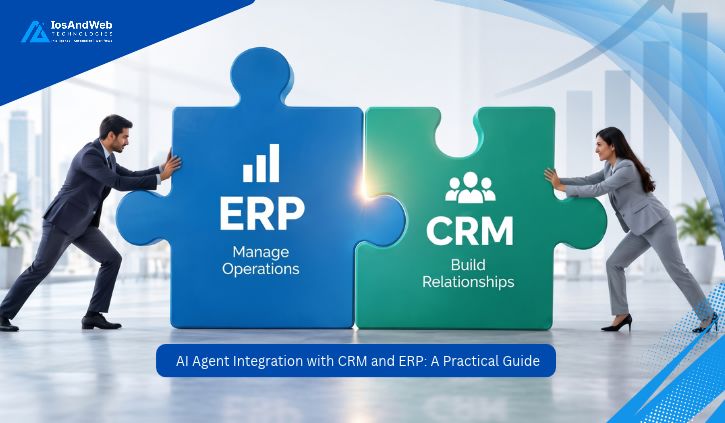
AI Agents are intelligent and smart software agents that enable automation across apps. That’s automation of your business apps or systems by pairing them smart AI agents that can fetch data from or across other apps, comprehend and interpret requests and then perform automated actions. CRM or customer relationship management is for sales pipeline management, marketing automation and customer relationship management. ERP or enterprise resource planning is for accountings, finance, inventory, purchases and other business resources.
This allows the app to be more integrated for instance An Enterprise AI agent can have been used to find a new customer enquiry in a CRM, ensure the product is available in an ERP and will be reporting to the sales teams the information they need. This approach supports end-to-end business processes and reduces the need for employees to switch between apps.
Key Benefits of Integrating AI Agents with Business Systems
Implementing AI integration solutions can improve several areas of business performance.
1. Automated Customer Relationship Management
CRM Integration with AI agents Businesses can report on customer interactions, prioritise leads, track sales progress and generate personalised responses. AI agents will identify the customer and help propose next steps to allow your sales teams to nurture their pipelines.
2. Improved ERP Operations
AI agents can support inventory management, invoice processing, purchase order tracking, and financial reporting. By accessing ERP data, they can identify operational patterns and help employees make faster decisions.
3. Better Productivity Through AI Workflow Automation
AI workflow automation reduces repetitive administrative tasks by allowing intelligent agents to execute predefined business processes. This gives employees more time to focus on customer relationships, business planning, and strategic activities.
4. Connected Business Applications
AI system integration allows different software platforms to exchange information efficiently. With third-party tool integration, businesses can connect communication platforms, databases, payment applications, and other essential tools.
How to Integrate AI Agents into Enterprise Workflows
Understanding how to integrate AI agents into enterprise workflows requires proper planning, suitable technologies, and a clear implementation strategy.
Step 1: Identify Business Requirements
Start by identifying processes that consume time or require frequent manual intervention. Common examples include lead qualification, customer support, order processing, inventory monitoring, and report generation.
Step 2: Evaluate Existing CRM and ERP Platforms
Review your existing software infrastructure, available APIs, data sources, and security requirements. This helps determine the right approach for custom AI agent integration with existing business systems.
Step 3: Select the Right AI Technologies
LLM integration enables AI agents to understand natural language, process business information, and generate relevant responses.API integration for AI agents provides the ability for an AI agent to use the APIs of your CRM, ERP, and other enterprise applications.Agentic AI integration enables intelligent agents to plan tasks, make decisions, and perform actions according to specific business objectives
Step 4: Develop and Connect Custom AI Agents
Businesses may also team up with a professional AI agent integration firm to create solutions as per their operational needs. Custom AI agent integration deals with the integration of intelligent agents into legacy software, data, and external applications.In complex processes, many specialised agents working collaboratively to accomplish the task in parallel, in multi-agent orchestration.
Step 5: Test, Deploy, and Monitor
Before deployment, test the complete integration for accuracy, data security, performance, and reliability. Continuous monitoring ensures that AI agents perform correctly as business requirements evolve.
Why Businesses Need Professional AI Agent Integration Services
Business application automation with AI can streamline all business processes with expert AI agent integration services connecting all applications without sacrificing process accuracy and process security.Reliable AI agent integration services for businesses provide secure, scalable solutions tailored to organisational requirements.
The AI integration company should also provide adaptable AI automation solutions, support with the system rollout and testing, and ongoing optimisation.Selecting the right AI agent integration company helps enterprises leverage enterprise software integration instead of replacing their current CRM or ERP system.
Future of AI Agent Integration in Business Operations
Intelligent automation connecting a range of business apps will be the future of enterprise automation. AI integration platforms will help organizations to connect their divisions, capture live data, and automate workflows in a way that was not previously possible. Use AI Agents with your enterprise applications Organisations seeking to Build AI App for Business 2026 can leverage AI agents to make apps more intelligent, run flexible and scale their business.
Conclusion
AI agent integration with CRM and ERP platforms helps businesses automate operations, connect applications, and optimise workflows through LLMs, APIs, and multi-agent orchestration.You can With the right level of integration skills, you will have tomorrow’s integrated, adaptive, intelligent, connected, sustainable architectures.