IAW

iaw-white-logo iosandweb technologies
Categories
Blog

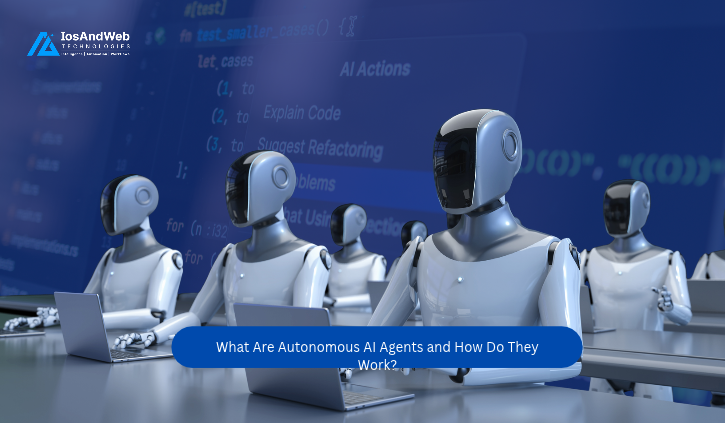
What Are Autonomous AI Agents and How Do They Work?

Artificial intelligence can transform your business operations, customer interactions, and decision making. A new technology type of artificial intelligence is helping to achieve this, namely Autonomous AI Agents that can be used to automate complex processes, learn and reason with data, and conduct information, and complete tasks and business processes within a real-time or near real-time environment using minimal human input. 

Automation tools run by rules, AI agents are smarter than that. As businesses and organizations strive to find smarter ways of gaining business value and digital transformation, there is an increasing need for autonomous AI to remove the boring work.

AI is is now supporting business operations and enterprise systems, including customer interactions and enterprise processes.

What Are Autonomous AI Agents?

Autonomous AI Agents are self-aware intelligent agents that can acquire data, process data, act, and reach any goal without human input using artificial intelligence (AI), machine learning (ML), and LLMs to interact with the user, business applications, databases, and third-party applications and devices.

If a system is making a decision based on the circumstances and then performing an action. What any other kinds of AI would do if it was autonomous for instance, autonomous AI can run an AI for sales ops to help you identify leads, sort and qualify their customer records, update CRM records, and ready them for next steps. Autonomous AI’s ability to perform a variety of tasks increases its power.

How Do Autonomous AI Agents Work?

There are multiple interaction stages in which autonomous AI agents do their work to perform a task with minimum human intervention. 

1. Goal Understanding and Task Planning

The agent initially comprehends the user’s instructions or corporate goals. The agent recognizes the desired result, decomposes complex requirements into smaller tasks, and generates a plan of action.

2. Data Collection and Analysis

Agents collect information from databases, APIs, websites, and connected business applications. They analyze relevant information to understand the situation and determine the next appropriate action.

3. AI Decision-Making

The agent analysis the alternatives then selects the course of action by grounding and contextual understanding. Intelligent Agentic AI products can modify its plans and approach as changes occur or as info is provided. Intelligent automation and autonomous decision-making can help companies navigate complex processes with advanced Agentic AI solutions.

4. Autonomous Task Execution

The system executes the specified tasks with AI tool integration, APIs and incorporated software tools. These can be tasks such as editing customer profiles, writing reports, processing requests or streamlining business workflows.AI workflow automation enables organizations to connect different business processes and complete repetitive activities with greater efficiency.Autonomous task execution allows AI agents to complete assigned activities independently while monitoring results and adjusting actions when required.

5. Monitoring and Feedback

The agent sees the effects of its task once it is finished and it evaluates whether there are any other tasks to be made. Feedback and performance monitoring ensures better reliability in the future.

Key Technologies Behind Autonomous AI Systems

Modern autonomous AI systems use multiple technologies to perform tasks intelligently and efficiently.

  • Large Language Model (LLM) Agents – Comprehend the language, interpret instructions, and enable reasoning.
  • Machine Learning: Assists agents in recognizing trends, understanding data, and performing better.
  • AI Orchestration: Leads various agents, tools, and processes as they work together to achieve complex goals.
  • Multi-Agent Systems: Have a number of specialized agents working together across various points of a workflow.
  • AI Tool Integration: Integrates intelligent agents to API, CRM applications, databases, and enterprise software.

Together, these technologies support intelligent process automation and enable organizations to manage operations more effectively.

Autonomous AI Agents vs Traditional AI Chatbots

The use of conversational AI for automationHow do chatbots work Traditional AI chatbots will simply answer a question asked by the user and, on the basis of a predefined rule or trained language model, offer a response. Autonomous AI agents can understand complex tasks by executing multi-step reasoning and communicating with external apps.

An example of a traditional bot is providing an order status; autonomous agents can track down the order, update the delivery info, notify the relevant department and notify the customer of the delivery status.This creates a bigger divergence making autonomous agents for the more sophisticated business processes that need decision-making and autonomous execution of activities.

How Autonomous AI Agents Improve Business Productivity

Autonomous AI agents are being leveraged by organizations for business process automation in order to lower manual tasks and enable efficiencies. Their use cases are spread across various industries and business units.Autonomous AI agents for business process automation help organizations simplify repetitive operations, reduce manual workloads, and improve overall productivity.

Key business benefits include:

  • Increased Operational Efficiency: Automate repetitive tasks and reduce unnecessary manual processes.
  • Faster Task Completion: Execute workflows and respond to business requirements more quickly.
  • Improved Decision-Making: Analyze business information and support data-driven decisions.
  • Better Scalability: Manage increasing workloads without proportionally increasing operational resources.
  • Reduced Operational Costs: Improve resource utilization and minimize time spent on routine activities.

Understanding how autonomous AI agents improve business productivity helps organizations identify automation opportunities and optimize their daily operations. 

Business AI agents can be employed in sales, human resources, finance, marketing, data processing, and customer service. For instance, companies use AI for activities like generating invoices, setting appointments, preparing reports, and qualifying leads.

Why Businesses Need Autonomous AI Agent Development Services

When it comes to intelligent automation, selecting the right AI model is important. But what’s far more critical is the model you choose. Ensuring your data is protected, where you’ll use and integrate it, your operations, and your technical foundation-all of these factors matter.

Enterprise Autonomous AI agents development customized autonomous AI agent development enables companies to create solutions that address their distinct business needs. Custom autonomous AI agent development services for enterprise businesses can encompass AI model selection, workflow design, API integration, multi-agent collaboration, testing, and deployment.

Reliable AI agent development services, we can also assist you in creating the correct monitoring systems and human approval for sensitive operations. You can then rest assured that automation is both effective and secure.

If you wish to enable intelligent agents to work with your existing business apps, IosAndWeb Technologies can help you with our AI Agent Integration Services. Choose the most suitable integration method and develop scalable Agentic AI systems aligned with your digital transformation goals.

Conclusion

Autonomous AI Agents are the evolution of AI, which includes the capability for reasoning, planning, decision-making and task execution. Whereas other automation options can perform tasks, autonomous agents can change a task mid-flight and combine multiple tasks to generate value for the business. As the technology advances, we see autonomous AI can be leveraged to automate and optimize processes, improve performance and build better systems.

If used correctly, with the correct approach for the development of the technology, this can help organisations guarantee intelligent automation. All in a highly secure way, with accurate controls and human oversight.

Categories
Blog

Agentic AI vs Generative AI: Which OneDoes Your Business Actually Need?

AI is revolutionizing content creation, automation, and efficiency in organizations. Agentic AI and Generative AI are the two next major AI tools that leverage the potential of AI. 

Know the differences between agentic AI vs generative AI. So that organizations can realize maximum value from AI.

AI is employed to automate the business processes but in different manners.Knowing the distinction between agentic vs generative ai is more difficult, but you need to know which one’s better for your business depending on your goals, costs, and daily activities.

Click here to read our full comparison on which AI you should choose.Read our full compare and contrast guide you to how to should weigh and prioritize.

You will be able to pick the right product for your organization once you understand the Agentic AI vs. Generative AI.

Understanding how agentic AI and generative AI work allows companies to select the right system based on their goals, capabilities and desired automation level.

What Is Generative AI?

Generative AI is an artificial intelligence system capable of creating new content based on user input. It can generate virtually anything digital – from text and images to summaries and code.

AI assistant can understand your question, using LLMs, and generate a response. How to use an AI assistant? An AI writing app can be used for creating content, doing research, running marketing campaigns, or supporting your customers.

Generative AI Capabilities

Some common generative AI capabilities include:

  • Creating blogs, emails, and social media posts.
  • Writing website content and product descriptions.
  • Summarizing documents and reports.
  • Generating code and assisting developers.
  • Helping businesses answer customer questions.

Generative AI can be leveraged across the enterprise to produce written content, conduct research, generate reports and communicate with customers, among many other initiatives.

For example, Generative AI for Marketing can be utilized by the marketing team to create social media updates, blog articles, and emails. Though, it is vital for humans to audit the generated data to avoid misinformation, brand inconsistency, and errors.

Generative AI is used in applications that create writing, research, and digital content. Its ability to generate content allows organizations to more efficiently produce marketing content, website content, and customer support responses.

Numerous other applications also draw upon large language models (LLMs) which analyze prompts and the context provided to gain insights into, and provide interpretive, topical, and useful information.

What Is Agentic AI?

Agentic AI is an AI system that is capable of planning tasks, making decisions, using tools, and completing multiple tasks to reach a goal.

They are capable of completing tasks with minimal human oversight, depending on their design.

AI agents can gather information, process data, interface with your business application, and then choose what to do next – all while adhering to the rules established.

Agentic AI systems use AI reasoning to understand tasks and plan actions. Autonomous AI agents can interact with connected tools and applications to complete tasks. 

These systems support intelligent automation and help businesses manage autonomous workflows more efficiently. 

Agentic AI Capabilities

Some important agentic AI capabilities include:

  • Automating routine business tasks.
  •  Planning and executing multi-step workflows.
  •  Using integrated tools and applications.
  •  Analyzing data to inform decision-making.
  •  Tracking work and checking results. 

AI reasoning and AI decision-making help Agentic AI systems select suitable actions based on available information, business rules, and defined goals. 

A further example could be a AI agent is scrolling through some customer information and creating an ordered list of sales leads and follow-up emails. If given certain accounts it can update records or send predefined emails.

Agentic AI vs Generative AI: Key Differences

The agentic AI vs generative AI difference lies in their primary functions: Generative AI creates content, while Agentic AI plans and executes tasks. Both technologies can work together to support business operations. 

While agentic ai is only concerned with whether the work is actually being done for the goal itself. 

Generative AI can be used to generate content, research & write, do customer support. AgenticAI can be used to automate actions, leverage tools, and orchestrate workflows.

Put simply, generative AI is the creator, while agentic AI is the worker. Both can save you time at your organization.

The agentic AI vs GenAI comparison shows that Generative AI creates information, while Agentic AI uses information to perform tasks. Both technologies can support AI automation when implemented according to business requirements.

Agentic AI vs Generative AI Use Cases

Both technologies have their business uses, but it depends on the task as to which one is the better option. 

Generative AI Use Cases

Generative AI is useful when businesses need to create or improve content. Common uses include:

  • Writing blogs and website content.
  • Creating marketing campaigns.
  • Preparing customer support responses.
  • Summarizing reports and documents.
  • Supporting research and software development.

For instance, a retailer might generate product descriptions or marketing emails using Generative AI.

Agentic AI Use Cases

Agentic AI is useful for tasks that require multiple steps and actions. Common applications include:

  • Sales automation: Organizing leads and preparing follow-up messages.
  • Customer support: Finding order details and directing customer requests.
  • Business operations: Automating repetitive tasks across applications.
  • IT support: Collecting information about technical issues.
  • Data analysis: Gathering information and preparing reports 

The agentic AI vs generative AI use cases above demonstrate the advantage of up-front flexibility that these two agentic AI vs generative AI use cases can give your business.

Agentic AI vs Generative AI: Which One Is Better for Your Business?

There is no one answer, as they both address very different issues.If you are wondering what is the difference between Agentic AI and Generative AI, the main distinction is content creation versus task execution. 

When deciding when to use Agentic AI vs Generative AI, consider whether your business needs better content production or automated workflows.

Select an AI tool Learn more about every product Subscribe to our newsletter For assistance with your writing, research, marketing, docs, speaking with customers Select Generative AI To assist you and your organization in automating mundane tasks, consolidating various workflows, connecting applications or getting the task done faster. Agentic AI

Some companies can take advantage of both by combining AI agents and Generative AI. For example, Generative AI could generate the customer email, and an AI agent could gather customer information and determine what the next action should be.

Business that wish to employ these features, should look into AI Integration Services for Business to implement the AI in your existing system and increase productivity.

Best Practices for Using AI in Business

Prior to jumping into AI, determine which tasks are the most difficult and how software might be able to help. Start with a pilot test, analyze the outcome, and see how much better- in terms of productivity, accuracy and savings -you got.

The organizations must safeguard their sensitive information, validate the outputs that AI has produced and limit the application of robotic responses.

Regarding Agentic AI, I propose that anything that runs the business, including customer data, billing data, and pretty much everything else, should be used as a high-risk object in the bucket of human oversight, controls, and approvals.

Determine whether you require content creation or automating tasks before making a final decision.Before choosing between Agentic AI or Generative AI, determine the amount of time, resources and workflow complexity each can handle.

Conclusion

Understanding the distinctions between agentic AI vs generative AI can help your business make an educated choice of which to deploy.

 Generative AI is what you use to generate text and content and to do research, and Agentic AI is what you use to complete tasks and work flows.All organizations have the option of starting with just one of these techniques, or can combine the two.

 By implementing these technologies with intelligence, human input and security, organizations can boost productivity and extend the long term life of their business.