
IAW

iaw-white-logo iosandweb technologies
Categories
Blog

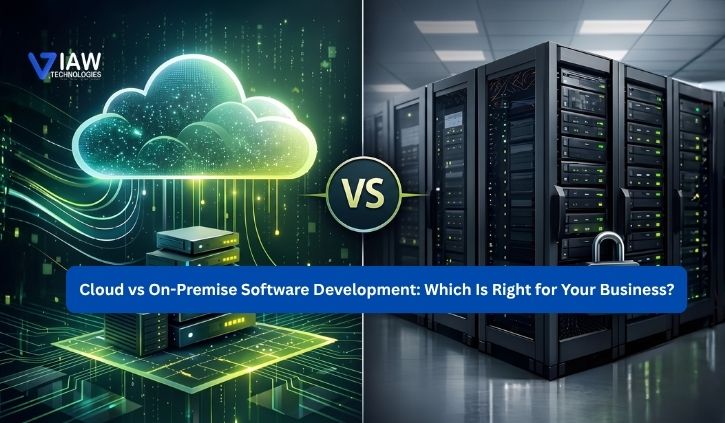
Cloud vs On-Premise Software Development: Which Is Right for Your Business?

Today, the business world must be equipped with software that can develop and adapt; enable workers from many distant locations to collaborate on the same project; that will protect confidential information; and that will prove to be an efficient investment to future trends.
. Software deployment models make some critical choices when making decisions for their software.

However, cloud vs on-premises software development is not just about where you host the software anymore. It includes aspects like the ease of scalability, data security, how much control you will have over your infrastructure, speed of deployment, maintenance, and more.

Then, between cloud and on-premises software development, which one is the right choice for your business? It is absolutely dependent on your business needs, your budget, your security, and future growth

Cloud Software Development: What Does It Mean?

Cloud software development refers to applications designed to run on a cloud computing environment instead of on-premises servers in your workplace. When choosing between cloud and on-premises deployment, businesses should evaluate their current technology environment and long-term requirements. The cloud service provider will provide the application with all other necessary computing services, like storage, networking, database management, and hosting on the cloud.

Organisations can allocate the resources needed on the fly and scale their applications in the cloud without purchasing more hardware components on their premises. Cloud software solutions are attractive to young businesses, digital products and dispersed organizations because computer resources are at our command instantly.


Also, cloud-based software development enables contemporary methods like continuous integration, continuous delivery, containers, managed databases and cloud-native architectures.

On-Premise Software Development: What Does It Mean?

On-premises software development relies on an organization to have applications developed that it will run on hardware, infrastructure, and systems that it itself owns or directly controls. When using on-premises development, the business itself generally controls and provides all necessary hardware, networks, hosting, security, and administration and the deployment, backups, upgrades, and maintenance of all software.
This on-premises approach puts great control back in the hands of a business over the hardware and information.


It is an on-premises development that best fits businesses that operate with data security requirements that must remain internal; have existing, complex IT structures and policies that must remain under the full control of the business; have specialised systems that may be highly proprietary or legacy; and any business where certain strict security or operational controls must remain at the discretion of the business owner.

Also, cloud-based software development enables contemporary methods like continuous integration, continuous delivery, containers, managed databases and cloud-native architectures. Virtualization in Cloud Computing helps businesses use computing resources efficiently by allowing multiple virtual environments to run on shared physical infrastructure.

Cloud vs On-Premise Software: Key Differences

The difference between cloud software and on-premises software becomes clearer when comparing their approach to infrastructure and resource management.

Scalability: Cloud environments can scale resources according to application demand, while on-premises systems may require additional hardware and infrastructure upgrades.

Deployment: Cloud platforms can enable faster software deployment because infrastructure resources can be provisioned digitally. On-premises deployments may require physical configuration and internal IT coordination.

Maintenance: Cloud providers typically manage significant portions of the underlying infrastructure, whereas on-premises environments require the organization to manage its own servers and infrastructure.

Accessibility: Cloud applications can generally be accessed from different locations with appropriate authentication and network connectivity. On-premises applications may depend more heavily on internal network configurations.

Data control: Physical resources controlled by an on-premises system. A shared physical resource within a public cloud where responsibility for securing the resources is shared between the provider and client.

Benefits of Cloud Software Development

The benefits of cloud software development go beyond reducing dependence on physical servers. When implemented correctly, cloud solutions can help businesses build a more flexible and scalable technology environment.

Greater Scalability

Cloud infrastructure provides companies with the flexibility to ramp up and down as needed for the amount of computing resources. For applications that are heavily seasonal, experience unexpected spikes in traffic or very high traffic growth.

Faster Deployment

Allows development teams to provision environments and deploy applications quicker without the lag caused by purchasing and configuring the underlying hardware infrastructure. This may lead to shorter development lifecycles and more frequent delivery of enhancements by the business.

Flexible Accessibility

Users, clients or employees located remotely may all benefit from cloud-based applications. With appropriate security and authentication mechanisms, users can authenticate and use applications from outside of the office environment. 

Reduced Infrastructure Management

With the adoption of clouds, the necessity to buy and to maintain physical infrastructure will be decreased. The company will need to be much more concentrated on its applications and on its own business processes and leave many operational burdens with the cloud provider.

Improved Business Agility

The cloud allows you to experiment easily, launching new services, increasing resources, or scaling technology based on your business’ needs at any given time. This flexibility is often of special concern for many young businesses and fast-growing companies.

When Does On-Premise Software Make More Sense?

Cloud adoption is the best answer to most enterprises… but not all. The difference between cloud software vs on-premise software becomes clearer when comparing their approach to infrastructure and resource management. If a company wants to use a proprietary stack on a specific type of hardware, has numerous sensitive workloads, meets compliance requirements, or runs many complex and monolithic applications on its own hardware, an on-premises solution might work for the enterprise.

It ensures a higher level of control over hardware configuration, network architecture, software builds and versions, data storage solutions, etc.

Yet, increased control implies increased responsibility. For an on-premises structure, you are in control of all the hardware failures, machine maintenance, hardware replacements, backup processes, and disaster recovery, and all of this must have someone monitoring it and securing it from breaches of security. 

Cloud or On-Premise Software for Business: How to Choose?

A choice between cloud and on-premises implementation also requires businesses to examine where current technology is and where it needs to be. Consider factors such as security of data, scalability, IT infrastructure, where hosting is located, price of maintenance and ongoing costs, how to implement new software, legality/compliance issues, who can access information and who controls it, and more.

If your business has and expects to experience rapid expansion, cloud software is likely right for you.

On the flip side, if your business demands a huge amount of control over its IT infrastructure, on-premises makes more sense. Or it could even be a hybrid approach encompassing both the previous models. Clearly, the ultimate decision depends on what kind of technology isn’t quite as in the foreground—your specific needs concerning security, operational demands, and the future.

Organizations should begin any cloud migration by determining what software it will utilise, where its data is, the kind of security it needs for those applications and its data, and how it is going to support everything over the long term. 

Final Thoughts

There are pros for both cloud and on-premises solutions, including the following: cloud software development is scalable, agile, and flexible; deploys faster; and requires less physical infrastructure for the client, while on-premises allows for more direct control over the data and infrastructure for software vendors.

As any organization contemplating new applications should have its goals in sight, early consideration of these elements ensures a business does not suffer unnecessary costs of infrastructure or technical restraints down the line. Using an appropriate custom software development strategy, a business should design a solution that remains productive, secure, and scalable for its future use and value.

Frequently Asked Questions

What is the difference between cloud and on-premises software?

Cloud software runs on cloud infrastructure, while on-premises software runs on the company’s own IT infrastructure.

Is cloud software better than on-premises software for businesses?

Cloud software is ideal for businesses needing scalability, flexibility, and faster deployment, while on-premises software offers greater data control.

What are the benefits of cloud software development?

Key benefits of cloud software development include scalability, faster deployment, remote accessibility, and reduced infrastructure maintenance.

Which is more secure: cloud or on-premises software?

Both can be secure. Data security depends on proper architecture, access controls, monitoring, and security practices.
Categories
Blog

How to Build a SaaS Product from Scratch: A Step-by-Step Guide

Developing a new SaaS product is more than just building and launching an application. A successful SaaS product must include a tested business idea, a clear product strategy, solid product design, scalable product architecture, adequate security, and an ongoing improvement process. Software as a Service development combines these elements to create secure and scalable online products. 

As SaaS application development trends in 2026 increasingly embrace AI-native features and agentic workflows, these capabilities should be considered when planning a new product. 

If you are wondering how to build a SaaS product from scratch, the process starts with validating the idea and continues through MVP development, product design, development, testing, launch, and continuous improvement. 

1. Validate Your SaaS Product Idea

The very first thing that needs to be done in SaaS product development is to pinpoint a real customer problem. Before beginning custom SaaS development or custom software development, carry out research on the target market, competition, customer needs, and existing solutions.

Conduct interviews, survey the potential customers, have a close look at the competitors and identify needs which can be fulfilled by your product. With the help of product validation, you will know whether your solution is actually demanded by the target market and that they are ready to pay for it. This step-by-step SaaS product development guide helps startups validate ideas, control costs, and build features based on real customer needs. 

This SaaS product development process for startups helps teams validate ideas, control costs, and build features based on real customer needs. 

2. Define Your MVP

MVP development allows startups to deploy a streamlined version of their software with only the core functionality required to solve the main customer problem. Instead of implementing all the features on your to-do list, brainstorm: what is the key problem your SaaS application should address? An MVP usually consists of user sign-up & login, dashboard, business workflows, payments processing, basic reports & notification settings, etc.

MVP’s primary goal is to launch quickly, get feedback from users, understand their engagement level, and utilize data in the decision of what features to develop next. 

3. Plan SaaS Product Design and Architecture

Effective SaaS product design and UI/UX design for SaaS should keep the interface clean and simple while ensuring the technology can support future growth. – SaaS application architecture, database structure, API design, API integration, authentication, authorisation, third-party integration, monitoring, and data management 

Multi-tenant architecture is an important consideration in SaaS platform development, allowing different customers to share application infrastructure while maintaining appropriate data isolation. 

4. Choose a Modern Technology Stack

The tech stack depends on many factors such as product requirements, anticipated traffic volume, security measures required, skill level of available developers and scale, future plans of a product, etc. Common Tech stacks range from React.js, Node.js, Python language, to databases (including but not limited to PostgreSQL); and the tech of cloud computing services and containers as well. 

In 2026, cloud-based software development and cloud-native deployment are becoming increasingly important for building scalable applications that require flexible infrastructure, observability, and deployment automation. Cloud computing services can provide flexible infrastructure as the SaaS application grows. 

The cost of building a SaaS product in 2026 will vary based on product complexity, technology choices, AI features, integrations, security requirements, and the development team’s expertise. that would require elastic infrastructure, observability, and automation in deployment. Hybrid cloud is gaining traction as a preferred deployment strategy by native cloud developers in India. 

5. Add AI Where It Creates Real Value

One significant area of transformation will be the move from AI functionality towards an all-new level with both AI-native applications and agentic workflows. AI agents are able to execute a series of steps, automate routines, offer individualized content to individual users and interact with third-party services.

But of course, we don’t want to see an onslaught of technology incorporated solely because it’s trending. 

Understanding where AI can create real value is also important when deciding how to develop a successful SaaS application that delivers measurable benefits to users.

Companies will want to recognize where in an AI agent can deliver measurable ROI — the automatic support, documentation management, recommendation, data analysis or task automating.

6. Develop, Test, and Deploy

Once product design and architecture are complete, the SaaS software development phase can begin using Agile software development practices. Development will occur in the form of a small series of sprints during which customers can receive features progressively and get incorporated with their feedback. Throughout the SaaS product development process, testing should be in place from start to finish. By having the functional, performance, security, API and user acceptance testing, the problems could be found before they affect the end user.

DevOps for SaaS solutions provides an effective framework which helps SaaS teams deliver better quality and more frequent releases through automated deployment, monitoring, infrastructure automation, and continuous delivery. 

7. Prioritize SaaS Security and AI Governance

SaaS security should not be treated as a last-minute check. It needs to be built into the development process from the beginning through access controls, authentication, authorization, encryption, secure APIs, backups, and monitoring to protect customer data. —– And as AI-enabled SaaS platforms continue to grow in adoption, while enterprise SaaS solutions increasingly require stronger governance, security controls, compliance, and centralized administration, governance takes just as much importance. 2026 SaaS Research reveals customer fear of AI Data loss, Shadow AI and controls needed to governAI agents and AI apps 

8. Launch, Measure, and Scale

The SaaS product lifecycle doesn’t end once the product is launched. Tracking customer onboarding, engagement, retention, conversions, requests for support, and product usage is key to understanding how users interact with your product. The most popular model for SaaS products is subscription-based software, although usage-, value-, and outcome-based models are becoming more common in the AI market. However, usage-, value-, and outcome-based models are more present in the AI market. 

Conclusion

The SaaS product development process requires the right balance between business validation, product design, SaaS application architecture, development, security, and scalability. Companies in 2026 should, however, incorporate AI-native functionalities, agentic workflows, cloud-native infrastructure, governability and a pay-as-you-go pricing structure.

Whether the team is in-house or managed by a SaaS development company, following a structured SaaS product development approach can provide a solid foundation for building scalable software solutions and achieving long-term growth 

What is SaaS product development?

SaaS product development is the process of creating, testing, launching, and maintaining software that users access online, usually through a subscription model.

How long does it take to build a SaaS product?

SaaS application development can take a few months for a basic MVP, while complex SaaS products may take longer depending on features, integrations, and technical requirements.

How much does SaaS product development cost?

The cost of SaaS product development depends on the product’s features, complexity, design, integrations, security, and development team. An MVP usually costs less than a full-scale SaaS platform.

What technologies are used to build a SaaS application?

Common technologies for SaaS application development include React, Node.js, Python, PostgreSQL, cloud platforms, APIs, containers, and DevOps tools.

How do I choose the right SaaS development company?

Choose a SaaS development company or software development company with relevant SaaS experience, a strong portfolio, technical expertise, clear communication, good security practices, and reliable post-launch support.

Categories
Blog

On-Demand App Development Company: Features, Cost & Benefits

The on-demand economy has fundamentally transformed how consumers access services and products. From ordering food to booking rides, scheduling home services to finding healthcare providers, on-demand applications have become an integral part of our daily lives. According to recent industry reports, the global on-demand app market is projected to reach over $335 billion by 2025, reflecting the massive opportunity for businesses willing to enter this space.

If you’re considering developing an on-demand application for your business, partnering with the right on-demand app development company is crucial to your success. But what exactly should you look for? What features are essential? How much will it cost? And what benefits can you expect? This comprehensive guide answers all these questions and more.

What is an On-Demand App Development Company?

An on-demand app development company specializes in creating mobile and web applications that connect service providers with customers in real-time. These companies possess specific expertise in building platforms that facilitate instant service delivery, seamless transactions, and efficient matching algorithms.

Unlike traditional app development firms, on-demand specialists understand the unique challenges of this business model: real-time tracking, dynamic pricing, multi-sided marketplaces, and the complexities of managing supply and demand. They bring proven frameworks, industry best practices, and technical capabilities specifically tailored to on-demand services.

Types of On-Demand Apps

Before diving deeper, it’s helpful to understand the various categories of on-demand applications:

Service-Based Apps: Platforms connecting customers with service providers (cleaning, plumbing, beauty services, tutoring)

Transportation & Delivery Apps: Ride-sharing, food delivery, courier services, and logistics platforms

Healthcare Apps: Telemedicine, on-demand doctor consultations, medicine delivery, and home healthcare services

Entertainment & Lifestyle Apps: Streaming services, event booking, fitness coaching, and personal shopping

Professional Services Apps: Freelance marketplaces, legal consultation, financial advisory, and business services

Each category has unique requirements, but the fundamental principles of on-demand app development remain consistent across verticals.

Essential Features of On-Demand App Development Services

When evaluating on-demand app development services, look for providers who can deliver these critical features:

User-Centric Features

Intuitive Registration & Onboarding: Seamless sign-up process with social media integration, phone verification, and minimal friction. First impressions matter tremendously in the competitive on-demand space.

Advanced Search & Filtering: Robust search capabilities that allow users to find exactly what they need based on location, price, ratings, availability, and specific requirements. Smart filters enhance user experience and increase conversion rates.

Real-Time Tracking: GPS-enabled tracking that shows service provider location, estimated arrival time, and route details. This transparency builds trust and reduces customer anxiety.

In-App Communication: Secure messaging and calling features that allow customers and service providers to communicate without sharing personal contact information, maintaining privacy while enabling coordination.

Multiple Payment Options: Integration with various payment gateways including credit cards, digital wallets, UPI, net banking, and cash on delivery. Payment flexibility directly impacts conversion rates.

Rating & Review System: Comprehensive feedback mechanisms that help maintain service quality, build community trust, and provide valuable data for continuous improvement.

Push Notifications: Timely alerts for booking confirmations, service updates, promotional offers, and important announcements that keep users engaged.

Service Provider Features

A quality on-demand app development company understands that your platform serves two audiences—customers and service providers. Provider-side features should include:

Easy Registration & Profile Management: Streamlined onboarding with document verification, portfolio showcasing, and service listing capabilities.

Order Management Dashboard: Clear interface showing pending requests, active bookings, completed services, and earnings history.

Availability Management: Tools allowing providers to set working hours, manage bookings, and control their schedules effectively.

Navigation & Route Optimization: Integrated mapping solutions that help providers reach customers efficiently, saving time and resources.

Earnings Transparency: Detailed breakdown of earnings, commissions, tips, and payment schedules with easy withdrawal options.

Admin Panel Features

Your administrative team needs powerful tools to manage the entire ecosystem:

Comprehensive Dashboard: Real-time analytics showing active users, ongoing services, revenue metrics, and performance indicators.

User & Provider Management: Tools to approve, suspend, or manage both customers and service providers with complete profile access.

Booking & Order Management: Overview of all transactions, ability to resolve disputes, issue refunds, and handle complaints.

Content Management System: Easy updating of app content, promotional banners, service categories, and pricing structures.

Revenue Management: Detailed financial reporting, commission tracking, payment processing, and analytics.

Notification Management: Ability to send targeted push notifications, email campaigns, and SMS alerts to specific user segments.

Advanced Technical Features

Beyond basic functionality, professional on-demand app development services should include:

AI-Powered Matching Algorithms: Intelligent systems that match customers with the most suitable service providers based on location, availability, ratings, and historical preferences.

Dynamic Pricing Engine: Surge pricing capabilities that adjust rates based on demand, time of day, and other market factors.

Multi-Language & Multi-Currency Support: Essential for scaling beyond regional markets and serving diverse customer bases.

Advanced Analytics: Deep insights into user behavior, service patterns, peak hours, popular services, and growth opportunities.

Scalable Cloud Infrastructure: Backend architecture that can handle traffic spikes, scale efficiently, and ensure 99.9% uptime.

Security Features: End-to-end encryption, secure payment processing, data privacy compliance, and fraud detection mechanisms.

Cost of On-Demand App Development

One of the most common questions businesses ask is: “How much will it cost?” The answer varies significantly based on several factors, but understanding the cost structure helps in budgeting and planning.

Factors Affecting Development Cost

App Complexity: Simple apps with basic features cost less than sophisticated platforms with advanced AI, real-time analytics, and complex integrations.

Platform Choice: Developing for a single platform (iOS or Android) costs less than cross-platform development, though the latter offers broader market reach.

Design Requirements: Custom, premium UI/UX design with animations and branded elements increases costs compared to template-based designs.

Feature Set: Each additional feature adds to development time and cost. Prioritize must-have features for the MVP (Minimum Viable Product).

Technology Stack: Choice of technologies, frameworks, and third-party integrations impacts both initial development and ongoing maintenance costs.

Development Location: An on-demand app development company in North America or Western Europe typically charges $100-250 per hour, while companies in Eastern Europe charge $50-100, and Asian firms charge $25-80 per hour.

Post-Launch Services: Maintenance, updates, bug fixes, server costs, and customer support add to the total cost of ownership.

Cost Breakdown by App Type

Basic On-Demand App: $25,000 – $50,000

  • Single platform (iOS or Android)
  • Essential features only
  • Template-based design
  • Standard payment integration
  • Basic admin panel

Medium Complexity App: $50,000 – $120,000

  • Both iOS and Android platforms
  • Advanced features (real-time tracking, in-app chat)
  • Custom UI/UX design
  • Multiple payment gateways
  • Comprehensive admin dashboard
  • Basic analytics

Enterprise-Grade App: $120,000 – $300,000+

  • Native apps for both platforms
  • Advanced AI/ML features
  • Custom animations and interactions
  • Multiple third-party integrations
  • Advanced analytics and reporting
  • Scalable cloud infrastructure
  • Dedicated account management

These estimates include the complete development cycle: planning, design, development, testing, and deployment. Remember that ongoing maintenance typically costs 15-20% of initial development costs annually.

Ways to Optimize Development Costs

Start with MVP: Launch with core features, validate the business model, then add advanced features based on user feedback and data.

Choose Cross-Platform Development: Technologies like React Native or Flutter allow building for both iOS and Android simultaneously, reducing costs by 30-40%.

Use Ready-Made Solutions: Some on-demand app development services offer white-label solutions that can be customized, significantly reducing time-to-market and costs.

Phased Development Approach: Break the project into phases, launching basic functionality first and adding features iteratively based on user demand.

Offshore or Nearshore Development: Partner with reputable development companies in regions with lower labor costs without compromising quality.

Key Benefits of Professional On-Demand App Development Services

Partnering with an experienced on-demand app development company delivers substantial advantages beyond just getting an app built.

Technical Expertise & Best Practices

Professional developers bring years of experience building similar platforms. They understand common pitfalls, security vulnerabilities, and performance optimization techniques that prevent costly mistakes. Their expertise ensures your app is built on solid technical foundations from day one.

Faster Time-to-Market

Experienced teams have established workflows, reusable components, and proven methodologies that accelerate development. What might take an inexperienced team 12 months, a specialized on-demand app development company can accomplish in 4-6 months, giving you a critical competitive advantage.

Scalability & Future-Proofing

Professional developers architect applications with growth in mind. They build scalable backend infrastructure, write clean maintainable code, and implement modular designs that accommodate future features without requiring complete rewrites.

Reduced Technical Debt

Poor initial development creates technical debt—shortcuts and suboptimal solutions that become increasingly expensive to fix over time. Quality on-demand app development services prioritize code quality, documentation, and best practices that minimize technical debt.

Comprehensive Testing & Quality Assurance

Professional teams implement rigorous testing protocols including functional testing, performance testing, security testing, and user acceptance testing. This comprehensive approach identifies and resolves issues before they reach users.

Post-Launch Support & Maintenance

Reputable development companies provide ongoing support, ensuring your app remains functional, secure, and up-to-date with the latest OS versions and security patches. This continuous partnership is invaluable for long-term success.

Market Insights & Strategic Guidance

Beyond coding, experienced developers offer strategic insights based on market trends, user behavior patterns, and competitor analysis. They can advise on feature prioritization, monetization strategies, and growth opportunities.

Access to Full-Stack Teams

An on-demand app development company provides access to diverse talent: UI/UX designers, frontend developers, backend engineers, QA specialists, project managers, and DevOps experts—eliminating the challenge of assembling this team yourself.

How to Choose the Right On-Demand App Development Company

Selecting the right development partner is perhaps the most critical decision in your app journey. Here’s how to evaluate potential companies:

Portfolio & Experience

Review their previous work, specifically looking for on-demand applications they’ve built. Case studies, client testimonials, and live apps in the app stores provide concrete evidence of their capabilities.

Technical Competency

Ensure they possess expertise in relevant technologies: native development (Swift, Kotlin), cross-platform frameworks (React Native, Flutter), backend technologies (Node.js, Python, Ruby), cloud infrastructure (AWS, Google Cloud), and real-time technologies (WebSocket, Firebase).

Industry Understanding

An on-demand app development company with experience in your specific vertical (healthcare, transportation, home services) brings valuable domain knowledge that translates to better features and user experience.

Communication & Transparency

Effective communication is non-negotiable. Your development partner should provide regular updates, welcome feedback, be responsive to concerns, and maintain transparency about progress and challenges.

Development Methodology

Understand their process. Agile methodologies with regular sprints, demos, and iterative feedback loops ensure you remain involved and can course-correct as needed.

Post-Launch Services

Clarify what happens after launch. Do they provide bug fixes, maintenance, updates, and support? What are the terms and costs? A good partnership extends well beyond initial deployment.

Cost vs. Value

While budget matters, the cheapest option rarely delivers the best results. Focus on value—what you receive for your investment in terms of quality, expertise, and long-term partnership.

The Development Process with Professional Services

Understanding what to expect helps set realistic timelines and ensures smooth collaboration with your chosen on-demand app development services provider.

Discovery & Planning Phase (2-3 weeks)

This critical phase involves understanding your business model, target audience, competitive landscape, and specific requirements. The team creates detailed project specifications, technical architecture, and project timelines.

UI/UX Design Phase (3-4 weeks)

Designers create wireframes, mockups, and interactive prototypes that visualize the user experience. This phase includes multiple review cycles to ensure the design aligns with your vision and user needs.

Development Phase (12-16 weeks)

The core development happens in agile sprints, typically 2-week cycles. Frontend and backend development occur in parallel, with regular demos allowing you to track progress and provide feedback.

Quality Assurance Phase (3-4 weeks)

Comprehensive testing identifies and resolves bugs, performance issues, and usability concerns. This includes functional testing, integration testing, security testing, and device compatibility testing.

Deployment & Launch (1-2 weeks)

The team handles app store submissions, server setup, final configuration, and launch coordination. They ensure everything is properly configured for a smooth public release.

Post-Launch Support (Ongoing)

After launch, the team monitors performance, addresses any issues, collects user feedback, and begins planning the next iteration of features and improvements.

Emerging Trends in On-Demand App Development

Staying current with trends ensures your app remains competitive:

AI & Machine Learning Integration: Predictive algorithms for demand forecasting, personalized recommendations, and intelligent matching between customers and service providers.

Voice-Enabled Features: Voice commands and voice assistants making apps more accessible and convenient.

IoT Integration: Connecting on-demand services with smart home devices and wearables for seamless experiences.

Blockchain for Transparency: Secure, transparent transaction records and smart contracts for automated payments.

AR/VR Experiences: Augmented reality for virtual try-ons, property viewing, or service previews before booking.

Sustainability Features: Carbon footprint tracking, eco-friendly service options, and green delivery alternatives.

Conclusion: Investing in Professional On-Demand App Development

The on-demand economy shows no signs of slowing down, and businesses that establish strong digital presences now will reap long-term rewards. However, success requires more than just a good idea—it demands flawless execution, which comes from partnering with the right on-demand app development company.

Professional on-demand app development services provide the expertise, resources, and strategic guidance necessary to transform your vision into a successful, scalable platform. While the investment may seem substantial, the alternative—a poorly executed app that frustrates users and damages your brand—costs far more in the long run.

By understanding the essential features, realistic cost expectations, and substantial benefits outlined in this guide, you’re better equipped to make informed decisions about your on-demand app development journey. The key is finding a development partner who doesn’t just code your specifications but truly becomes invested in your success.

Take time to evaluate potential partners thoroughly, prioritize quality over cost savings, and remember that your app is not just a project—it’s the digital foundation of your business that will serve customers, empower service providers, and drive growth for years to come. Choose wisely, and your on-demand app can become a powerful competitive advantage in today’s digital-first economy.