
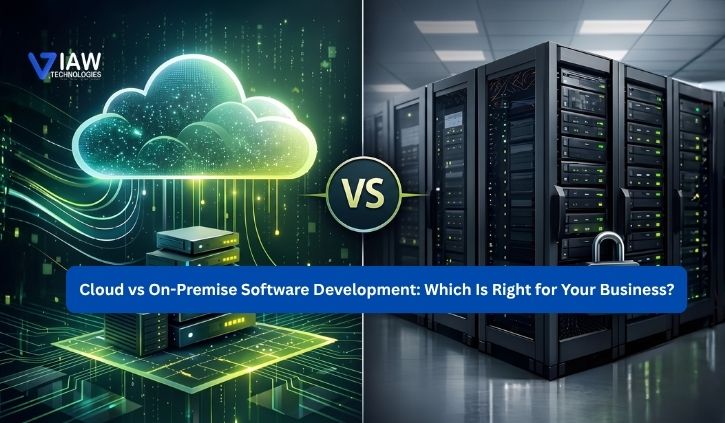
Today, the business world must be equipped with software that can develop and adapt; enable workers from many distant locations to collaborate on the same project; that will protect confidential information; and that will prove to be an efficient investment to future trends.
. Software deployment models make some critical choices when making decisions for their software.
However, cloud vs on-premises software development is not just about where you host the software anymore. It includes aspects like the ease of scalability, data security, how much control you will have over your infrastructure, speed of deployment, maintenance, and more.
Then, between cloud and on-premises software development, which one is the right choice for your business? It is absolutely dependent on your business needs, your budget, your security, and future growth
Cloud Software Development: What Does It Mean?
Cloud software development refers to applications designed to run on a cloud computing environment instead of on-premises servers in your workplace. When choosing between cloud and on-premises deployment, businesses should evaluate their current technology environment and long-term requirements. The cloud service provider will provide the application with all other necessary computing services, like storage, networking, database management, and hosting on the cloud.
Organisations can allocate the resources needed on the fly and scale their applications in the cloud without purchasing more hardware components on their premises. Cloud software solutions are attractive to young businesses, digital products and dispersed organizations because computer resources are at our command instantly.
Also, cloud-based software development enables contemporary methods like continuous integration, continuous delivery, containers, managed databases and cloud-native architectures.
On-Premise Software Development: What Does It Mean?
On-premises software development relies on an organization to have applications developed that it will run on hardware, infrastructure, and systems that it itself owns or directly controls. When using on-premises development, the business itself generally controls and provides all necessary hardware, networks, hosting, security, and administration and the deployment, backups, upgrades, and maintenance of all software.
This on-premises approach puts great control back in the hands of a business over the hardware and information.
It is an on-premises development that best fits businesses that operate with data security requirements that must remain internal; have existing, complex IT structures and policies that must remain under the full control of the business; have specialised systems that may be highly proprietary or legacy; and any business where certain strict security or operational controls must remain at the discretion of the business owner.
Also, cloud-based software development enables contemporary methods like continuous integration, continuous delivery, containers, managed databases and cloud-native architectures. Virtualization in Cloud Computing helps businesses use computing resources efficiently by allowing multiple virtual environments to run on shared physical infrastructure.
Cloud vs On-Premise Software: Key Differences
The difference between cloud software and on-premises software becomes clearer when comparing their approach to infrastructure and resource management.
Scalability: Cloud environments can scale resources according to application demand, while on-premises systems may require additional hardware and infrastructure upgrades.
Deployment: Cloud platforms can enable faster software deployment because infrastructure resources can be provisioned digitally. On-premises deployments may require physical configuration and internal IT coordination.
Maintenance: Cloud providers typically manage significant portions of the underlying infrastructure, whereas on-premises environments require the organization to manage its own servers and infrastructure.
Accessibility: Cloud applications can generally be accessed from different locations with appropriate authentication and network connectivity. On-premises applications may depend more heavily on internal network configurations.
Data control: Physical resources controlled by an on-premises system. A shared physical resource within a public cloud where responsibility for securing the resources is shared between the provider and client.
Benefits of Cloud Software Development
The benefits of cloud software development go beyond reducing dependence on physical servers. When implemented correctly, cloud solutions can help businesses build a more flexible and scalable technology environment.
Greater Scalability
Cloud infrastructure provides companies with the flexibility to ramp up and down as needed for the amount of computing resources. For applications that are heavily seasonal, experience unexpected spikes in traffic or very high traffic growth.
Faster Deployment
Allows development teams to provision environments and deploy applications quicker without the lag caused by purchasing and configuring the underlying hardware infrastructure. This may lead to shorter development lifecycles and more frequent delivery of enhancements by the business.
Flexible Accessibility
Users, clients or employees located remotely may all benefit from cloud-based applications. With appropriate security and authentication mechanisms, users can authenticate and use applications from outside of the office environment.
Reduced Infrastructure Management
With the adoption of clouds, the necessity to buy and to maintain physical infrastructure will be decreased. The company will need to be much more concentrated on its applications and on its own business processes and leave many operational burdens with the cloud provider.
Improved Business Agility
The cloud allows you to experiment easily, launching new services, increasing resources, or scaling technology based on your business’ needs at any given time. This flexibility is often of special concern for many young businesses and fast-growing companies.
When Does On-Premise Software Make More Sense?
Cloud adoption is the best answer to most enterprises… but not all. The difference between cloud software vs on-premise software becomes clearer when comparing their approach to infrastructure and resource management. If a company wants to use a proprietary stack on a specific type of hardware, has numerous sensitive workloads, meets compliance requirements, or runs many complex and monolithic applications on its own hardware, an on-premises solution might work for the enterprise.
It ensures a higher level of control over hardware configuration, network architecture, software builds and versions, data storage solutions, etc.
Yet, increased control implies increased responsibility. For an on-premises structure, you are in control of all the hardware failures, machine maintenance, hardware replacements, backup processes, and disaster recovery, and all of this must have someone monitoring it and securing it from breaches of security.
Cloud or On-Premise Software for Business: How to Choose?
A choice between cloud and on-premises implementation also requires businesses to examine where current technology is and where it needs to be. Consider factors such as security of data, scalability, IT infrastructure, where hosting is located, price of maintenance and ongoing costs, how to implement new software, legality/compliance issues, who can access information and who controls it, and more.
If your business has and expects to experience rapid expansion, cloud software is likely right for you.
On the flip side, if your business demands a huge amount of control over its IT infrastructure, on-premises makes more sense. Or it could even be a hybrid approach encompassing both the previous models. Clearly, the ultimate decision depends on what kind of technology isn’t quite as in the foreground—your specific needs concerning security, operational demands, and the future.
Organizations should begin any cloud migration by determining what software it will utilise, where its data is, the kind of security it needs for those applications and its data, and how it is going to support everything over the long term.
Final Thoughts
There are pros for both cloud and on-premises solutions, including the following: cloud software development is scalable, agile, and flexible; deploys faster; and requires less physical infrastructure for the client, while on-premises allows for more direct control over the data and infrastructure for software vendors.
As any organization contemplating new applications should have its goals in sight, early consideration of these elements ensures a business does not suffer unnecessary costs of infrastructure or technical restraints down the line. Using an appropriate custom software development strategy, a business should design a solution that remains productive, secure, and scalable for its future use and value.
Frequently Asked Questions
What is the difference between cloud and on-premises software?
Cloud software runs on cloud infrastructure, while on-premises software runs on the company’s own IT infrastructure.
Is cloud software better than on-premises software for businesses?
Cloud software is ideal for businesses needing scalability, flexibility, and faster deployment, while on-premises software offers greater data control.
What are the benefits of cloud software development?
Key benefits of cloud software development include scalability, faster deployment, remote accessibility, and reduced infrastructure maintenance.
Which is more secure: cloud or on-premises software?
Both can be secure. Data security depends on proper architecture, access controls, monitoring, and security practices.