IAW

iaw-white-logo iosandweb technologies
Categories
Blog

Cloud Migration for AI Applications: What Businesses Need to Know

AI is being implemented into business strategies all around the world to help them automate services, generate intelligent insights from information, enhance their customer satisfaction and ensure the quickest possible business decisions. 

The ongoing implementation and expansion of AI also has the demanding necessity for a stable infrastructural foundation in place to cope with data volumes and complexity and varying performance expectations, which is why migration to the cloud for AI applications is a necessity for businesses to implement and further their goals.

Migrating an AI application to the cloud is not as simple as porting existing software off on-premises software onto an on-premises server. The workloads of AI necessitate different compute, large volumes of data processing, secure storage, and adaptive cloud architectures. 

Cloud migration for businesses should be carefully planned, and AI cloud migration can help organizations attain greater flexibility, enhanced scalability, stronger security, and improved operating efficiency. 

What Is Cloud Migration for AI Applications?

Cloud migration for AI applications is the act of transferring AI applications, machine learning models, data, databases, APIs, supporting applications, and infrastructure from legacy systems, private data centres, and on-premise applications to the cloud.

It involves several steps, such as data migration, updating applications, using cloud services, reconfiguring servers and networks, and connecting with other services provided by the cloud. 

This may involve upgrading hardware by using servers with GPUs, the latest high-performance computers, vast and expandable storage capacity, and dedicated infrastructure services for the AI models. However, the intent is not just relocating a programme but to configure a ready-to-use, scalable platform to allow its AI models to run easily.

Why Should Businesses Migrate AI Applications to the Cloud?

AI workloads vary dramatically by how well we perform model training, what we’re using models for in terms of inference, data processing and whether our users are using and putting load on our applications. In the cloud, we don’t need to continue to carry expensive hardware that we aren’t actively using, and we can scale up and down. 

This scalability is crucial to applications based on AI because sometimes you will have very intense model training and at other times have high usage and need more resources available.

They can also bring you closer to managed AI and automation tools and modern development stacks, so your team spends more time developing your AI applications and less time fiddling around with your infrastructure.

How to Migrate AI Applications to the Cloud

Businesses looking for how to migrate AI applications to the cloud should begin by assessing their existing applications, models, data, dependencies, and infrastructure requirements. 

Migrating an AI application is never a simple one-to-one move. It begins with performing an inventory of existing application use, models, data stores, databases, dependencies, data sources and infrastructure needs to identify which parts can be migrated, rewritten, modernized or replaced. Next, create a cloud migration strategy for AI applications that identifies the specific business drivers, existing application architecture, security policies, workload characteristics, resource requirements, budget, and future growth needs.

When it comes to data migration, there is a lot to consider, as the AI use applications heavily rely on data. Enterprises should manage their datasets responsibly during data migration, ensure the confidentiality, accuracy, integrity, accessibility, and legality of the data being migrated, and have proper backups, governance, and sync mechanisms put in place. Once migration is completed, test the applications’ performance, security, scalability, speed, and latency with the migrated data, and integrate them.

Cloud Security and AI Infrastructure

Security in the cloud needs to be viewed as part of the migration process, not as a post-migration task. AI applications can run on sensitive business data, customer data, or business know-how. Organizations must take necessary controls around identity and access management, encryption, network security, monitoring and data security.

A good cloud infrastructure design can offer scalable computing resource power, unified monitoring systems, and a secure place to store your information, with the software you need automatically deployed in minutes. Monitoring Your System We constantly monitor your network to detect security holes, and save you from consuming more power than required.

How Much Does AI Cloud Migration Cost?

Cloud Cost Estimation in AI Application Migration In an AI app migrating to the cloud, the cost is based on its complexity, volumes of data, resources needed for processing power, GPU consumption, cloud storage, network, security measures and possible modernization. 

A simplified migration might need minor adjustments, but for a complicated AI machine, an overhaul may include rethinking its architecture, redesigning its database, optimizing the AI model and a high volume of interaction points. Businesses ought to estimate both the initial relocation investment and the running cloud operational cost.

Workload for AI may demand extensive computational powers during the model training phase; therefore, business users need to consider their cloud spending watch and optimization strategy from the word go.

Which Cloud Platform Is Best for AI Applications?

There isn’t one cloud platform that will be ideal for all business AI requirements. The decision regarding which platform best suits an organization’s needs will be dictated by an organization’s specific AI workloads, its technological architecture, budget constraints, security needs, data location requirements, and preferred service lines. 

Businesses can also review and assess comparisons of cloud storage, GPU, compute capacity and services, ease of use, AI and ML models and features, cloud integration options, access to tech support, and various payment options for clouds prior to buying them for the long term based on current needs.

Biggest Challenges of AI Cloud Migration

Potential major difficulties of AI cloud migration could be detailed data migration; compatibility issues regarding application; dependencies of legacy systems; security threats; problems in performance; costs which outgrow budget; and shortage of specific cloud skills.


Organizations can mitigate these risks through precise assessment, phased workload migration, application testing, performance monitoring, and experienced cloud migration services.

Creating a Scalable AI Future

While cloud migration may seem to be about merely lifting and shifting applications, it can be transformed into a platform to modernize legacy systems, scale up on AI infrastructure, move to cloud-native applications and be ready to innovate in the future. 

With a combination of secure cloud infrastructure, data management, scaled computing power and AI integration services, businesses can leverage AI to integrate the services with the already existing applications workflow. A strategic approach to cloud migration for AI applications helps the organizations in forming a sustainable, affordable and more securely scalable environment.

Frequently Asked Questions

1. What is cloud migration for AI applications?

Cloud Migration for AI Applications means moving AI applications, models, data, and AI infrastructure from on-premises systems to the cloud using AI application migration practices.

2. Why should businesses migrate AI applications to the cloud?

AI cloud migration helps businesses manage AI workloads, improve cloud scalability, access flexible cloud computing, and build efficient cloud infrastructure.

3. How much does AI cloud migration cost?

The cost of migrating AI applications to the cloud depends on data volume, application complexity, GPU requirements, cloud storage, security, and application modernization needs.

4. Which cloud platform is best for AI apfplications?

The best cloud platform for AI applications depends on AI workloads, budget, cloud security, computing requirements, scalability, and the AI services a business needs.

5. What are the biggest challenges of migrating AI applications to the cloud?

Major AI cloud migration challenges include data migration, cloud security risks, application compatibility, legacy dependencies, performance issues, cost management, and limited cloud expertise.

Categories
Blog

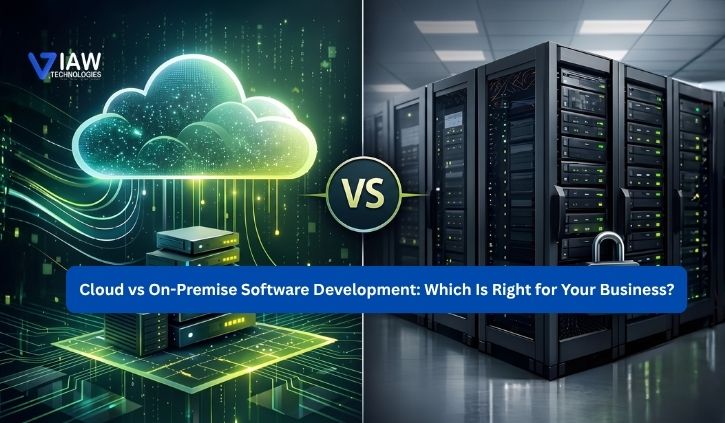
Cloud vs On-Premise Software Development: Which Is Right for Your Business?

Today, the business world must be equipped with software that can develop and adapt; enable workers from many distant locations to collaborate on the same project; that will protect confidential information; and that will prove to be an efficient investment to future trends.
. Software deployment models make some critical choices when making decisions for their software.

However, cloud vs on-premises software development is not just about where you host the software anymore. It includes aspects like the ease of scalability, data security, how much control you will have over your infrastructure, speed of deployment, maintenance, and more.

Then, between cloud and on-premises software development, which one is the right choice for your business? It is absolutely dependent on your business needs, your budget, your security, and future growth

Cloud Software Development: What Does It Mean?

Cloud software development refers to applications designed to run on a cloud computing environment instead of on-premises servers in your workplace. When choosing between cloud and on-premises deployment, businesses should evaluate their current technology environment and long-term requirements. The cloud service provider will provide the application with all other necessary computing services, like storage, networking, database management, and hosting on the cloud.

Organisations can allocate the resources needed on the fly and scale their applications in the cloud without purchasing more hardware components on their premises. Cloud software solutions are attractive to young businesses, digital products and dispersed organizations because computer resources are at our command instantly.


Also, cloud-based software development enables contemporary methods like continuous integration, continuous delivery, containers, managed databases and cloud-native architectures.

On-Premise Software Development: What Does It Mean?

On-premises software development relies on an organization to have applications developed that it will run on hardware, infrastructure, and systems that it itself owns or directly controls. When using on-premises development, the business itself generally controls and provides all necessary hardware, networks, hosting, security, and administration and the deployment, backups, upgrades, and maintenance of all software.
This on-premises approach puts great control back in the hands of a business over the hardware and information.


It is an on-premises development that best fits businesses that operate with data security requirements that must remain internal; have existing, complex IT structures and policies that must remain under the full control of the business; have specialised systems that may be highly proprietary or legacy; and any business where certain strict security or operational controls must remain at the discretion of the business owner.

Also, cloud-based software development enables contemporary methods like continuous integration, continuous delivery, containers, managed databases and cloud-native architectures. Virtualization in Cloud Computing helps businesses use computing resources efficiently by allowing multiple virtual environments to run on shared physical infrastructure.

Cloud vs On-Premise Software: Key Differences

The difference between cloud software and on-premises software becomes clearer when comparing their approach to infrastructure and resource management.

Scalability: Cloud environments can scale resources according to application demand, while on-premises systems may require additional hardware and infrastructure upgrades.

Deployment: Cloud platforms can enable faster software deployment because infrastructure resources can be provisioned digitally. On-premises deployments may require physical configuration and internal IT coordination.

Maintenance: Cloud providers typically manage significant portions of the underlying infrastructure, whereas on-premises environments require the organization to manage its own servers and infrastructure.

Accessibility: Cloud applications can generally be accessed from different locations with appropriate authentication and network connectivity. On-premises applications may depend more heavily on internal network configurations.

Data control: Physical resources controlled by an on-premises system. A shared physical resource within a public cloud where responsibility for securing the resources is shared between the provider and client.

Benefits of Cloud Software Development

The benefits of cloud software development go beyond reducing dependence on physical servers. When implemented correctly, cloud solutions can help businesses build a more flexible and scalable technology environment.

Greater Scalability

Cloud infrastructure provides companies with the flexibility to ramp up and down as needed for the amount of computing resources. For applications that are heavily seasonal, experience unexpected spikes in traffic or very high traffic growth.

Faster Deployment

Allows development teams to provision environments and deploy applications quicker without the lag caused by purchasing and configuring the underlying hardware infrastructure. This may lead to shorter development lifecycles and more frequent delivery of enhancements by the business.

Flexible Accessibility

Users, clients or employees located remotely may all benefit from cloud-based applications. With appropriate security and authentication mechanisms, users can authenticate and use applications from outside of the office environment. 

Reduced Infrastructure Management

With the adoption of clouds, the necessity to buy and to maintain physical infrastructure will be decreased. The company will need to be much more concentrated on its applications and on its own business processes and leave many operational burdens with the cloud provider.

Improved Business Agility

The cloud allows you to experiment easily, launching new services, increasing resources, or scaling technology based on your business’ needs at any given time. This flexibility is often of special concern for many young businesses and fast-growing companies.

When Does On-Premise Software Make More Sense?

Cloud adoption is the best answer to most enterprises… but not all. The difference between cloud software vs on-premise software becomes clearer when comparing their approach to infrastructure and resource management. If a company wants to use a proprietary stack on a specific type of hardware, has numerous sensitive workloads, meets compliance requirements, or runs many complex and monolithic applications on its own hardware, an on-premises solution might work for the enterprise.

It ensures a higher level of control over hardware configuration, network architecture, software builds and versions, data storage solutions, etc.

Yet, increased control implies increased responsibility. For an on-premises structure, you are in control of all the hardware failures, machine maintenance, hardware replacements, backup processes, and disaster recovery, and all of this must have someone monitoring it and securing it from breaches of security. 

Cloud or On-Premise Software for Business: How to Choose?

A choice between cloud and on-premises implementation also requires businesses to examine where current technology is and where it needs to be. Consider factors such as security of data, scalability, IT infrastructure, where hosting is located, price of maintenance and ongoing costs, how to implement new software, legality/compliance issues, who can access information and who controls it, and more.

If your business has and expects to experience rapid expansion, cloud software is likely right for you.

On the flip side, if your business demands a huge amount of control over its IT infrastructure, on-premises makes more sense. Or it could even be a hybrid approach encompassing both the previous models. Clearly, the ultimate decision depends on what kind of technology isn’t quite as in the foreground—your specific needs concerning security, operational demands, and the future.

Organizations should begin any cloud migration by determining what software it will utilise, where its data is, the kind of security it needs for those applications and its data, and how it is going to support everything over the long term. 

Final Thoughts

There are pros for both cloud and on-premises solutions, including the following: cloud software development is scalable, agile, and flexible; deploys faster; and requires less physical infrastructure for the client, while on-premises allows for more direct control over the data and infrastructure for software vendors.

As any organization contemplating new applications should have its goals in sight, early consideration of these elements ensures a business does not suffer unnecessary costs of infrastructure or technical restraints down the line. Using an appropriate custom software development strategy, a business should design a solution that remains productive, secure, and scalable for its future use and value.

Frequently Asked Questions

What is the difference between cloud and on-premises software?

Cloud software runs on cloud infrastructure, while on-premises software runs on the company’s own IT infrastructure.

Is cloud software better than on-premises software for businesses?

Cloud software is ideal for businesses needing scalability, flexibility, and faster deployment, while on-premises software offers greater data control.

What are the benefits of cloud software development?

Key benefits of cloud software development include scalability, faster deployment, remote accessibility, and reduced infrastructure maintenance.

Which is more secure: cloud or on-premises software?

Both can be secure. Data security depends on proper architecture, access controls, monitoring, and security practices.

Categories
Blog

How to Build a SaaS Product from Scratch: A Step-by-Step Guide

Developing a new SaaS product is more than just building and launching an application. A successful SaaS product must include a tested business idea, a clear product strategy, solid product design, scalable product architecture, adequate security, and an ongoing improvement process. Software as a Service development combines these elements to create secure and scalable online products. 

As SaaS application development trends in 2026 increasingly embrace AI-native features and agentic workflows, these capabilities should be considered when planning a new product. 

If you are wondering how to build a SaaS product from scratch, the process starts with validating the idea and continues through MVP development, product design, development, testing, launch, and continuous improvement. 

1. Validate Your SaaS Product Idea

The very first thing that needs to be done in SaaS product development is to pinpoint a real customer problem. Before beginning custom SaaS development or custom software development, carry out research on the target market, competition, customer needs, and existing solutions.

Conduct interviews, survey the potential customers, have a close look at the competitors and identify needs which can be fulfilled by your product. With the help of product validation, you will know whether your solution is actually demanded by the target market and that they are ready to pay for it. This step-by-step SaaS product development guide helps startups validate ideas, control costs, and build features based on real customer needs. 

This SaaS product development process for startups helps teams validate ideas, control costs, and build features based on real customer needs. 

2. Define Your MVP

MVP development allows startups to deploy a streamlined version of their software with only the core functionality required to solve the main customer problem. Instead of implementing all the features on your to-do list, brainstorm: what is the key problem your SaaS application should address? An MVP usually consists of user sign-up & login, dashboard, business workflows, payments processing, basic reports & notification settings, etc.

MVP’s primary goal is to launch quickly, get feedback from users, understand their engagement level, and utilize data in the decision of what features to develop next. 

3. Plan SaaS Product Design and Architecture

Effective SaaS product design and UI/UX design for SaaS should keep the interface clean and simple while ensuring the technology can support future growth. – SaaS application architecture, database structure, API design, API integration, authentication, authorisation, third-party integration, monitoring, and data management 

Multi-tenant architecture is an important consideration in SaaS platform development, allowing different customers to share application infrastructure while maintaining appropriate data isolation. 

4. Choose a Modern Technology Stack

The tech stack depends on many factors such as product requirements, anticipated traffic volume, security measures required, skill level of available developers and scale, future plans of a product, etc. Common Tech stacks range from React.js, Node.js, Python language, to databases (including but not limited to PostgreSQL); and the tech of cloud computing services and containers as well. 

In 2026, cloud-based software development and cloud-native deployment are becoming increasingly important for building scalable applications that require flexible infrastructure, observability, and deployment automation. Cloud computing services can provide flexible infrastructure as the SaaS application grows. 

The cost of building a SaaS product in 2026 will vary based on product complexity, technology choices, AI features, integrations, security requirements, and the development team’s expertise. that would require elastic infrastructure, observability, and automation in deployment. Hybrid cloud is gaining traction as a preferred deployment strategy by native cloud developers in India. 

5. Add AI Where It Creates Real Value

One significant area of transformation will be the move from AI functionality towards an all-new level with both AI-native applications and agentic workflows. AI agents are able to execute a series of steps, automate routines, offer individualized content to individual users and interact with third-party services.

But of course, we don’t want to see an onslaught of technology incorporated solely because it’s trending. 

Understanding where AI can create real value is also important when deciding how to develop a successful SaaS application that delivers measurable benefits to users.

Companies will want to recognize where in an AI agent can deliver measurable ROI — the automatic support, documentation management, recommendation, data analysis or task automating.

6. Develop, Test, and Deploy

Once product design and architecture are complete, the SaaS software development phase can begin using Agile software development practices. Development will occur in the form of a small series of sprints during which customers can receive features progressively and get incorporated with their feedback. Throughout the SaaS product development process, testing should be in place from start to finish. By having the functional, performance, security, API and user acceptance testing, the problems could be found before they affect the end user.

DevOps for SaaS solutions provides an effective framework which helps SaaS teams deliver better quality and more frequent releases through automated deployment, monitoring, infrastructure automation, and continuous delivery. 

7. Prioritize SaaS Security and AI Governance

SaaS security should not be treated as a last-minute check. It needs to be built into the development process from the beginning through access controls, authentication, authorization, encryption, secure APIs, backups, and monitoring to protect customer data. —– And as AI-enabled SaaS platforms continue to grow in adoption, while enterprise SaaS solutions increasingly require stronger governance, security controls, compliance, and centralized administration, governance takes just as much importance. 2026 SaaS Research reveals customer fear of AI Data loss, Shadow AI and controls needed to governAI agents and AI apps 

8. Launch, Measure, and Scale

The SaaS product lifecycle doesn’t end once the product is launched. Tracking customer onboarding, engagement, retention, conversions, requests for support, and product usage is key to understanding how users interact with your product. The most popular model for SaaS products is subscription-based software, although usage-, value-, and outcome-based models are becoming more common in the AI market. However, usage-, value-, and outcome-based models are more present in the AI market. 

Conclusion

The SaaS product development process requires the right balance between business validation, product design, SaaS application architecture, development, security, and scalability. Companies in 2026 should, however, incorporate AI-native functionalities, agentic workflows, cloud-native infrastructure, governability and a pay-as-you-go pricing structure.

Whether the team is in-house or managed by a SaaS development company, following a structured SaaS product development approach can provide a solid foundation for building scalable software solutions and achieving long-term growth 

What is SaaS product development?

SaaS product development is the process of creating, testing, launching, and maintaining software that users access online, usually through a subscription model.

How long does it take to build a SaaS product?

SaaS application development can take a few months for a basic MVP, while complex SaaS products may take longer depending on features, integrations, and technical requirements.

How much does SaaS product development cost?

The cost of SaaS product development depends on the product’s features, complexity, design, integrations, security, and development team. An MVP usually costs less than a full-scale SaaS platform.

What technologies are used to build a SaaS application?

Common technologies for SaaS application development include React, Node.js, Python, PostgreSQL, cloud platforms, APIs, containers, and DevOps tools.

How do I choose the right SaaS development company?

Choose a SaaS development company or software development company with relevant SaaS experience, a strong portfolio, technical expertise, clear communication, good security practices, and reliable post-launch support.

Categories
Blog

Software Development Trends 2026: Technologies Shaping the Future

The software development landscape is experiencing a profound transformation that’s fundamentally changing how we conceive, build, and deploy applications. As we navigate through 2026, developers, technology leaders, and organizations must understand and embrace the software development trends 2026 is bringing to the forefront—not just to remain competitive, but to unlock new possibilities that were unimaginable just a few years ago.

From AI-assisted coding that dramatically accelerates development cycles to quantum computing opening doors to previously unsolvable problems, the technologies emerging today are reshaping the entire software engineering paradigm. Let’s explore the trends that are defining the future of software development and what they mean for your projects, teams, and organizations.

AI-Powered Development: The New Pair Programming Partner

Generative AI and Code Completion Tools

Perhaps no trend has impacted software development as dramatically as the integration of artificial intelligence directly into the coding workflow. The software development trends 2026 showcase AI tools that have evolved far beyond simple autocomplete—they’re now sophisticated coding partners capable of understanding context, generating entire functions, debugging complex issues, and even suggesting architectural improvements.

Tools like GitHub Copilot, Amazon CodeWhisperer, and their successors have matured significantly. These AI assistants can now understand natural language descriptions of desired functionality and translate them into working code across multiple programming languages. They’re trained on billions of lines of code, learning from patterns, best practices, and common pitfalls.

The productivity gains are substantial. Developers report completing routine coding tasks 40-50% faster, allowing them to focus on complex problem-solving, architecture decisions, and creative aspects of software development. However, the role of human developers remains crucial—AI tools excel at pattern recognition and code generation, but strategic thinking, understanding business context, and making nuanced architectural decisions still require human expertise and judgment.

AI-Driven Testing and Quality Assurance

Quality assurance has been revolutionized by AI-powered testing frameworks that can automatically generate test cases, identify edge cases human testers might miss, and predict where bugs are most likely to occur based on code complexity and historical data.

These intelligent testing systems can perform visual regression testing, detect performance bottlenecks, and even suggest optimizations. They learn from past bugs to predict vulnerable areas in new code, enabling proactive rather than reactive quality management.

For development teams, this means faster release cycles, fewer production bugs, and more comprehensive test coverage without proportionally increasing QA resources. The key is implementing these tools strategically while maintaining human oversight for critical systems and complex scenarios.

Cloud-Native and Edge Computing Architecture

Kubernetes and Container Orchestration Evolution

Cloud-native development has become the default approach for modern applications, and the software development trends 2026 show this paradigm continuing to mature and expand. Kubernetes has evolved from a complex orchestration platform into a more accessible, developer-friendly ecosystem with improved abstractions and simplified management tools.

The latest iterations offer better auto-scaling capabilities, enhanced security features, and seamless integration with serverless computing models. Organizations are moving beyond simple “lift and shift” cloud migrations toward truly cloud-native architectures designed specifically to leverage distributed computing environments.

Microservices architecture, which breaks applications into smaller, independent services that can be developed, deployed, and scaled independently, has become standard practice. This approach offers unprecedented flexibility, enabling teams to iterate quickly, scale specific components as needed, and adopt new technologies without rewriting entire applications.

Edge Computing for Real-Time Processing

As IoT devices proliferate and applications demand lower latency, edge computing—processing data closer to where it’s generated rather than sending everything to centralized cloud servers—has become increasingly critical.

The software development trends 2026 demonstrate how developers are building applications that intelligently distribute processing between edge devices, edge servers, and cloud infrastructure based on factors like latency requirements, bandwidth constraints, and computational needs.

This architecture is particularly transformative for applications in autonomous vehicles, industrial IoT, augmented reality, and real-time analytics where even milliseconds of latency matter. Developers must now think about data synchronization, offline functionality, and distributed state management in ways that weren’t necessary in traditional cloud-only architectures.

Low-Code and No-Code Platforms Rising

Democratizing Software Development

Low-code and no-code platforms have evolved from simple website builders into sophisticated development environments capable of creating complex, enterprise-grade applications. These platforms allow business analysts, designers, and “citizen developers” to build functional applications without extensive programming knowledge.

For professional developers, these platforms aren’t threatening—they’re empowering. They handle repetitive, boilerplate code automatically, allowing developers to focus on custom logic, integrations, and complex features that require specialized expertise. The best platforms offer “escape hatches” where developers can drop into traditional code when needed, providing flexibility without sacrificing the speed advantages.

Organizations adopting these platforms report dramatically reduced development timelines for certain types of applications, particularly internal tools, simple customer-facing apps, and workflow automation. The key is understanding which projects are well-suited for low-code approaches and which require traditional development.

Visual Development Environments

Visual programming interfaces have become more sophisticated, allowing developers to build complex logic flows, design database schemas, and create integrations through intuitive graphical interfaces. These tools generate production-ready code underneath, which can be customized and extended as needed.

The software development trends 2026 show these visual environments increasingly incorporating AI to suggest optimal workflows, identify potential issues, and even generate appropriate visual structures from natural language descriptions. This convergence of low-code platforms and AI is creating a new development paradigm that’s both accessible and powerful.

Quantum Computing: From Theory to Practice

Quantum Algorithms Entering Mainstream Development

While quantum computing might seem like distant future technology, 2026 marks a turning point where it’s becoming accessible to a broader range of developers. Major cloud providers now offer quantum computing services, and development frameworks have emerged that abstract away much of the complexity.

Quantum computing won’t replace classical computing—instead, it addresses specific problem types where quantum properties provide exponential advantages: cryptography, molecular simulation, optimization problems, and certain AI/machine learning applications.

Developers don’t need physics PhDs to leverage quantum computing anymore. High-level frameworks allow them to identify problems suitable for quantum approaches, implement algorithms using relatively familiar programming paradigms, and integrate quantum processing into traditional applications through API calls.

Post-Quantum Cryptography Implementation

As quantum computers become more powerful, they pose a threat to current encryption methods. The software development trends 2026 include widespread adoption of post-quantum cryptography—encryption algorithms designed to resist attacks from quantum computers.

Organizations are beginning to implement “crypto-agility”—architectures that can swap out encryption algorithms without major refactoring—preparing for the eventual transition to quantum-resistant security. For developers, this means understanding new cryptographic approaches and building systems with future-proof security architectures.

Advanced Cybersecurity and DevSecOps

Security Integrated Throughout Development Lifecycle

The traditional approach of addressing security at the end of the development cycle has been replaced by DevSecOps—integrating security practices throughout every stage from design to deployment. The software development trends 2026 emphasize “shift left” security, where vulnerabilities are identified and addressed as early as possible.

Modern development pipelines include automated security scanning, dependency vulnerability checks, secrets management, and compliance verification as standard components. AI-powered tools analyze code for security vulnerabilities, suggest fixes, and even predict potential attack vectors based on application architecture.

Zero-trust architecture has become the default security model, assuming no user or service should be trusted by default, regardless of whether they’re inside or outside the network perimeter. This approach requires developers to implement robust authentication, authorization, and encryption at every level of the application.

Privacy-Preserving Technologies

With data privacy regulations tightening globally, developers are implementing privacy-preserving technologies like differential privacy, homomorphic encryption, and secure multi-party computation. These techniques allow applications to derive insights from data or perform computations without exposing underlying sensitive information.

For developers, this means thinking about privacy from the design phase—what data is truly necessary to collect, how it’s stored and processed, and how user control and transparency are maintained throughout the data lifecycle.

WebAssembly and Cross-Platform Development

WebAssembly Beyond the Browser

WebAssembly (Wasm) started as a way to run high-performance code in web browsers but has evolved into a universal runtime that works across platforms. The software development trends 2026 show Wasm enabling developers to write code once in languages like Rust, C++, or Go and run it efficiently on web browsers, servers, edge devices, and even embedded systems.

This portability is transformative. Applications can run with near-native performance regardless of the underlying platform, and developers can choose the best language for each component without platform constraints. Wasm’s security model—sandboxed execution with explicit permissions—also makes it attractive for running untrusted code safely.

Progressive Web Applications and Hybrid Approaches

Progressive Web Applications (PWAs) have matured to the point where they provide experiences nearly indistinguishable from native mobile apps while being deployed through standard web technologies. They work offline, send push notifications, access device hardware, and integrate with operating system features.

Combined with frameworks like React Native, Flutter, and modern cross-platform development tools, teams can build applications that provide excellent user experiences across web, mobile, and desktop platforms while maintaining a single codebase. This dramatically reduces development and maintenance costs while accelerating time-to-market.

Sustainable and Green Software Development

Energy-Efficient Code and Carbon-Aware Computing

Sustainability has entered the software development conversation in meaningful ways. Developers are now considering the environmental impact of their code—how much energy it consumes, how efficiently it uses computing resources, and its overall carbon footprint.

Tools now exist to measure the energy consumption and carbon impact of applications, allowing developers to optimize for efficiency. Cloud providers are offering carbon-aware computing options that automatically schedule workloads during times when renewable energy is most available.

The software development trends 2026 include architectural patterns designed for efficiency: serverless computing that scales to zero when not in use, efficient algorithms that accomplish tasks with minimal computational overhead, and thoughtful caching strategies that reduce redundant processing.

Sustainable Software Engineering Practices

Beyond individual applications, teams are adopting sustainable development practices: optimizing CI/CD pipelines to reduce unnecessary builds, implementing efficient testing strategies that maintain quality while consuming fewer resources, and designing systems that degrade gracefully rather than failing catastrophically and requiring resource-intensive recovery processes.

This isn’t just environmentally responsible—it often leads to cost savings and better-performing applications. Efficient code typically runs faster, scales better, and provides superior user experiences while consuming fewer resources.

Collaborative Development and Remote-First Tools

Advanced Collaboration Platforms

The shift to remote and hybrid work has accelerated the evolution of collaborative development tools. Modern platforms go beyond simple code repositories to provide integrated environments where developers can pair program in real-time, conduct code reviews asynchronously with rich context, and maintain team awareness without constant meetings.

These tools incorporate AI to automatically assign reviewers based on code expertise, suggest relevant documentation, and even mediate technical discussions by summarizing different perspectives and identifying consensus or conflict areas.

Async-First Development Workflows

Teams are increasingly adopting async-first workflows that don’t require everyone to be online simultaneously. This approach demands better documentation, clearer communication, and tools that preserve context effectively. The benefits extend beyond accommodating time zones—they include deeper focus time, more thoughtful decision-making, and better inclusivity for developers with different working styles.

The software development trends 2026 show organizations developing new rituals and practices specifically designed for distributed teams, from asynchronous design reviews to documentation-driven development approaches that ensure knowledge is captured and accessible.

Blockchain and Decentralized Applications

Practical Blockchain Applications

While the hype around cryptocurrency has settled, blockchain technology is finding genuine applications in supply chain transparency, identity verification, digital rights management, and decentralized finance. Development frameworks have matured, making it easier to build blockchain-integrated applications without deep cryptographic expertise.

Smart contracts—self-executing code on blockchain networks—are being used for automated agreements, transparent transactions, and applications where trust and auditability are paramount. Developers are learning to think about consensus mechanisms, gas fees, and immutability as design constraints that enable new types of applications.

Web3 and Decentralized Architecture

Web3 technologies are evolving beyond speculation into practical tools for building decentralized applications where users control their data and identity. While not appropriate for every application, decentralized architectures offer compelling advantages for scenarios requiring censorship resistance, user data sovereignty, or transparent operations.

Developers working in this space must understand fundamentally different paradigms around state management, identity, and trust models compared to traditional centralized applications.

Preparing for the Future of Software Development

Successfully navigating these software development trends 2026 requires more than just technical skills—it demands continuous learning, adaptability, and strategic thinking about which technologies make sense for your specific context.

Not every trend will be relevant to every project or organization. The key is understanding the landscape, identifying which innovations align with your goals and constraints, and investing in learning and experimentation strategically.

Encourage your development teams to allocate time for learning new technologies, experimenting with emerging tools, and sharing knowledge. Create environments where trying new approaches is encouraged and failure is treated as a learning opportunity.

Conclusion: Embracing Transformation

The software development trends 2026 represent more than incremental improvements—they’re fundamentally transforming how software is conceived, built, and delivered. From AI that augments developer capabilities to quantum computing solving previously intractable problems, from sustainable coding practices to decentralized architectures, these trends are opening new possibilities while presenting new challenges.

The most successful developers and organizations will be those that embrace this transformation while maintaining focus on fundamentals: writing clean, maintainable code; understanding user needs deeply; building secure, reliable systems; and fostering collaborative, innovative teams.

The future of software development is being written today. By understanding and thoughtfully adopting these trends, you’re not just keeping pace with change—you’re positioning yourself to shape the future of technology.
Categories
Blog

Top 10 Benefits of Using SaaS Product Development Services for Your Startup

But let’s be real: as much fun as it is to start a business, it’s also phenomenally difficult. From managing minimal resources to acquiring the right talent and actually getting the product to market before your competitors do, a startup founder has a lot on their plate. This is where SaaS product development services come in-a game changer for the modern-day entrepreneur.

Be it a startup or an idea to initiate one, one must have come across something as important as Software as a Service solutions. But what if one leverages professional SaaS product development services to take the journey from an idea to a profitable business? This comprehensive guide will look at the top 10 benefits that make these services invaluable assets for startups that want to scale efficiently and sustainably.

What Are SaaS Product Development Services?

Let me elaborate for clarity’s sake: SaaS product development services mean specialized offerings from development agencies or teams that support businesses in building, launching, and maintaining cloud-based software applications. Unlike traditional software, which users install on their computers, SaaS products are accessible with a web browser and hosted on cloud infrastructures.

These services normally encompass everything from initial concept validation and UI/UX design through full-stack development, testing, deployment, and ongoing maintenance. Examples include companies like Salesforce, Slack, or Zoom-all SaaS products that revolutionized their respective industries by delivering value through the cloud.

Now, let’s discuss why your startup seriously needs to consider partnering with experts in this field:

1. Significantly Lower Initial Investment and Development Costs

Probably the most compelling reason why startups choose SaaS product development services is how the overall costs are drastically reduced compared with building an in-house team from scratch. When you’re bootstrapping or working with limited seed funding, every dollar counts.

Why It’s Cost-Effective

Traditional development requires a substantial upfront investment in infrastructure, servers, licensing, and a full team of developers, designers, project managers, and QA specialists. With SaaS development services, you will be renting the expertise and infrastructure rather than buying them.

With development agencies, the tools, frameworks, and experienced professionals are already invested in and able to hit the road running. They work on either a project or retainer basis, meaning you’re not paying for full-time salaries, benefits, office space, and equipment for a permanent team. You pay for exactly what you need, exactly when you need it.

Besides, there’s the added advantage of SaaS architecture in that the cloud-based applications will not require expensive physical servers or maintenance costs. Your product lives in the cloud, leveraging platforms like AWS, Google Cloud, or Azure, which operate on pay-as-you-go models that scale with your growth.

2. Faster Time-to-Market for Your Product

Everything in the world of startups is about speed. The longer it takes to launch your product, the more capital you burn and the greater the risk that a competitor will beat you to market. SaaS product development services are specifically designed to quicken this timeline.

How They Speed Things Up

With established workflows and prebuilt components, experienced SaaS development teams apply proven methodologies like Agile and DevOps to streamline the entire development process. They have built comparable products before and know exactly which shortcuts to take and which pitfalls to avoid.

Many agencies use modern frameworks and libraries that allow for rapid prototyping and development. Without having to build everything from scratch, they can choose from existing technologies and adapt them to suit your needs. This may cut months off your development time and get your MVP into users’ hands sooner.

For a startup, this speed advantage isn’t just a convenience; it can be the difference between successfully locking in that next round of funding versus running out of runway.

3. Access to Specialized Expertise and State-of-the-Art Technologies

Unless you have unlimited capital, it is simply unrealistic to hire a complete team of specialists that include front-end developers, back-end engineers, cloud architects, DevOps experts, UI/UX designers, and security specialists in a startup. That’s where SaaS product development services come into play, offering immense value.

The Expertise Advantage

The professional SaaS development agencies include teams of specialists who regularly update their knowledge in state-of-the-art technologies, frameworks, and best practices. They bring collective experience from working on dozens or even hundreds of projects across different industries.

Need machine learning integration? They have data scientists for it. Want to build a mobile-responsive application with real-time features? Their front-end specialists know which technologies to use. Concerned about security and compliance? Their architects understand GDPR, HIPAA, and other regulatory requirements.

This breadth of expertise would cost hundreds of thousands of dollars to assemble in-house, let alone the time and effort required to recruit, vet, and onboard these specialists. In its place, with a development service, you have access to this whole skill set right away, without the overhead.

4. Scalability Built into Your Product from Day One

Ultimately, one of the largest challenges with startups is in building something that works for 100 users but breaks when suddenly you have 10,000 users. Poor architecture decisions made early in development create technical debt that haunts you for years. Professional SaaS product development services ensure your product is built to scale from the ground up.

Planning for Growth

Experienced SaaS developers design solutions with scalability as an integral principle. Modern approaches to microservices, containerization, load balancing, and more let your infrastructure scale seamlessly along with your user base.

What that means is that when that dream scenario happens-your product goes viral or you land an enterprise client-your platform will not crash under the pressure but will scale up through auto-scaling, maintaining performance and user experience even when demand spikes.

Building scalability into your product right from the start is much less expensive than trying to retrofit it later once you are already dealing with performance issues and losing customers due to downtime.

5. Focus on Your Core Business While Experts Handle Development

As the founder of a startup, the only greatest resource you have is time. Any moments that are spent trying to puzzle out technical difficulties or trying to manage developers are moments you are not spending acquiring customers, fundraising, or engaging in strategic partnerships or business development.

The Focus Benefit

Essentially, when you use SaaS product development services, you outsource the technical complexity to people who live and breathe software development. This leaves you to do what only you can do as a founder: build relationships, pitch investors, understand your market, and refine your business model.

You’re still involved in product development by way of the regular check-ins, sprint reviews, and key feature/priority decisions. You won’t, however, be up at 2 AM debugging code or trying to resolve a conflict between your developers and designers.

This division of labor is extremely powerful for startups, as founders can hold onto strategic oversight while specialists take over tactical execution.

6. Less Technical Risk & High Quality Assurance

Building software is risky, especially if you are not a technical founder or your in-house team is not versed in modern development practices. Bugs, security vulnerabilities, and architectural flaws can sink your startup before it even gets started. The services offered around SaaS product development considerably mitigate these risks.

Quality and Risk Management

Professional development agencies have instituted processes that ensure quality assurance, through code reviews, automated testing, security audits, and performance optimization. They follow industry standards and best practices that ensure your product is not just functional but robust, secure, and maintainable.

They also carry insurance, and many offer some kind of warranty or guarantee on their work. If something breaks or isn’t done to spec, they are contractually required to make the repair. When you hire individual developers or cobble a team together without processes, you bear all risk yourself.

Moreover, experienced agencies can identify potential problems before they become expensive disasters. They’ve seen what may go wrong and know how to prevent it from happening and save you from painful, costly mistakes.

7. Continuous Updates and Maintenance Support

Launching your product is actually just the beginning, not the end. Software requires periodic maintenance, security updates, bug fixes, and feature enhancements regularly to make sure it remains competitive and secure. Most of the SaaS product development services do include post-launch support that lets your product stay healthy and evolve with market demands.

Long-Term Partnership

Rather than developing your product and then disappearing, quality SaaS development partners stick around through maintenance contracts or retainer agreements. They monitor the performance of your application, apply security patches, optimize code, and deploy new features as your business grows.

This relationship is continuous, hence very valuable for startups that cannot afford a full-time development team. You get the benefits of continuous improvement without the overhead of permanent staff.

Plus, with every evolution of your product and each new feature or integration you develop, your development partner already understands your codebase and is able to implement changes more efficiently than a new team would, starting from scratch.

8. Better Security and Compliance from the Start

In the modern-day digital world, data breaches and security vulnerabilities can take down a startup overnight. Customers and investors alike ask for robust security measures while regulatory frameworks involving GDPR, CCPA, and other industry-specific requirements drive the demand further. Professional SaaS product development services incorporate security into your product architecture right from day one.

Security-First Approach

Perhaps the best thing about experienced SaaS developers is their knowledge of security best practices that include encryption, secure authentication, periodic vulnerability assessments, and observance of data protection regulations. They implement multi-layered security approaches which will protect both your business and customers.

With startups entering regulated industries, such as healthcare, finance, and education, compliance is absolutely unavoidable. Development agencies specializing in such industries know precisely what to do to make the product compliant with SOC 2, HIPAA compliance, or PCI DSS standards.

It will be exponentially harder and more expensive to try to bolt on security measures after a product is built than it would have been to incorporate them in the first place. This is one area where cutting corners can prove catastrophic, making professional services a wise investment.

9. Ability to pivot, change fast

Startup wisdom dictates that pivoting isn’t just common, it’s expected. Your early product idea is very likely to shift significantly with customer feedback, further market research, or competitive pressures. SaaS product development services give you the agility you need to make these changes without starting over from scratch.

Agile Adoption

Professional development teams work iteratively in sprints, meaning you are able to continuously test features, receive feedback, and iterate on your roadmap. If you find out that users want Feature X and not Feature Y, or that your target market is different than you thought, a good development partner will be able to quickly change course.

This kind of flexibility is far more difficult to achieve through traditional waterfall development approaches or even with in-house teams, which may be resistant to change or missing the diverse skillsets needed to support major pivots.

The modular architecture that experienced SaaS developers build also allows features to be more easily added, removed, or changed without disrupting the entire system. This architectural flexibility is a major competitive advantage in the fast-moving startup environment.

10. Proven Methodologies and Best Practices

Finally, SaaS product development services bring proven methodologies that have been refined over countless projects. They do not have to figure out what works through trial and error using your budget—they already know.

Process Maturity

Professional agencies manage projects within established frameworks like Agile, Scrum, or Kanban. They maintain regular sprint planning, daily stand-ups, retrospectives, and demonstrations to keep everyone aligned and the project moving forward.

They also follow coding standards, documentation practices, and version control systems that guarantee your code base stays clean, organized, and maintainable. If you ever have to transition development to another team or bring it in-house, well-documented code following industry standards will make that transition much easier.

These are methodologies not just for organization, but for maximizing value delivery, reducing waste, and ensuring that your investment is going into a product customers will love and that will solve their actual problems.

Making the Decision: Is It Right for Your Startup?

While SaaS product development services do indeed come with a number of key benefits, they are most certainly not the only option available. A lot of technical founders would much rather build everything in-house, and some will have co-founders or early employees who are extremely strong technically.

But for the majority of startups, especially non-technical founders, smaller budgets, or tight timelines, professional SaaS development services mark the most pragmatic path to success. They enable you to compete with well-funded competitors, tap the best expertise in the world, and maintain focus on what makes your business different, rather than getting lost in technical complexity.

The key is in selecting the right development partner. Look for agencies with track records in your industry that communicate transparently and have a vested interest in your success, not just in completing a project. Check their portfolio, speak with past clients, and make sure their values and working style align with yours.

Conclusion

The field of startups has never been as competitive as it is now. Usually, the ones that end up succeeding make smart, strategic choices about where they invest their scant resources. You are not merely outsourcing code when you take advantage of SaaS product development services; you are extending your team with a strategic partner that will help you move more quickly toward product-market fit, reduce technical risk, and give you the time to create a sustainable business.

From cost savings and faster time-to-market to access to specialized expertise and built-in scalability, the benefits are very sound and can be measured. In a setting where 90% of the startups fail, often for reasons that could have been prevented, working with professionals who have experience and know how to avoid common pitfalls might prove to be one of the smartest investments you will ever make.

Whether one is at the ideation or MVP development phase, SaaS product development services can transform this daunting technical journey into an exciting opportunity for materializing one’s vision in the most effective and efficient way.