IAW

iaw-white-logo iosandweb technologies
Categories
Blog

Next.js vs React: Which Framework Should Your Business Choose?

Selecting the appropriate web development framework is one of the major factors that directly affects the performance, SEO, scalability, development speed, and long-term maintenance of modern web applications.

The question of Next.js vs React is common among companies planning to create a new digital product because these two closely related technologies serve different purposes and meet different business needs. Ultimately, the decision is less about which technology is better and more about what your business needs from its web application.

Understanding React and Next.js

Due to its component reuse and component architecture, React developers bring to React.js development services that are widely adopted in front-end development, and it’s a sensible choice for React.js development.


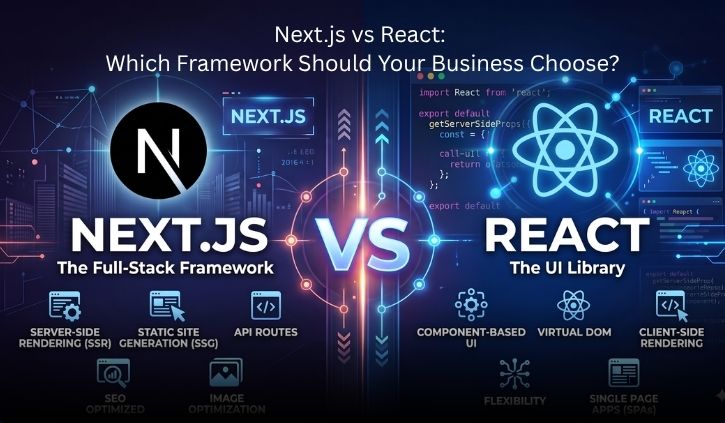
React is a flexible library, perfect for developing SPAs, dashboards, and web portals. It is widely used to build modern web applications through reusable React components. Next.js is a React-based JavaScript framework that adds extra functionality and structure for developing complete web applications.


The Next.js framework provides a structured environment for building modern applications. It supports server-side rendering (SSR), static site generation (SSG), and client-side rendering (CSR), along with routing, API handling, and flexible web application architecture. These Next.js features help developers create scalable and fast-loading websites based on specific business requirements.


Therefore, it can be a strong choice for businesses developing scalable web applications that require an excellent user experience and reliable technical infrastructure.

Next.js vs React: Key Differences for Businesses

The primary difference between React and Next.js lies in the features each respective technology uses and also its structure. By default, however, React uses much fewer constraints, which would then offer more control and freedom to your application based upon your project’s requirements to choose your preferred tools and structure that makes the most sense for your project.


On the other hand, Next.js offers a complete environment by itself, with many critical features embedded.


The difference in capabilities also has ramifications for businesses when considering the speed at which projects can be developed and then maintained. React can be a strong choice for highly dynamic applications that may not have significant indexing demands. Next.js works best for those sites and applications for which natural traffic, load times, and scale are a high priority.

With regard to web application performance, both technologies can achieve high performance when implemented correctly. However, a Next.js vs React performance comparison should consider factors such as rendering methods, page-loading requirements, SEO needs, and application complexity. Next.js provides additional options for delivering content efficiently and building fast-loading websites.

SEO and Performance Considerations

One of the key benefits of Next.js over React for SEO is its ability to support server-rendered and statically generated content through server-side rendering (SSR) and static site generation (SSG). client-side rendering: As you know, sometimes there’s a potential to rely a lot on JS rendering in the browser before displaying useful information. Next.js gives developers greater control over the delivery of content.


In doing so, this can help in the SEO development of your website, speed up loads, and make your content indexable. The technology itself is, however, not the only thing that search engines consider when ranking a website, but rather the aspects of technical SEO, content relevance, Core Web Vitals, responsive design, internal links, and the user experience.

React applications can also be optimized for SEO, although some projects may require additional configuration or supporting technologies. For businesses where search ranking plays a significant part in the acquisition of potential customers, Next.js can therefore provide a more streamlined approach for businesses with strong SEO requirements.

When Should a Business Choose React?

React is an excellent option for highly interactive applications rather than primarily static, content-driven websites. Businesses asking, “Should I choose Next.js or React for web development?”, should consider their application’s interactivity, SEO requirements, and long-term development needs. It is well suited for dashboards and customer portals, any type of internally used business portal, and apps where users spend more time interacting with authenticated features than discovering pages through organic search. Since it is popular and has a broad ecosystem of resources, it can be a practical choice for businesses continuing their React development plans or maintaining an existing React application.

When Should You Choose Next.js?

Next.js can be a strong option for businesses creating marketing websites, SaaS platforms, e-commerce sites, corporate websites, publishing platforms, and other large, search-friendly, speed-optimized sites. For businesses looking for the best JavaScript framework for modern web applications, Next.js can be a strong choice when SEO, performance, scalability, and structured development are priorities.

It may also be better suited for the development of projects that require full-stack web development through a full-stack React framework, since it provides capabilities for different application needs in one place. Scalable web app to make as much and more business progress. The platform that will help you to create a web app that may scale up long-term in your custom web development enterprise for ongoing progress.


Next.js can also be a strong choice for enterprise web development, where performance, scalability, extensibility, and long-term maintainability are important for business growth.

Making the Right Technology Decision

Regarding whether we shall be utilizing Next.js for the web or React depends on our selection of the stack, which will involve a bunch of Next. JS-enforced technologies will take care of our product’s complexity & target. Starting web development for the purpose of building simple interactive UIs will always be with React since it is very easy. But we can take ease in this with the use of advanced techniques of Next.js.
Traffic volume, search engine optimisation, product complexity, responsive web design, development expertise, and long-term scalability should all be considered before choosing the right technology.

An experienced Next.js development company or proficient React development team can evaluate the existing architecture, product requirements, and business goals before recommending the appropriate approach.
With the aid of web development solutions, we will cater to your needs based on our approach, whether our product should be built utilizing just React or the entire Next.js stack. In addition to this, an entire setup for an application which has a backend too can be taken care of via our Node.js web application development service, as we will provide a complete architecture.

FAQ

What is the difference between Next.js and React?

React is a JavaScript library for building user interfaces, while Next.js is a React-based web development framework that provides features like routing, SSR, SSG, and API routes.

Is Next.js better than React for SEO?

Yes, Next.js can be better suited for SEO-focused websites because SSR and SSG can make content more accessible to search engines. These are important benefits of Next.js over React for SEO.

Which framework is better for business websites: Next.js or React?

Next.js is generally a better choice for business websites that prioritize SEO, performance, scalability, and organic traffic, while React is suitable for highly interactive applications. The final choice depends on the needs of the business and its modern web applications.

When should I choose Next.js over React?

Choose Next.js when you need server-side rendering, static site generation, built-in routing, SEO-friendly web development, and a scalable web application architecture. A Next.js vs React performance comparison can also help businesses evaluate which approach best fits their project.

Can React applications be migrated to Next.js?

Yes, React applications can be migrated to Next.js, although the migration effort depends on the application’s architecture, routing, dependencies, and rendering requirements. Businesses may consider migration when they need additional Next.js features for SEO, performance, or scalability.
Categories
web development

Why Do Enterprises Choose Custom MEAN Stack Development Companies in the USA?

In this fast-changing age of technology, enterprises are always in search of robust, scalable, and effective web development solutions. While developing dynamic web applications to execute intricate business specifications, most forward-thinking companies are turning towards custom MEAN stack development companies in the USA because of their experience and success rate.

The MEAN stack—MongoDB, Express.js, Angular, and Node.js—is the king of today when it comes to developing modern web applications. Yet, why are companies especially resorting to custom development practices, and why would USA-based companies be the ideal choice? Let’s explore this detailed guide.

What is the MEAN stack architecture?

Why is MEAN Stack Special

The MEAN stack is an end-to-end JavaScript application development methodology which makes the entire process a breeze. Every component has its work cut out:

MongoDB: A NoSQL database that offers scalability and flexibility

Express.js: A minimalist Node.js web framework which simplifies server-side programming

Angular: A powerful front-end framework for dynamic user interface creation

Node.js: A server-side JavaScript runtime that enables fast, scalable network applications

The elegance of this stack is that it employs only one language objective—JavaScript runs everywhere throughout the entire application, from database activities to user interface communication.

Benefits of Full-Stack JavaScript Development

If companies hire a mean stack development company in USA, they get to enjoy a series of significant advantages:

Simplified Development Process: Due to JavaScript on each layer, context switching is minimal and developers can code more productively throughout the whole application stack.

Improved Performance: Node.js provides amazing performance for I/O-bound applications and thus is ideal for business-scale applications handling many concurrent users.

Low-Cost Development: Both front-end and back-end coding can be done by a single team, avoiding the need for separate expert teams and reducing overall development expenses.

Dramatic Prototyping: There are swift cycles of development permitted by the native stack of technology, thus allowing companies to place their products in the market much more quickly.

Why Companies Need Custom MEAN Stack Solutions

Managing Special Business Requirements

Every company has special business processes, workflows, and requirements that pre-packaged solutions are simply not capable of meeting. Custom MEAN stack application development allows companies to:

Build Specialised Functionality: Build features that are specifically designed to adapt to current business processes and user expectations.

Ensure They Scale: Build applications that scale with the business, coping with increasing loads of users and data without degrading performance.

Federate with Existing Systems: Integrate new applications seamlessly with existing systems, CRMs, ERPs, and other business-critical applications.

Be Ahead of the Competition: Develop superb features and functionality which make the business stand apart from competitors.

Security and Compliance Issues

Regulated industries need applications with effective security and compliance requirements. A well-settled MEAN stack development company in the USA knows:

  • Industry-specific compliance needs (HIPAA, SOX, PCI-DSS)
  • Enterprise-sized security implementations
  • Data security and privacy needs
  • Regular security scanning and maintenance
  • The Benefits of Hiring USA-Based Development Companies

Technical Know-How and Innovation

The US never fell behind when it comes to technology innovation, and the MEAN stack development is no exception. The companies of the USA offer:

Cutting-Edge Technical Expertise: Veteran developers with a history of expertise in the newest frameworks, tools, and best practices at your service.

Strategy Based on Innovation: R&D-emphasised firms, hence ensuring customers get the newest solutions.

Strong Educational Background: The majority of the developers come from top-ranked universities and have strong experience in managing complex enterprise projects.

Communication and Project Management

Employing a dedicated MEAN stack development company in the USA is of monumental advantage in project completion:

Effective Communication: Native English speakers and cultural fit ensure better understanding of project requirements and expectations.

Time Zone Compatibility: Common work hours enable real-time communication and speed up issue resolution.

Agile Methodologies: All USA-based organizations use proven and tested project management methodologies ensuring timely completion and cost optimization.

Quality Assurance: Advanced quality control processes and test procedures adhering to international standards.

Partial list of some of the most important services offered by Custom MEAN Stack Development organizations

End-to-End Development Solutions

Professional development agencies are offering end-to-end solutions for the whole application life cycle:

Requirements Analysis and Planning: Large-scale business requirement analysis and technical requirement analysis to prepare detailed project blueprints.

Custom Application Development: Developing applications from scratch with MEAN stack technologies, customized to meet individual business needs.

API Development and Integration: Creating secure APIs and integrating third-party services, payment gateways, and legacy systems.

Database Design and Optimization: Designing effective MongoDB schemas and implementing optimization techniques for better performance.

Ongoing Support and Maintenance

Performance Monitoring: Continuous monitoring of application performance and ongoing optimization.

Security Updates: Regular security patching and updates to protect against new threats.

Feature Additions: Continuous addition of new features and enhancements based on user feedback and business expansion.

Technical Support: 24/7 technical support services to troubleshoot any technical query or issue.

Industries Benefiting from Custom MEAN Stack Development

  • Healthcare and Medical Services
  • Healthcare organizations deploy MEAN stack applications for:
  • Patient management systems
  • Telemedicine platforms
  • Electronic health records (EHR)
  • Medical appointment scheduling
  • Financial Services and Fintech

Banks and financial institutions leverage custom MEAN stack solutions for:

  • Online banking platforms
  • Investment management tools
  • Payment processing systems
  • Cryptocurrency trading platforms
  • E-commerce and Retail
  • Retail companies can leverage:
  • Custom shopping cart solutions
  • Inventory management systems
  • Customer relationship management (CRM)
  • Analytics and reporting dashboards
  • Education Technology
  • Schools and EdTech vendors leverage:
  • Learning management systems (LMS)
  • Student information systems
  • Online examination software
  • Virtual classroom platforms
  • Selecting the Right MEAN Stack Development Partner
  • Evaluation Criteria

While selecting a mean stack development company in usa, business organizations should remember:

Technical Expertise: Ensure that the team members are familiar with each aspect of the MEAN stack and possess a good success history of similar projects.

Portfolio and Case Studies: Browse previous work and customer feedback to assess deliverable excellence.

Development Process: Find out how they approach the project, ensure quality, and communicate with clients.

Post-Launch Support: Consider their emphasis on post-launch service support and maintenance.

Questions to Ask Potential Partners

How much experience do you have with enterprise-level MEAN stack projects?

How do you provide application security and manage regulatory compliance?

What is your typical project timeline and delivery process?

How do you handle changes in projects and revisions of scope?

What are the types of post-launch support services you provide?

Future Trends in MEAN Stack Development

Integration of New Technologies

The field of web development is evolving, and USA-based custom MEAN Stack development firms are integrating:

Artificial Intelligence and Machine Learning: Integrating AI/ML features to enable predictive analytics and auto-decision-making.

Internet of Things (IoT): Developing applications which connect and converse with IoT devices and sensors.

Progressive Web Applications (PWAs): Developing web applications providing app-like native experiences.

Microservices Architecture: Employing microservices patterns to provide scalability and maintainability.

Performance Optimization Techniques

Latest development trends prioritize:

  • Server-side rendering for superior SEO and performance
  • Code splitting and lazy loading to reduce first page load time
  • Smart caching strategies
  • Database optimization methods

Conclusion: Choosing the Right Option for Your Business

Choosing to outsource to a MEAN stack development company in the USA is a thoroughly thought-out decision that can make a big impact on the digital transformation process of your company. The blend of technical expertise, cultural alignment, and proven best practices makes USA firms ideal partners for innovative enterprise projects.

Custom MEAN stack development gives the scalability, flexibility, and performance that business organisations need in today’s world. With the proper development company, you can be sure your web applications are meeting current business needs but are also designed to expand and evolve with your business.

As you make your choices for partners, remember that the lowest cost is not always the best value. Find a company that has strong technical expertise, communication skills, and a genuine desire to make your project successful. A successful partnership will yield not just a functional application but also a competitive advantage that drives business success for years to come.

No matter if you need to bring older systems up to speed, create new applications for consumers, or build internal tools to simplify things, custom MEAN stack development is the key to success in the new digital economy.