
IAW

iaw-white-logo iosandweb technologies
Categories
Blog

Next.js vs React: Which Framework Should Your Business Choose?

Selecting the appropriate web development framework is one of the major factors that directly affects the performance, SEO, scalability, development speed, and long-term maintenance of modern web applications.

The question of Next.js vs React is common among companies planning to create a new digital product because these two closely related technologies serve different purposes and meet different business needs. Ultimately, the decision is less about which technology is better and more about what your business needs from its web application.

Understanding React and Next.js

Due to its component reuse and component architecture, React developers bring to React.js development services that are widely adopted in front-end development, and it’s a sensible choice for React.js development.


React is a flexible library, perfect for developing SPAs, dashboards, and web portals. It is widely used to build modern web applications through reusable React components. Next.js is a React-based JavaScript framework that adds extra functionality and structure for developing complete web applications.


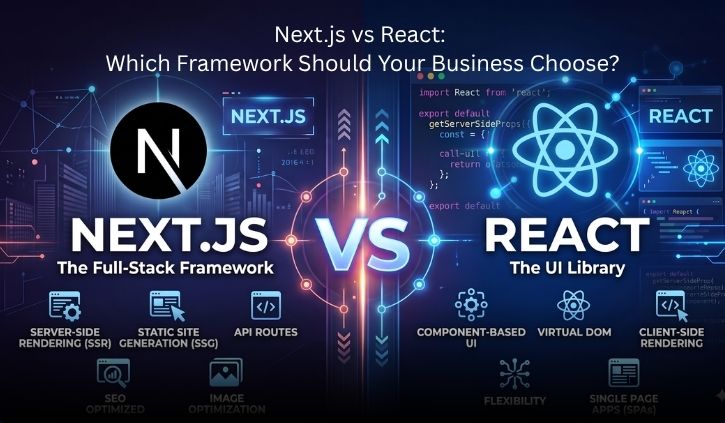
The Next.js framework provides a structured environment for building modern applications. It supports server-side rendering (SSR), static site generation (SSG), and client-side rendering (CSR), along with routing, API handling, and flexible web application architecture. These Next.js features help developers create scalable and fast-loading websites based on specific business requirements.


Therefore, it can be a strong choice for businesses developing scalable web applications that require an excellent user experience and reliable technical infrastructure.

Next.js vs React: Key Differences for Businesses

The primary difference between React and Next.js lies in the features each respective technology uses and also its structure. By default, however, React uses much fewer constraints, which would then offer more control and freedom to your application based upon your project’s requirements to choose your preferred tools and structure that makes the most sense for your project.


On the other hand, Next.js offers a complete environment by itself, with many critical features embedded.


The difference in capabilities also has ramifications for businesses when considering the speed at which projects can be developed and then maintained. React can be a strong choice for highly dynamic applications that may not have significant indexing demands. Next.js works best for those sites and applications for which natural traffic, load times, and scale are a high priority.

With regard to web application performance, both technologies can achieve high performance when implemented correctly. However, a Next.js vs React performance comparison should consider factors such as rendering methods, page-loading requirements, SEO needs, and application complexity. Next.js provides additional options for delivering content efficiently and building fast-loading websites.

SEO and Performance Considerations

One of the key benefits of Next.js over React for SEO is its ability to support server-rendered and statically generated content through server-side rendering (SSR) and static site generation (SSG). client-side rendering: As you know, sometimes there’s a potential to rely a lot on JS rendering in the browser before displaying useful information. Next.js gives developers greater control over the delivery of content.


In doing so, this can help in the SEO development of your website, speed up loads, and make your content indexable. The technology itself is, however, not the only thing that search engines consider when ranking a website, but rather the aspects of technical SEO, content relevance, Core Web Vitals, responsive design, internal links, and the user experience.

React applications can also be optimized for SEO, although some projects may require additional configuration or supporting technologies. For businesses where search ranking plays a significant part in the acquisition of potential customers, Next.js can therefore provide a more streamlined approach for businesses with strong SEO requirements.

When Should a Business Choose React?

React is an excellent option for highly interactive applications rather than primarily static, content-driven websites. Businesses asking, “Should I choose Next.js or React for web development?”, should consider their application’s interactivity, SEO requirements, and long-term development needs. It is well suited for dashboards and customer portals, any type of internally used business portal, and apps where users spend more time interacting with authenticated features than discovering pages through organic search. Since it is popular and has a broad ecosystem of resources, it can be a practical choice for businesses continuing their React development plans or maintaining an existing React application.

When Should You Choose Next.js?

Next.js can be a strong option for businesses creating marketing websites, SaaS platforms, e-commerce sites, corporate websites, publishing platforms, and other large, search-friendly, speed-optimized sites. For businesses looking for the best JavaScript framework for modern web applications, Next.js can be a strong choice when SEO, performance, scalability, and structured development are priorities.

It may also be better suited for the development of projects that require full-stack web development through a full-stack React framework, since it provides capabilities for different application needs in one place. Scalable web app to make as much and more business progress. The platform that will help you to create a web app that may scale up long-term in your custom web development enterprise for ongoing progress.


Next.js can also be a strong choice for enterprise web development, where performance, scalability, extensibility, and long-term maintainability are important for business growth.

Making the Right Technology Decision

Regarding whether we shall be utilizing Next.js for the web or React depends on our selection of the stack, which will involve a bunch of Next. JS-enforced technologies will take care of our product’s complexity & target. Starting web development for the purpose of building simple interactive UIs will always be with React since it is very easy. But we can take ease in this with the use of advanced techniques of Next.js.
Traffic volume, search engine optimisation, product complexity, responsive web design, development expertise, and long-term scalability should all be considered before choosing the right technology.

An experienced Next.js development company or proficient React development team can evaluate the existing architecture, product requirements, and business goals before recommending the appropriate approach.
With the aid of web development solutions, we will cater to your needs based on our approach, whether our product should be built utilizing just React or the entire Next.js stack. In addition to this, an entire setup for an application which has a backend too can be taken care of via our Node.js web application development service, as we will provide a complete architecture.

FAQ

What is the difference between Next.js and React?

React is a JavaScript library for building user interfaces, while Next.js is a React-based web development framework that provides features like routing, SSR, SSG, and API routes.

Is Next.js better than React for SEO?

Yes, Next.js can be better suited for SEO-focused websites because SSR and SSG can make content more accessible to search engines. These are important benefits of Next.js over React for SEO.

Which framework is better for business websites: Next.js or React?

Next.js is generally a better choice for business websites that prioritize SEO, performance, scalability, and organic traffic, while React is suitable for highly interactive applications. The final choice depends on the needs of the business and its modern web applications.

When should I choose Next.js over React?

Choose Next.js when you need server-side rendering, static site generation, built-in routing, SEO-friendly web development, and a scalable web application architecture. A Next.js vs React performance comparison can also help businesses evaluate which approach best fits their project.

Can React applications be migrated to Next.js?

Yes, React applications can be migrated to Next.js, although the migration effort depends on the application’s architecture, routing, dependencies, and rendering requirements. Businesses may consider migration when they need additional Next.js features for SEO, performance, or scalability.

Categories
Blog

How Much Does Custom Web Development Cost in 2026?

In case you’re looking forward to creating a business website in 2026 and then if anyone asks you – how much does a custom web development price tag may come out to? But web development price varies depending on various attributes like design, functionality, usage of technology, third-party integrators, platform, security, and scalability as well as, of course, your complexity of website. For example, the quantity of the website pages needed, the amount of functionality needed along with the technology used & method the website is constructed along with tools used in third parties & the size of the website can help to estimate actual expense.

Though a simple website may not cost that much more than it, to construct some software or maybe some platforms, we require a bit, a whole lot more money than we previously considered.

In GoDaddy India’s publication on website development costs, factors just like design, functionality of the websites, performance of websites, web page hosting costs, web building expenses, content management systems costs, SEO costs and ongoing website maintenance charges need to be considered too.

What Is the Average Custom Web Development Cost in 2026?

These figures act as indications, though, as the price of the custom website you will ultimately receive can vary based on the complexity, required features and technology, the integrations and also the time that would be needed to build everything, although for custom applications this could range dramatically, as building your website is often based around your business needs rather than a templated design or drag-and-drop approach. So, for example, custom business website prices could potentially range between 50,000 and 200,000 or over, depending on the style and features you desire, while complex and interactive applications and e-commerce websites would undoubtedly cost even more to develop, where there are custom admin dashboards, payment processing integrations and external APIs, large databases, automations, heightened security or increased scaling needed for your business to operate.

Key Factors That Affect Custom Web Development Cost

1. Website Design and UI/UX

Your web designer/developer uses a typical UI/UX web design process consisting of user research, wireframing, prototyping, and designing for responsive capabilities, followed by testing and then building out the website. Elements of Development Design – Navigation, Accessibility, Page Structure, Design Responsiveness or lead design toward conversions can create more development work time and associated costs. Template-based website development can definitely become more economical than the other custom web development model but is generally less customised overall from the ground up than may be required of custom and might require further user analysis, initial front-end web page design/concept, initial web development building, user testing & testing for optimisation.

2. Front-End and Back-End Development

The technologies in play are important, as this alone determines the cost of the website. Front-end development deals with the aspect of the website’s visible user interface and the aspects the web users engage with in front-end web designing. Back-end developers deal with the hidden side of the website involving aspects of database management, authenticate servers, APIs, business procedures, etc. Building out a full-stack website would necessarily require more time to build out than a mere five-page informational webpage site.

3. Website Features and Integrations

Such features as payment systems, customer dashboards, booking, APIs, CMS, search engines, user accounts, analytics, and automation are examples of features that can make development expensive.

For instance, e-commerce website development involves such features as product management, shopping cart, payment system, order management, security, and inventory.

At the same time, CMS website development can help businesses to manage content easily and save money on developers’ hours for updating the site.

4. Business Size and Scalability

It depends. Some small businesses only require a single landing page, a contact form, basic service pages and a handful of features, while enterprise web development projects require multiple roles, databases, APIs, integrations, advanced security, reporting, and scalable web applications.

5. AI Integration and Modern Web Development Requirements

Many organizations are examining the possibilities of leveraging AI features in professional web development & modern digital platforms in 2026. When you think of the possible AI features that are being built today into professional website design – the use of an AI-powered chatbot, smart search (NLP-based), recommendation engine (machine learning), an AI tool to assist customers with an automated chatbot, personalisation features, or even incorporating a different service via an AI API – the development needs rise and, therefore, so does the total cost.

Many of these require a new backend, APIs, more complicated data transformations, security implementation, unit and functional testing, and monitoring. Based on functionality, security, business needs and growth of the website, you will get modern and suitable web application development. So the requirements, as the web application will mature, include responsive web development, better security, better website optimization, and also accessibility.

What Does a Custom Website Development Company Include?

A professional custom website development company may provide custom web development services, including research, planning, custom website design, development, testing, deployment, security, and support.

When searching for the best web development company, the offered quotation is not the only crucial criterion, as a business needs to consider the provider’s expertise, portfolio, development methodologies, security measures, communication policy, and maintenance services. Therefore, a company should ask a candidate about its understanding of the project’s scope, timelines, technology, testing techniques, and ongoing support to get the most relevant offer.

A website built with a strong foundation of SEO, code optimization, mobile-first design and responsiveness, better content organization and structure, enhanced accessibility and optimization for website performance is undoubtedly the surest way of providing what modern end-users are expecting and what search engines would look for.

Additional Costs to Consider

It is essential to understand that your initial quote for creating your website could have left out a lot of additional fees and expenses, including domain name registration and renewal, hosting, SSL certificates, subscriptions for third-party services, plugins, premium themes, content production, search engine optimization, and security. Website maintenance services usually provide technical support, troubleshooting, CMS updates, security upgrades, backups, performance optimization, software updates, and other related services. It is wise to plan budget allocations for these ongoing expenditures to make web development services affordable.

Another factor that has to be considered is the effect on your organic performance that may take effect in the long run because of technical website implementation The technical analysis of your website should look for technical SEO factors, including whether or not you can be crawled or indexed, presence of redirects, missing links or errors, core web vital scores, and usability on mobile devices as well as structured data. Indexing and canonicalisation problems and errors, broken links, poor redirects, site errors and no mobility are another common issue if you are asking, “Why is my website traffic declining even if it’s on Google?”

By learning how to regain lost organic website traffic, how to troubleshoot a drop in traffic, and how to improve the website rankings and traffic, your business will see an increase in long-tail search engine traffic.

Is Custom Web Development Worth the Investment?

For businesses that demand flexibility, unique functionalities, scalability and full control, custom development is often a strategic investment.

Unlike a standard template, custom website development allows functionality, workflows, integrations, and user experiences to be designed around the actual requirements of a business.

Whatever your business needs are, whether you need business website development, an e-commerce system, or an extensive web platform, investing in the right solution rather than the cheapest one is almost always the best way to turn your idea into reality.

When a business also requires APIs, web applications, automation, mobile applications, or other connected systems, Custom Software Development services can provide a more comprehensive digital solution tailored to its specific operational requirements.

FAQs

How much does custom web development cost in 2026?

Custom web development can range from around ₹50,000 for smaller custom projects to several lakhs for advanced platforms. Features, design, integrations, technology, and scalability determine the final price.

What factors affect custom web development costs?

Design complexity, front-end and back-end development, number of pages, integrations, database requirements, security, CMS, e-commerce features, and ongoing maintenance can all affect cost.

Is custom web development worth the investment for businesses?

Yes, when a business needs unique functionality, scalability, better control, and a website tailored to specific business processes.

How long does it take to develop a custom website?

A basic custom website may take a few weeks, while complex e-commerce platforms or web applications can take several months depending on functionality and project scope.

How do I choose the right custom web development company?

Evaluate its portfolio, technical expertise, development process, communication, client reviews, security practices, pricing transparency, and post-launch website maintenance services before making a decision.