
Selecting the appropriate web development framework is one of the major factors that directly affects the performance, SEO, scalability, development speed, and long-term maintenance of modern web applications.
The question of Next.js vs React is common among companies planning to create a new digital product because these two closely related technologies serve different purposes and meet different business needs. Ultimately, the decision is less about which technology is better and more about what your business needs from its web application.
Understanding React and Next.js
Due to its component reuse and component architecture, React developers bring to React.js development services that are widely adopted in front-end development, and it’s a sensible choice for React.js development.
React is a flexible library, perfect for developing SPAs, dashboards, and web portals. It is widely used to build modern web applications through reusable React components. Next.js is a React-based JavaScript framework that adds extra functionality and structure for developing complete web applications.
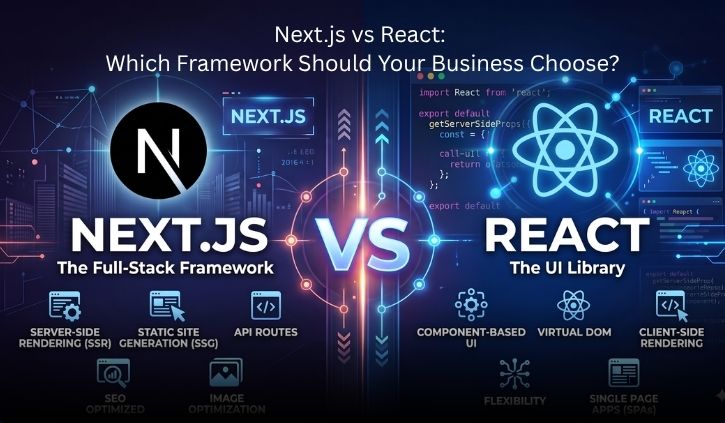
The Next.js framework provides a structured environment for building modern applications. It supports server-side rendering (SSR), static site generation (SSG), and client-side rendering (CSR), along with routing, API handling, and flexible web application architecture. These Next.js features help developers create scalable and fast-loading websites based on specific business requirements.
Therefore, it can be a strong choice for businesses developing scalable web applications that require an excellent user experience and reliable technical infrastructure.
Next.js vs React: Key Differences for Businesses
The primary difference between React and Next.js lies in the features each respective technology uses and also its structure. By default, however, React uses much fewer constraints, which would then offer more control and freedom to your application based upon your project’s requirements to choose your preferred tools and structure that makes the most sense for your project.
On the other hand, Next.js offers a complete environment by itself, with many critical features embedded.
The difference in capabilities also has ramifications for businesses when considering the speed at which projects can be developed and then maintained. React can be a strong choice for highly dynamic applications that may not have significant indexing demands. Next.js works best for those sites and applications for which natural traffic, load times, and scale are a high priority.
With regard to web application performance, both technologies can achieve high performance when implemented correctly. However, a Next.js vs React performance comparison should consider factors such as rendering methods, page-loading requirements, SEO needs, and application complexity. Next.js provides additional options for delivering content efficiently and building fast-loading websites.
SEO and Performance Considerations
One of the key benefits of Next.js over React for SEO is its ability to support server-rendered and statically generated content through server-side rendering (SSR) and static site generation (SSG). client-side rendering: As you know, sometimes there’s a potential to rely a lot on JS rendering in the browser before displaying useful information. Next.js gives developers greater control over the delivery of content.
In doing so, this can help in the SEO development of your website, speed up loads, and make your content indexable. The technology itself is, however, not the only thing that search engines consider when ranking a website, but rather the aspects of technical SEO, content relevance, Core Web Vitals, responsive design, internal links, and the user experience.
React applications can also be optimized for SEO, although some projects may require additional configuration or supporting technologies. For businesses where search ranking plays a significant part in the acquisition of potential customers, Next.js can therefore provide a more streamlined approach for businesses with strong SEO requirements.
When Should a Business Choose React?
React is an excellent option for highly interactive applications rather than primarily static, content-driven websites. Businesses asking, “Should I choose Next.js or React for web development?”, should consider their application’s interactivity, SEO requirements, and long-term development needs. It is well suited for dashboards and customer portals, any type of internally used business portal, and apps where users spend more time interacting with authenticated features than discovering pages through organic search. Since it is popular and has a broad ecosystem of resources, it can be a practical choice for businesses continuing their React development plans or maintaining an existing React application.
When Should You Choose Next.js?
Next.js can be a strong option for businesses creating marketing websites, SaaS platforms, e-commerce sites, corporate websites, publishing platforms, and other large, search-friendly, speed-optimized sites. For businesses looking for the best JavaScript framework for modern web applications, Next.js can be a strong choice when SEO, performance, scalability, and structured development are priorities.
It may also be better suited for the development of projects that require full-stack web development through a full-stack React framework, since it provides capabilities for different application needs in one place. Scalable web app to make as much and more business progress. The platform that will help you to create a web app that may scale up long-term in your custom web development enterprise for ongoing progress.
Next.js can also be a strong choice for enterprise web development, where performance, scalability, extensibility, and long-term maintainability are important for business growth.
Making the Right Technology Decision
Regarding whether we shall be utilizing Next.js for the web or React depends on our selection of the stack, which will involve a bunch of Next. JS-enforced technologies will take care of our product’s complexity & target. Starting web development for the purpose of building simple interactive UIs will always be with React since it is very easy. But we can take ease in this with the use of advanced techniques of Next.js.
Traffic volume, search engine optimisation, product complexity, responsive web design, development expertise, and long-term scalability should all be considered before choosing the right technology.
An experienced Next.js development company or proficient React development team can evaluate the existing architecture, product requirements, and business goals before recommending the appropriate approach.
With the aid of web development solutions, we will cater to your needs based on our approach, whether our product should be built utilizing just React or the entire Next.js stack. In addition to this, an entire setup for an application which has a backend too can be taken care of via our Node.js web application development service, as we will provide a complete architecture.
FAQ
What is the difference between Next.js and React?
React is a JavaScript library for building user interfaces, while Next.js is a React-based web development framework that provides features like routing, SSR, SSG, and API routes.
Is Next.js better than React for SEO?
Yes, Next.js can be better suited for SEO-focused websites because SSR and SSG can make content more accessible to search engines. These are important benefits of Next.js over React for SEO.
Which framework is better for business websites: Next.js or React?
Next.js is generally a better choice for business websites that prioritize SEO, performance, scalability, and organic traffic, while React is suitable for highly interactive applications. The final choice depends on the needs of the business and its modern web applications.
When should I choose Next.js over React?
Choose Next.js when you need server-side rendering, static site generation, built-in routing, SEO-friendly web development, and a scalable web application architecture. A Next.js vs React performance comparison can also help businesses evaluate which approach best fits their project.
Can React applications be migrated to Next.js?
Yes, React applications can be migrated to Next.js, although the migration effort depends on the application’s architecture, routing, dependencies, and rendering requirements. Businesses may consider migration when they need additional Next.js features for SEO, performance, or scalability.