IAW

iaw-white-logo iosandweb technologies
Categories
Blog

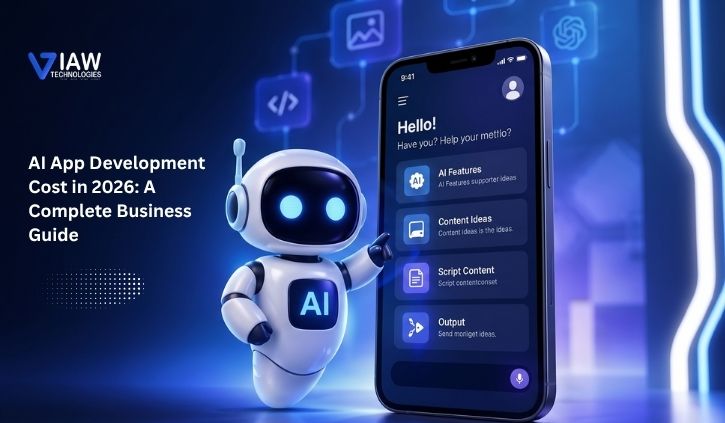
AI App Development Cost in 2026: A Complete Business Guide

Artificial intelligence is reshaping mobile applications, empowering businesses to streamline processes, personalize user interactions, enhance decision-making, and provide innovative digital solutions. Given the increasing adoption of AI, businesses are keen to understand AI app development and the cost involved in building a new mobile app. 

What Is the AI App Development Cost in 2026?

AI application costs can vary widely based on complexity, AI features, underlying technologies, and the integrations chosen by your company.

How Much Does It Cost to Develop an AI App in 2026?

It varies in costs of AI app development because there are various apps designed with different capabilities. Development of a simple application leveraging existing AI APIs might cost much less than that of advanced artificial intelligence applications based on machine learning, generative AI, computer vision, predictive analytics, and intelligent automation. Businesses shouldn’t consider only the cost of development but also the cloud, the cost of cloud storage, API call costs, security measures, test cases and deployment costs and also the ongoing maintenance cost for the development of the AI app.


Businesses should consider the overall cost to develop an AI app, including development, deployment, launch, and ongoing operational expenses.
Businesses often ask how much it costs to build an AI app, but the answer depends on its functionality, complexity, integrations, and maintenance requirements.

Major Factors Affecting AI App Development Cost

Understanding the factors affecting AI app development cost can help businesses create a realistic budget for their project.

1. App Complexity

The number and difficulty of AI features are likely the biggest single cost factor. Basic applications that have a feature, such as an AI chatbot or a prediction feature for recommendation services, will typically require much less development effort than an enterprise application involving voice recognition, machine vision, speech-to-text, machine-learning-powered prediction algorithms or autonomous processes.

2. AI Technology and Model Selection

This is one of the strongest indicators, as AI type determines whether a company can leverage readily made AI models via APIs or invests in developing custom app AI based on needs. A company utilising ML tech for an application may incur costs tied to data formatting and preparation, model training, and app refinement. If relying on generative AI, app development costs depend on model costs, the number of token utilization, app prompt design, and ongoing maintenance and optimization processes.

3. AI Integration and API Integration

The overall development cost of an app also depends on the kind of AI technology incorporated. Companies may choose an experienced AI app development company to build a solution that suits their specific business needs.

Or they may pick from readily available pre-trained AI models via APIs and deploy them in an application.
Machine learning-based applications typically involve the stages of data collection and preparation, training the machine learning model, testing the models, tuning the model, and deployment. Whereas generative AI in a mobile app may include selection of the right pre-trained generative models, prompt design, text generation model, tokenization, API usage and its constant monitoring for its performance.

Hence, the selection of the right type of AI technology for your app determines not just functionality and efficiency but also affects the overall cost.

4. Technology Stack

Technology Stack Choices Also Influence Development Prices Every aspect of the tech stack, from front-end tools and back-end tech to data storage solutions, cloud environments, AI tools, security solutions, etc., needs to function cohesively. Selecting a technology stack that scales readily can also simplify handling a growing user base, large data volumes, or greater AI demand while avoiding expensive rewrites at a future point.

5. Development Team and Timeline

Development Timelines Lead To Development Cost There are also the development costs, which usually increase with the complexity of the app. Choosing the right technology early in the app development process can help businesses manage resources efficiently, reduce delays, and control development costs. 

Custom AI App Development vs. Traditional App Development

Developing fully custom AI apps may be expensive, as it is likely to need the aid of specialized AI knowledge, data processing, model integration, extra testing and infrastructure, compared to a native or cross-platform application. Nevertheless, businesses don’t always have the need to develop their own AI models; it can simply integrate an existing AI service (e.g., machine learning APIs, natural language processing) to gain intelligence at a cheaper development cost and a much faster time.

The cost of AI-powered app development depends on the level of customization, AI features, integrations, and technology required for the application. 

The actual method to be implemented totally depends on the functionalities that the app needs, the targets who will use it, the required data and a company’s business strategy: businesses should think about adding AI.

In the apps to address some specific issue, and not only because they’re cool and trendy. Businesses can also use professional mobile app development services to build a scalable application platform and integrate AI capabilities according to their requirements.

Ongoing Maintenance and Operational Costs

AI app development doesn’t stop when the app is deployed; development costs should also extend to post-deployment expenses such as software updates, security measures, server upkeep, API fees, bug repairs, and AI model fine-tuning, and ongoing monitoring and optimization may eventually call for scaled infrastructure. 

Since AI applications continue to gain users over time and become popular, operational expenses of AI applications go high as users increase. It becomes very essential for organisations to control such expenses by continuously checking the operations with optimal checks that would ensure smooth flow of services from AI applications to control AI development expenses that are continuing.

Conclusion

AI App Development Price in 2026

The final AI app development price in 2026 can vary depending on specific business and technical requirements, so there is no fixed price that applies to every project. Several factors influence the overall cost, including app complexity, AI features, machine learning capabilities, generative AI, API integrations, technology stack, development expertise, development timeline, and post-development support.

Best Ways to Successfully Develop an AI Application

The best way to build a successful AI-powered app is to clearly define your business goals, choose the right AI functionalities, use scalable infrastructure, and partner with a skilled development company. A well-developed AI application can improve automation, personalization, performance, and efficiency while keeping development costs aligned with the business’s objectives.

FAQ

How much does it cost to develop an AI app in 2026?

The AI app development cost in 2026 depends on the app’s complexity, features, and integrations.

What factors affect AI app development cost?

App complexity, AI integration, API integration, technology stack, and maintenance affect the cost.

How long does it take to develop an AI-powered app?

The development timeline depends on the app’s features, complexity, and integration requirements.

Is custom AI app development more expensive than regular app development?

Yes, custom AI app development usually costs more due to advanced AI features and development requirements.


Categories
Blog

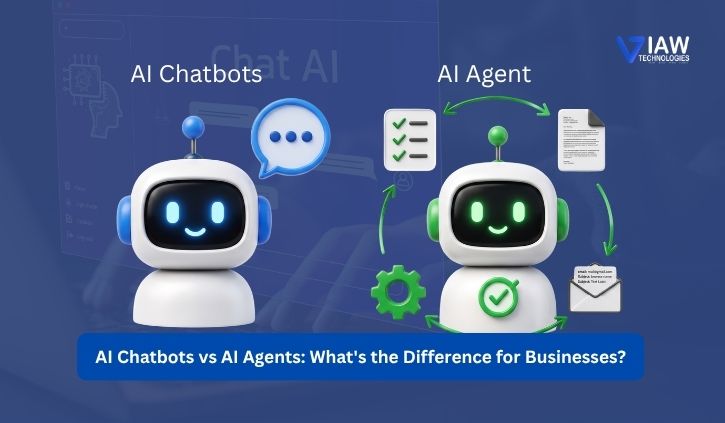
AI Chatbots vs AI Agents: What’s the Difference for Businesses?

AI is revolutionizing how companies communicate with customers, streamline their processes and take charge of repetitive processes. Some of the biggest and most commonly adapted types of AI technology are: AI chatbots AI agents Both agents and chatbots may use natural language to converse with users, but they’re utilized in very diverse contexts.

Knowing the Difference: AI Agents vs Chatbots is essential when deciding on the right AI solution to invest in for your business, as in some cases answering questions with a chatbot will suffice, while for others, an AI agent will be needed to take the conversation to the next level, as they make decisions and perform tasks, not answer questions. 

What Are AI Chatbots?

Simply put, AI chatbots are smart computers designed to talk to humans using voice or text as communication. AI chatbots work using advanced conversational AI, generative AI, and natural language processing technologies so they’d be able to comprehend human language and respond appropriately. 

Chatbots are predominantly used by businesses for customer service, lead generation, answering frequently asked questions, booking of appointments and suggesting items and offering basic technical support. 

An e-commerce store could deploy an AI chatbot on their website that fields inquiries related to stock levels, expected shipping dates, return policies and purchase order status so as to provide customers with quick support when they have queries. 

However, with their heavy reliance on conversations and response-orientated systems, most chatbots are often not agile enough for multi-step operations or requests that require high decision-making processes and interaction between many business systems. 

What Are AI Agents?

AI agents offer a step up from conventional artificial intelligence. This is where an AI agent receives an objective and is then expected to work its way toward finishing a specific goal. In the event of a task requiring a set of actions or the use of available tools, the agent can ascertain and execute accordingly to complete the desired task. Such is value to businesses that seek a step up from a conversational bot for purposes like;

The bottom line. Take, for instance, how customers seek to change an appointment with a professional. While a bot can identify the possibilities on offer, an AI bot could log into the scheduler and update an appointment by finding an alternative appointment time slot and sending the booking. In simpler terms, instead of just answering customer queries, an AI agent can action change.

AI Agents vs Chatbots: Understanding the Difference

The key difference between AI agents and chatbots is autonomy.

AI chatbots – Chatbots are computer programs that simulate the way humans use their voice to interact. AI chatbots help users answer their queries, get advice, and interact. AI Agent – An agent is defined as a piece of code. AI agents are meant to perform a task to reach a certain goal through sequential steps. 

AI ChatbotsAI Agents
Focus on conversationsFocus on goals and actions
Provide answers and assistancePerform tasks and workflows
Limited autonomyHigher level of autonomy
Best for routine interactionsBest for complex processes
Usually follow defined workflowsCan dynamically determine next steps
Limited system interactionCan integrate with multiple tools and systems

This makes the AI chatbot vs AI agent comparison more important for businesses choosing the right automation solution.

The right option depends on what a company actually wants to automate.

When Should Businesses Use AI Chatbots?

AI chatbots are an effective choice for reliable, scalable communication, customer support, and virtual assistants rather than complex task execution. 

They can be particularly useful for:

  • Answering frequently asked questions
  • Providing 24/7 customer assistance
  • Qualifying leads
  • Collecting customer information
  • Supporting basic troubleshooting
  • Handling common service requests

Businesses investing in AI chatbot development can improve response times, strengthen customer support automation, and reduce the workload on support teams.

Also, for many organisations, chatbots are an affordable way to get started with AI because you’re able to fulfil a customer use case with not that much complex integration.

When Should Businesses Use AI Agents?

AI chatbots are an effective choice for reliable, scalable communication, customer support, and virtual assistants rather than complex task execution. 

They can be particularly useful for:

  • Answering frequently asked questions
  • Providing 24/7 customer assistance
  • Qualifying leads
  • Collecting customer information
  • Supporting basic troubleshooting
  • Handling common service requests

Businesses investing in AI chatbot development can improve response times, strengthen customer support automation, and reduce the workload on support teams.
Also, for many organizations, chatbots are an affordable way to get started with AI because you’re able to fulfil a customer use case with not that much complex integration.

When Should Businesses Use AI Agents?

As businesses adopt intelligent automation, workflow automation, and autonomous AI for their operations, AI agents become more valuable. An AI agent can access CRM systems, databases, calendars, APIs, in-house software, and other business applications to perform task automation across multiple steps. 

An AI agent can, in a sales example, pinpoint a strong candidate, gather pertinent details, make a CRM note, book a meeting and inform the sales rep. These benefits of AI agents for businesses include reducing repetitive work, streamlining operations, improving productivity, and allowing employees to focus on higher-value tasks. 

Businesses that are looking to automate even more may want to try a category like ‘AI Automation Software Solutions to help integrate existing business functions and existing AI tools. 

AI Chatbot vs AI Agent: Which Is Right for Your Business?

How you pick between a chatbot or an AI bot really should begin with business outcomes. If you need help with chat or get immediate replies, a bot can support you. Lead qualification or general assistance – that is when you want an AI chatbot if we consider these needs.

AI does multi-step tasks and would support you on interactions between several other devices, producing decisions and full workflow automation. Then the agent is much more viable.

The long run isn’t restricted to merely one technological solution; AI bots with AI assistants could perform best to handle both the chat and complicated duties simultaneously. A bot’s ability would work best for initial contact, which could then escalate to an autonomous bot agent’s ability for actual reasoning capability or physical actions along the actual planet through integration to robotic systems to execute the required tasks by AI system technology. 

These types of combinations of chatbots, together with the ability to execute some genuine Earth motions by autonomous bots, will help produce quick, smart and also smooth digital experiences through AI systems.

FAQ

What is the difference between AI agents and chatbots?

AI chatbots mainly focus on conversations, answering questions, and providing information. AI agents can go further by making decisions, using tools, and completing tasks autonomously.

Are AI agents better than chatbots for businesses?

It depends on the business need. AI chatbots are ideal for customer support and routine queries, while AI agents are better for complex tasks, workflow automation, and business automation.

What can AI agents do that chatbots cannot?

AI agents can perform multi-step tasks, interact with business systems, use APIs, make decisions, and complete workflows with less human intervention. This makes AI agent development useful for advanced automation.

How much does AI agent development cost?

The cost of AI agent development depends on the project’s complexity, integrations, AI model, customization, and required features. Simple AI agents cost less, while advanced enterprise solutions require a larger investment.