
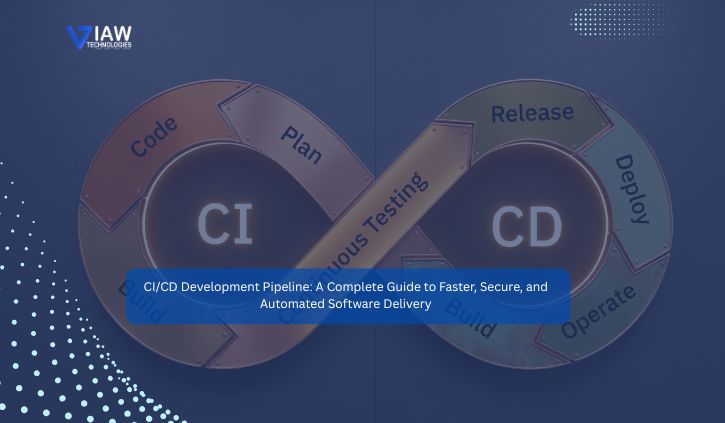
Speed up software delivery: faster and more consistent Software updates aren’t being pushed out months at a time anymore; they are going out multiple times per day, still securely and stable. Delivering modern software at such speeds requires an effective CI/CD development process to automate the building, testing and deployment of software. CI CD pipeline development processes an automated flow for a wide variety of the development and release lifecycle.
CI CD pipeline development saves manual work and avoids errors in the deployment of applications, speeding up high-quality software development.
A business is not bound to write enterprise applications, cloud applications, AI ML applications or containerized applications. It does not matter the form or format your application is in, following CI CD development best practices helps your team become more efficient and produce higher-quality applications. Businesses can accelerate software releases, recoveries from failures and issue resolutions in order to have more and more software ready on the fly. The article goes into the how and what of CI CD development pipeline development, all the way to CI CD development best practices and how you can leverage automation to take software development up another notch.
In accordance with the 2024 State of DevOps Report, those companies utilizing advanced CI CD procedures deploy much more of their software than those that utilize traditional manual delivery approaches, in addition to less frequently encountered deployment failures and drastically quicker recovery times when an incident takes place between development and ops teams.
These details alone suggest why implementing a dependable CI/CD development pipeline is an essential endeavor for the present era’s software engineer.
What Is a CI/CD Development Pipeline?
A CI/CD development pipeline is a set of instructions for a code to be released, moving from development to production with minimum to zero manual steps in between. The set is called as a combination of Continuous Integration (CI) and Continuous Delivery / Continuous Deployment (CD). It is a way to build code from development environment, test and release code. Rather than manually compiling applications, run code test cases and release applications; it is done automatically to decrease the time.
Goals of a CI/CD development pipeline:
- Automate development and repetitive tasks
- Identify software defects earlier in the cycle
Ensure predictable and consistent code deployments - Release code frequently and faster
- Facilitate better team collaboration
- Keep application stable
A well established pipeline serves the base for every DevOps engagement.
Understanding Continuous Integration (CI)
Continuous integration (CI) is the development practice of regularly integrating code from many different developers into a single code base, often several times a day.
With each code commit developers make, CI tools will:
- Test the code
- Download and verify all dependency requirements
- Run build and compilation of code
- Run all the unit tests
- Conduct analysis of the code quality
- Perform code security analysis
When problems arise, developers get real-time notice so the code will not enter into the production system.
Understanding Continuous Delivery and Continuous Deployment
Continuous Delivery and Continuous Deployment seem to be very similar, they are used in pair sometimes and have a great deal of similarities.
But these are indeed distinct practices, lets get started: Continuous Delivery:
Continuous Delivery
Continuous Delivery’s main idea is to have your software be ready to be released, whenever you desire after passing some quality checks(e.g, Automated Testing, Code Reviews etc.) . In this practice you don’t necessarily release it right away in production, but your system has it ready so you can manually deploy it in production when you feel ready.
In other words, in Continuous Delivery we fully automate the deployment pipeline to the point where a business decision can be enough to start the deployment.
For what?
I hear you asking. In those cases where there are regulation procedures to comply with or production deployments to be scheduled and planned, the business users of the company know when would be the best time for it. Let’s talk about the more radical brother then
Continuous Deployment:
The way Continuous Deployment differentiates itself from the above practice is by totally automating the process of going to production.
It means that once all the automatic tests have been executed and they all have passed, the code will go automatically to production without a human touching anything.
Yes, I’m being completely serious about that. If a new commit passed all quality checks (Automated tests, security vulnerability scan, lint, code reviews, etc.) you know, the system would directly deploy the change.
Although fully automated deployments may initially seem risky, robust automated testing and monitoring significantly reduce deployment failures.
What if something goes wrong?
It is typically a best practice that will be adopted by companies as diverse as SaaS platforms,cloud native application, tech startups and any organization that really wants to innovate faster and release value to users very quickly and that can trust its automated tests as a very important component.
Key Stages of a CI/CD Development Pipeline
1. Source Code Management
All the development and design start with a version control system. Team members can all work on their shared application codebase. The pipeline is kicked off automatically on every commit.
The most commonly used solutions for managing source code include Git-based platforms.
Branches, merging and other team functionalities like a “push”, are facilitated.
2. Build Automation
The build stage of the CI/CD pipeline will take the source code and create deployable assets :
As this part of the process flows:
- automatic installation of dependencies
- packages will be built
- the containers will be created
- build validation
Automated builds have reduced manual intervention.
3. Automated testing
It’s likely that most people find automation testing the most valuable piece in building a CI/CD Pipeline
In theCI/CD Pipeline structure multiple levels of automated testing can be used:
- Unit testing
- Integration testing
- functional testing
- API testing
- regression testing
- performance testing etc.
In this level, all validated code would go forward.
4. Security Validation
Today, security becomes part of modern pipeline development
Security automation:
- Scanning the open source dependencies
- Analyzing for vulnerabilities
- Performing static analysis of source code
- dynamic analysis
- Scanning for hardcoded secrets
- Scanning the source for licensed code
Embedding security in the early development stages, enables the practice of DevSecOps and helps eliminate expensive production vulnerabilities.
5. Deployment Automation
Once the pipeline successfully validates the application, it is auto-deployed to any of the following:
- Development servers
- QA servers
- Staging servers
- Infrastructure at production
Why Businesses Need a CI/CD Development Pipeline
Dedicated investment is an efficient way to gain clearly measurable operational improvements.
Faster Software Delivery
Automated deployments enable organizations to release new features at a high frequency without increasing costs associated with the development team.
Faster updates for customers keeping business competitive.
Better Software Quality
Agile testing identifies bugs early, before they reach the production customers.
This ensures more reliable applications, leading to better Customer Satisfaction.
Reduced Human Errors
When you manage the deployment process manually, you are more prone to errors in your configurations.
Automations make every deployment the same and reproducible. They guarantee each release will have the same validated procedures.
Improved Team Collaboration
In place, developers, testers, security engineers and operations staff provides a common automated workflow.
All this leads to avoiding communication gaps, and increasing visibility on projects.
Lower Operational Costs
Automation reduces the tedious, repetitive tasks associated with installation, enabling engineering teams to concentrate on creating innovations.
CI/CD Pipeline Development for Cloud-Native Applications
The core tenets of cloud native require automation. When enterprises implement these kinds of Kubernetes, serverless, microservices workloads they realize a competitive advantage with automated infrastructure provisioning, testing, scaling, deployment strategies.
Some of the many benefits derived from such capabilities include:
- Infrastructure as code
- Kubernetes deployment automation
- Docker automation
- Multi-cloud deployments
- Serverless automation
- Automated rollbacks
- Reduced complexity
- Scalability
Best Solutions for CI/CD Pipelines in Containerized AI Development
Model validation and updates, coupled with a scalable architecture are some common demands associated with any artificial intelligence solutions.
Some of the greatest options for container-ready AI development for CI/CD have in common
- Test automation
- Orchestration with containers
- Automated model validation
- Deploy
The CI/CD process for an AI-driven containerized application generally consist of:
- Automated validation for model training
- Container creation
- Automatic Kubernetes deployment
- Security scanning for AI dependencies
- Performance monitoring
Custom CI/CD Pipeline Development Services
Each organisation’s development workflow, infrastructure needs, compliance standards, and deployment strategy are unique.
Although there are pre-built automation templates for simpler projects, enterprises often need bespoke CI/CD pipeline development services that cater to their tech stack and business objectives.
- Custom pipelines can be designed to support:
- Multi-environment deployments
- Cloud-native applications
- Kubernetes orchestration
- Docker container automation
- Microservices architecture
- AI and machine learning workflows
- Enterprise security policies
- Infrastructure as Code (IaC)
With our customized pipeline, you get an optimized experience across all stages of your development lifecycle — from code commit to production deployment.
How to Develop a CI/CD Pipeline Successfully
In our experience, organizations achieve the best results when they implement a CI/CD development pipeline in phases rather than trying to automate every process at once. Starting with build automation and testing before expanding into deployment and security validation usually reduces implementation risks.
1. Analyze Project Requirements
Begin by understanding:
- Application architecture
- Programming languages
- Cloud infrastructure
- Deployment frequency
- Security requirements
- Compliance needs
With that comes a clear roadmap which will prevent you from having to make some expensive changes down the road during your development lifecycle.
2. Choose the Right Version Control System
A centralized version control repo makes collaboration between developers efficient while ensuring that each change in code can be tracked easily.
Some of the best practices around VCS are:
- Feature branching
- Pull request reviews
- Merge validation
- Protected branches
- Code ownership policies
All these things help create a solid foundation for setting up a good CI/CD development pipeline.
3. Automate your Build Processes
Eliminating tedious manual processes by automating builds ensures better consistency across different dev environments. It also speeds up deliveries with improved reliability as an added advantage.
This process generally involves:
- Dependency installation
- Code compilation
- Package creation
- Container image generation
- Artifact storage
4. Automate Testing
Your testing needs to occur on every commit.
Good pipelines should include:
- Unit testing
- Integration testing
- API testing
- UI testing
- Regression testing
- Performance testing
Automatically validated, production-ready code can progress.
5. Deploy to Every Environment
In Your CI CD pipeline development strategy, your deployment strategy needs to involve automated deployments to:
- Dev
- QA
- Stage
- Production
It’s essential to automate every deployment with the same methods and strategies, preventing many of the common configuration and deployment errors.
6. Monitor and Continuously Improve
It doesn’t end with deployment.
Continuous monitoring gives insight into:
- Application status
- Rates of errors
- Key performance indicators (KPI)
- Infrastructure usage
- Deployment success
Using the data gathered from monitoring, teams can optimize their pipeline over time.
CI/CD Development Pipeline vs Traditional Deployment
| Traditional Deployment | CI/CD Development Pipeline |
| Manual deployment | Automated deployment |
| Slow releases | Faster releases |
| More human errors | Reduced errors |
| Manual testing | Automated testing |
| Slow feedback | Continuous feedback |
Best Practices for CI/CD Pipeline Development
Many organizations implement CI/CD development pipelines to automate and integrate processes like builds, tests, deployments, and security scans based on their practical experiences. This practice offers a team a structured approach to theCI/CD workflow while reducing deployment risks, helping to prove out the pipeline development workflow and iteratively enhancing the software delivery pipeline.
Let’s dive into how your team can make the most of itsCI/CDdevelopment with the help of these best practices:
Keep thePipelineModular
Break your application build andCI/CDpipeline development processes down into a series of modular components that can be reused or debugged individually.
AutomateEverythingPossible
This means building, tests, security, deployment, and more. Automation eliminates manual, time-consuming tasks.
Shift Lefton Security
Don’t wait until the production environment to start testing your application’s security; find vulnerabilities earlier in the process by shifting the testing process “left” in theCI/CDpipeline.
ManageEverythingin version control
Applications code, pipeline scripts, infrastructure configuration – everything should be stored in a version control system.
Use Infrastructure asCode
You should use code to define and deploy infrastructure so you always know it matches the test and production environments.
Measureand Monitor theCI/CDPipeline
Here are some key metrics to track to help you ensure yourCI/CDdevelopment is running efficiently and improve overall software delivery:
- Build duration
- Lead time
- Deployment frequency
- Recovery time
- Failure rate
Common Challenges in CI/CD Development Pipelines
Despite the benefits, organizations may encounter challenges while implementing a CI/CD development pipeline.
Legacy Systems
Older applications may not support modern automation workflows.
Solution: Gradually modernize the architecture and introduce automation in phases.
Long Build Times
Large applications can slow pipeline execution.
Solution: Optimize build steps, enable caching, and run tests in parallel.
Security Risks
Hardcoded credentials and outdated dependencies increase security risks.
Solution: Use secure secret management, automated vulnerability scanning, and regular dependency updates.
Environment Inconsistencies
Differences between development and production environments often lead to deployment failures.
Solution: Use containers and Infrastructure as Code to standardize environments.
Scaling Challenges
As applications grow, pipelines can become increasingly complex.
Solution: Design scalable, modular pipelines that support parallel execution and reusable components.
Popular Tools Used for CI/CD Pipeline Development
Some widely adopted ones are listed below.
There are several tools to automate each stage of your CI/CD pipeline.
- Jenkins
- GitHub Actions
- GitLab CI/CD
- Azure DevOps
- CircleCI
- Bitbucket Pipelines
- Docker
- Kubernetes
- Terraform
- Ansible
- SonarQube
- Argo CD
Choosing the best combination of service for you will depend on your application’s architecture, deployment model, and business objective.
Why Choose Professional CI/CD Development Services?
Implementing automation involves much more than just installation of some tools.
To get the most out of your workflow, you need to plan and integrate things carefully while also optimizing processes over time.
By partnering with experts, we’ll make sure that your CI/CD development pipeline is both secure and scalable, meeting all of your business goals along the way.
Professional teams can help with:
- End-to-end pipeline design and implementation
- Cloud and container integration
- DevSecOps adoption
- Automated testing strategies
- Deployment automation
- Performance optimization
- Ongoing maintenance and monitoring
When an organization needs more than just a good code base, our integration with Professional Web Development Services ensures that your pipeline works best when paired with application engineering expertise.
For organizations focused on developing JS based applications, pairing our platform with a node.js web application development service will make you able to release updates even faster and scale better.
If your business has built out an entire digital product offering, then Full Stack Web Development Services help ensure all facets of your product’s development—from front end to back end—are handled seamlessly through one unified development team.
Frequently Asked Questions (FAQs)
1. What is a CI/CD development pipeline?
A CI/CD development pipeline is an automated workflow that moves code from development to production by automating building, testing, security validation, and deployment.
2. Why is a CI/CD development pipeline important for businesses?
It helps organizations release software faster, reduce deployment errors, improve collaboration, strengthen security, and deliver more reliable applications.
3. What is the difference between Continuous Delivery and Continuous Deployment?
Continuous Delivery prepares software for deployment after automated testing but requires manual approval for release. Continuous Deployment automatically releases validated code changes to production without manual intervention.
4. Can CI/CD pipelines support AI and containerized applications?
Yes. Modern CI/CD pipelines support Kubernetes, Docker, AI/ML workflows, automated model validation, security scanning, and cloud-native deployments.
5. Why should businesses choose custom CI/CD pipeline development services?
Custom CI/CD pipeline development services are tailored to an organization’s infrastructure, technology stack, compliance requirements, and deployment workflows, ensuring better scalability, security, and operational efficiency.
Conclusion
In today’s world of fast-paced technology, having an efficient CI/CD (Continuous Integration / Continuous Delivery) development pipeline has become a necessity for any company aiming for a competitive edge in software delivery.
By streamlining code integration, testing, security checks, and deployment processes, businesses can significantly enhance their speed to market while ensuring top-notch application quality.
Whether you are working on modernizing legacy apps, building cutting-edge cloud-native platforms, or looking for the most effective solutions when it comes to creating optimal CI/CD pipelines in containerized AI development environments – there’s no doubt about the immense long-term benefits of professional CI/CD pipeline development services.
From accelerated deployment times to heightened security standards and increased team synergy, developing a robust CI/CD pipeline strategy equips your enterprise’s development teams with all they need to excel at innovation without compromise.
As our ever-changing tech landscape continues to evolve rapidly forward, only those companies who invest strategically into designing customized CI/CD pipeline strategies suited specifically towards meeting unique business requirements stand poised at forefronts delivering exceptional quality applications swiftly & safely!
Given how rapidly companies are adopting cloud-native apps, AI solutions, and microservices, our investment in scalable CI/CD pipeline development has never been more important if we’re to deliver ongoing innovation and sustained business growth.
We’ve found that most companies start by automating build and test stages, before progressing onto things like security scans and production deployments. This allows them to incrementally validate their CI/CD development process, reduce deployment risks and deliver software incrementally and iteratively without significant impact on current ways of working.